


🤿 Scuba & Free Diving
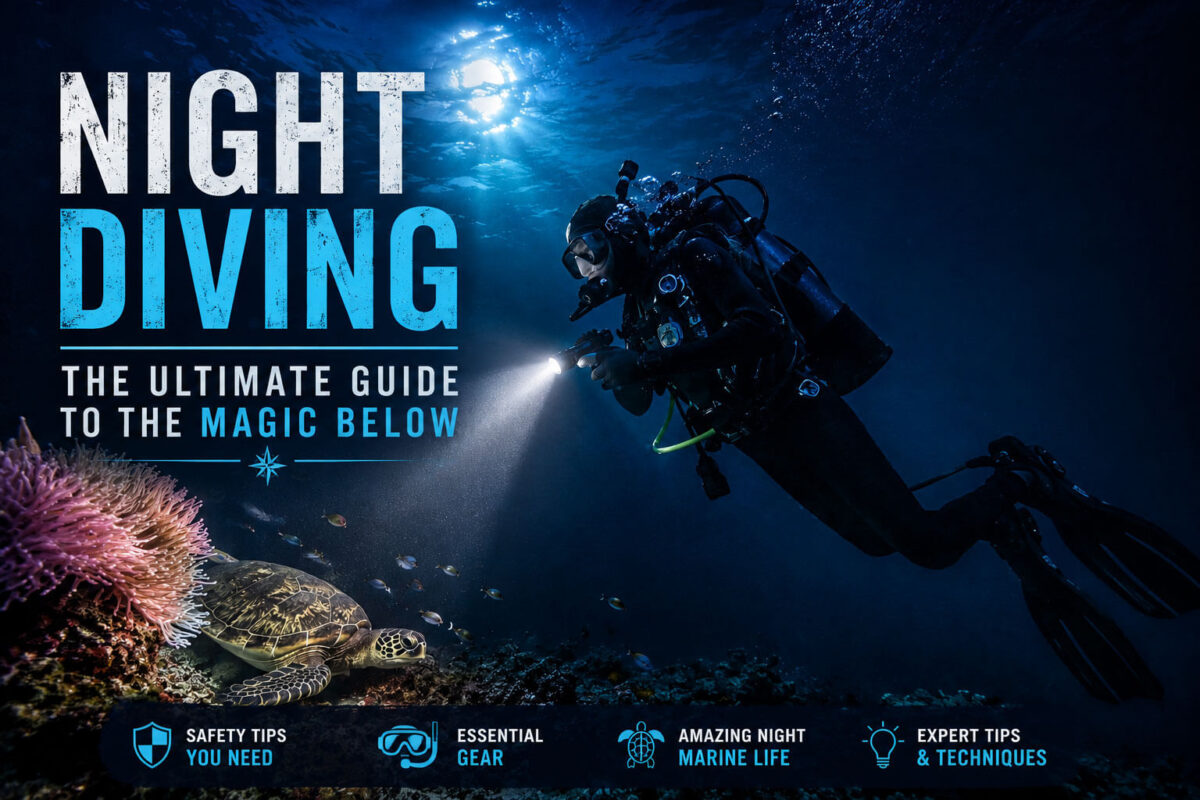
Night Diving: The Ultimate Guide to the Magic Below
Jul
Night Diving: Unlock the Magic & Mystery of the Ocean After Dark
Step into the ocean after sunset and you enter an entirely different world — one filled with bioluminescent plankton, hunting predators, and a silence so profound it changes you forever.
What Is Night Diving — and Why Does It Feel Like Another World?
Night diving is exactly what it sounds like: descending beneath the surface after the sun has set, torch in hand, to explore a reef or open water environment under the cover of darkness. But calling it simply “diving at night” wildly undersells the experience. The ocean transforms in ways that are nothing short of miraculous once the daylight fades — colours shift, behaviours change, and creatures that hide by day emerge to feed, spawn, and hunt in spectacular fashion.
For certified divers, night diving represents one of the most rewarding specialty skills available. It demands heightened awareness, solid buoyancy control, and calm under pressure — but it rewards those qualities with encounters you simply cannot have during a daytime dive. A coral reef that looks beautiful at noon becomes something else entirely at midnight: alive, electric, and quietly terrifying in the best possible way.
Night diving is recognised as a specialty certification by major training agencies including PADI and NAUI. While any open-water certified diver can legally attempt a night dive under appropriate supervision, completing a dedicated night diver specialty course gives you the skills, situational awareness, and confidence to make every dark-water dive genuinely safe and profoundly enjoyable. The course typically involves three supervised night dives, covering light signals, navigation, and buddy procedures specific to low-visibility conditions.
The key difference between night diving and day diving isn’t just the absence of light — it’s the complete cognitive reset it forces. You can no longer rely on visual landmarks in the same way. Your other senses sharpen. You learn to read the reef through the cone of your torch beam. And in doing so, you often notice details that daylight divers walk right past: a tiny crab hitching a ride on a jellyfish, a flamingo tongue snail grazing on a sea fan, a flounder half-buried in sand waiting patiently for a passing fish. Night diving teaches you to look differently. Once you learn that skill, it improves every single dive you ever take.
“Night diving strips away every comfortable assumption you have about the underwater world and replaces them with wonder. It is, without question, the most humbling and exhilarating thing you can do beneath the sea.”
Why Night Diving Reveals What Daytime Dives Miss
The Nocturnal Reef Awakens
During the day, a coral reef is busy — but in a relatively predictable way. Parrotfish graze, surgeonfish patrol territories, and the resident Napoleon wrasse slowly cruises the drop-off. By night, however, the entire cast of characters changes. Parrotfish retreat into mucus cocoons they secrete around themselves for protection. Moray eels abandon their holes and hunt actively across the reef. Lionfish abandon their daytime camouflage postures and begin pursuing small fish with ruthless efficiency. The organisms you see most at night are often the ones you’ll never encounter during a daytime dive at all.
Octopuses are perhaps the most dramatic example. These famously shy, highly intelligent animals spend daylight hours hidden in crevices and caves. At night, they emerge across the reef in numbers that would astonish any diver who hasn’t experienced it. Watching an octopus hunt — colour-shifting, shape-changing, methodically checking every crack in a coral head — is one of the most breathtaking wildlife encounters the ocean has to offer, and it’s almost exclusively a night diving privilege.
Bioluminescence — The Ocean’s Own Light Show
Perhaps the single most magical phenomenon in all of night diving is bioluminescence. In certain conditions — particularly in warm, calm, open water with low moon phases — the ocean itself glows. The luminescence comes from single-celled dinoflagellates, a type of bioluminescent plankton that emits blue-green light when physically disturbed. Wave your hand through the water and it erupts in cold blue fire. A fish darting past leaves a glowing wake. Every fin kick becomes a constellation.
Experienced night divers will sometimes agree with their buddy to turn off their torches simultaneously during a bioluminescent dive. The darkness that follows is absolute — and then, after a few seconds of stillness, the sea begins to glow around you. It is, without exaggeration, one of the most otherworldly experiences a human being can have on this planet. No video adequately captures it. You simply have to go and see it for yourself.
Spawning Events and Feeding Frenzies
Many reef species time their reproduction to the cover of darkness, and night divers occasionally stumble into mass spawning events that are simultaneously chaotic and deeply moving. Coral polyps, nudibranch species, and various reef fish all use the night to release eggs and sperm in synchronised clouds. These events are often linked to lunar cycles and water temperature, and dive operators in places like the Great Barrier Reef have developed sophisticated monitoring programs to predict and witness them.
Similarly, night diving exposes the ocean’s feeding hierarchies in unfiltered form. Hunting sharks become more visible after dark. Rays emerge from sandy substrate to feed. Cephalopods pursue small crustaceans with focused intent. Night diving is essentially a wildlife documentary you can swim through — and unlike a documentary, you’re right in the middle of it.
Types of Night Diving: Comparing Your Options
Not all night dives are the same. The type of dive you choose determines the gear you need, the skills required, the marine life you’re likely to encounter, and the overall experience you’ll have. Understanding the differences helps you choose the right style for your certification level, comfort, and goals — whether you’re a first-timer or a seasoned night diver chasing bioluminescence.
| Type of Night Dive | Best For | Key Feature | Difficulty | Level Required |
|---|---|---|---|---|
| Shore Night Dive | Beginners & local divers | Easy entry and exit, familiar dive site | Low–Medium | Open Water |
| Reef Night Dive | Wildlife enthusiasts | Maximum marine life activity & nocturnal species | Medium | Open Water |
| Drift Night Dive | Experienced divers | Current-assisted dive covering large distances | High | Advanced OW |
| Blackwater Night Dive | Macro & deep-sea enthusiasts | Open ocean over deep water, pelagic species | Very High | Advanced + Specialty |
| Cave & Cavern Night Dive | Technical divers | Enclosed environments requiring cave certification | Expert | Cave Certified |
The most accessible entry point for new night divers is the shore or reef night dive. A familiar site dived previously during daylight gives you a mental map that proves invaluable once the sun goes down. As you build confidence, drift night dives and blackwater dives open up extraordinary wildlife opportunities — but they demand correspondingly higher skill levels and should never be rushed into.
Night Diving Safety: Rules That Keep You and Your Buddy Out of Danger
The Buddy System Is Non-Negotiable at Night
Night diving without a buddy is considered unsafe practice by every major dive training agency. At night, the risks of becoming separated, disoriented, or experiencing an undetected equipment issue are significantly elevated. Buddy checks before entry should include not just air supply and BCD function, but also torch functionality, backup light confirmation, and signal light attachment. Establish clear visual communication signals using your torch beam before you descend — and agree on a lost buddy protocol in advance.
Navigation Skills Are Your Most Critical Asset
A diver who struggles with underwater navigation by day will be genuinely lost at night. The visual cues you rely on — coral formations, depth changes, ambient light direction — are either absent or drastically altered after dark. Before attempting night diving, ensure you’re comfortable with compass navigation and have practised natural navigation techniques. Dive your intended site during the day first, noting landmarks and measuring your swim time on key legs of the route.
Light Discipline and Signal Protocol
Your primary torch is your lifeline — but it must be used considerately. Shining a torch directly into another diver’s face causes temporary blindness in the dark, a serious safety hazard. Point your beam at the reef, the sand, or the water column ahead of you. Use deliberate, agreed signals: a slow circular motion means “I’m okay,” a rapid side-to-side sweep is “pay attention,” and a vigorous up-and-down movement means “emergency — surface immediately.”
- Primary torch: Always carry a high-lumen primary light rated for dive depths you’ll reach. Canister lights or large handheld units provide the brightest, most reliable beams.
- Backup torch: A secondary torch worn on the wrist or clipped to your BCD D-ring is mandatory, not optional. Primary torches fail — your backup is your safety net.
- Tank banger or rattle: Getting your buddy’s attention in a dark ocean requires more than waving. An audible signalling device ensures you’re heard even when your light beam isn’t visible.
- Surface marker buoy: A brightly lit or reflective SMB is essential for signalling your position to the boat when surfacing in darkness, especially in any current or chop.
- Dive flag and vessel lighting: Ensure your dive boat displays appropriate navigation lights and that the crew maintains a strict watch for surfacing divers at all times.
- Briefing and pre-dive site check: Never night dive a site you haven’t assessed in daylight. Entry and exit points must be confirmed before darkness falls, not discovered by torchlight.
How to Plan a Night Dive: A Step-by-Step Process
Dive the Site in Daylight First
A daytime reconnaissance dive at your intended night dive site is one of the most important steps you can take. Map the entry and exit points mentally, note the depth profile, identify hazards such as surge channels or sharp urchin-covered rocks, and observe where the interesting marine life tends to cluster. This mental map becomes your navigation framework once the torch goes on after dark. Many experienced night divers complete a daytime dive and then wait at the surface for dusk, maximising familiarity.
Check Conditions and Timing
Night diving in poor visibility, high current, or rough seas dramatically increases risk. Check local tide tables and current predictions carefully. Slack water — the brief window between tidal directions — is often the ideal window for night entry, particularly on exposed reef sites. Wind conditions affect surface visibility for your boat crew and your own safety on re-entry. Enter at dusk, when there’s still enough ambient light to see the entry point clearly, and aim to complete your dive within two hours of sundown for the richest nocturnal wildlife activity.
Conduct a Full Equipment Check — Including All Lights
Before every night dive, run through your standard pre-dive buddy check and then add a dedicated lights inspection. Turn on your primary torch and leave it running for two minutes to confirm battery strength. Check your backup light. Ensure your tank light, SMB, and any chemical glow sticks are properly attached and functional. Confirm that your dive computer is working and that you can read the display in the dark. If you use a slate or dive computer with a light, test that too. Equipment failures that are minor inconveniences by day can become serious emergencies at night.
Establish Your Buddy Plan and Signal Protocol
Before descending, agree explicitly with your buddy on the dive plan: maximum depth, planned duration, turn pressure, lost buddy procedure, and light signal meanings. Practice the signals on the surface so they’re instinctive underwater. Agree on how you’ll stay within visual range — typically within arm’s reach or within clear sight of each other’s light beam at all times. Discuss what you’ll do if visibility drops unexpectedly, if a light fails, or if one of you wants to end the dive early. Having these conversations before you’re in the dark makes everything run more smoothly.
Descend Slowly and Orient Before Moving
The descent in night diving is where disorientation most commonly occurs. Without ambient light, depth perception and spatial orientation can feel completely off until your brain recalibrates. Descend slowly, watch your depth gauge actively, and pause at the bottom or at a comfortable mid-water depth to let your eyes adjust and your mind settle. Establish which direction is the reef, which is open water, and confirm your compass heading before you start moving. This thirty-second orientation pause can prevent confusion that leads to unnecessary stress or surfacing in the wrong location.
Ascend Conservatively and Signal the Boat Clearly
The ascent and surface phase of a night dive requires particular care. Ascend at or slower than the standard 9 metres per minute, complete your safety stop at 5 metres for a full three minutes (or longer), and before breaking the surface, look up and rotate to check for boat traffic or obstructions above you. Once at the surface, inflate your BCD fully, activate any SMB light, and signal the boat with your torch immediately. Stay calm, maintain contact with your buddy, and communicate your position clearly before making any move toward the exit.
Essential Night Diving Gear: What Every Diver Needs in the Dark
Night diving requires your standard scuba configuration plus a carefully chosen set of additional equipment. The right gear doesn’t just make the dive safer — it makes it more comfortable, more enjoyable, and more productive. Skimping on lighting or signalling equipment is the single most common mistake new night divers make, and it’s easily avoided.
A high-output canister or handheld torch rated for your maximum dive depth. Aim for 1,000–3,000 lumens with a burn time exceeding your planned dive by at least 50%. Wide-beam options illuminate large reef sections, while narrow beams excel for macro hunting.
A compact wrist-mounted or clip-attached secondary light is non-negotiable. Choose one rated to the same depth as your primary, with enough output to navigate safely to the surface if the primary fails mid-dive. Test it before every dive.
A light attached to the top of your cylinder helps your buddy identify you from behind and your boat crew track you from above. Battery-powered clip-on tank lights are brighter and longer-lasting than chemical glow sticks and are reusable across hundreds of dives.
A standard SMB is vital on every dive, but at night you need one with a built-in light or reflective tape visible from a boat. Inflate it at 5 metres during your safety stop so your skipper can see your ascent position before you breach the surface.
A wrist-mounted or console compass with a backlit display is essential for night navigation. Even on familiar sites, the loss of ambient directional light makes compass navigation a primary skill. Practise taking and holding bearings until it becomes automatic.
A tank banger, rattler, or shaker gives you the ability to attract your buddy’s attention when light signals aren’t sufficient. Some night divers also carry an audible surface signalling device — a dive whistle or personal horn — for use after surfacing in open water far from the boat.
Best Night Diving Destinations in the World
Night diving elevates almost any dive site, but certain locations on earth are genuinely transcendent after dark. From bioluminescent bays in the Caribbean to manta ray feeding stations in the Pacific, the world’s finest night diving destinations offer experiences that defy easy description — and justify long-haul travel entirely on their own merits.
- Kona, Hawaii, USA: The manta ray night dive off the Kona coast is routinely listed as one of the top ten dives on the planet. Divers kneel on the sandy bottom with lights pointed upward, attracting plankton. Giant Pacific manta rays — with wingspans up to 4 metres — barrel roll through the plankton cloud inches from your mask in a display of filter feeding that is simultaneously enormous and utterly graceful.
- Palau, Micronesia: Palau’s reefs are spectacular by day and breathtaking by night. The island’s sheltered lagoons offer calm conditions ideal for night diving, and the marine biodiversity here is among the highest on earth. Coral spawning events in late spring draw specialist divers, and the resident mandarin fish — visible emerging from coral rubble at dusk — is one of the most photographed night dive subjects in the world.
- Tulamben, Bali, Indonesia: The famous USAT Liberty wreck at Tulamben transforms completely after dark. The ghostly ship, encrusted with soft coral and sponge, glows under torchlight while bumphead parrotfish sleep in the hull and moray eels hunt openly across the deck. Night entries from the shore here are straightforward, making it accessible for night divers at most experience levels.
- Red Sea, Egypt: The reefs at Sharm el-Sheikh and Dahab are among the most biodiverse in the world, and after dark the action intensifies dramatically. Sleeping turtles, hunting lionfish, and the occasional nocturnal shark patrol add genuine wildlife spectacle to already magnificent reef scenery. Year-round warm water and calm conditions make the Red Sea an almost perfect night diving environment.
- Bioluminescent Bay, Vieques, Puerto Rico: While technically a kayaking destination rather than a scuba site, some specialist operators offer guided snorkel and freedive experiences in Mosquito Bay — consistently rated the world’s brightest bioluminescent bay. On a calm, moonless night, the water glows an otherworldly blue-green with every movement. Witnessing bioluminescence in this concentration is a profoundly moving, almost spiritual experience.
- The Great Barrier Reef, Australia: Night diving on the outer Great Barrier Reef offers encounters with species that simply don’t show themselves during daylight hours. Reef sharks become more visible on hunting patrols, nudibranchs emerge from crevices to feed, and the coral itself comes alive — polyps fully extended, feeding tentacles swaying in the current like a slow-motion forest. Live-aboard operators on the Coral Sea offer multi-night itineraries with dedicated night dive schedules.
Solo vs. Guided Night Dives: Which Approach Is Right for You?
One of the most important decisions every night diver faces is whether to dive independently with a certified buddy or to hire a local guide. Both approaches have genuine merits, and the right choice depends on your experience level, familiarity with the site, and what you’re hoping to see. Understanding the trade-offs clearly will help you get more from every night dive you plan.
Diving at night with a certified buddy and no professional guide gives you complete freedom over your route, pace, and target species. You can linger over a hunting octopus for twenty minutes without feeling pressure to move on, or spend an entire dive in ten metres of water hunting nudibranchs. Independent night diving is best suited to divers who have significant night dive experience, know the specific site well from daytime dives, hold at least an advanced open water certification, and have genuinely excellent navigation skills. The absence of a guide is only advantageous if you have the skills to replace what a guide provides.
A local dive guide brings knowledge that no amount of YouTube research can fully replicate. They know exactly where the resident octopus hides, which coral head has been hosting a sleeping turtle, and when the mandarin fish emerge at dusk. They handle navigation so you can focus entirely on observation. For new night divers, for unfamiliar sites, and for specialty experiences like manta rays or blackwater dives, a guide is not just a convenience — it is genuinely the difference between an average dive and a transformative one. The cost is almost always worth it. Look for guides who hold Divemaster or Instructor credentials with specific night diving experience at your chosen site.
For most divers, the ideal progression is to begin with guided night dives while completing a formal night diver specialty course, then transition to independent night diving on familiar local sites as skills and confidence develop. Consider revisiting guided diving whenever you travel to a new destination — local knowledge is simply irreplaceable, and the wildlife encounters a skilled guide can produce will justify the fee many times over.
Night Diving Ethics and Marine Conservation
Responsible Behaviour After Dark
Night diving places divers in intimate proximity to marine life at its most vulnerable. Many species that are alert and evasive during the day are temporarily docile at night — parrotfish in mucus cocoons, sleeping turtles on the bottom, resting nurse sharks on sandy ledges. The ethical responsibility this places on divers cannot be overstated. Shining a torch directly at a sleeping animal for extended periods, touching or prodding resting creatures, or hovering directly above a sleeping sea turtle are all behaviours that cause measurable physiological stress and disrupt the rest cycles these animals depend on for survival and immune function.
Light Pollution and Its Impact on Coral Spawning
Mass coral spawning events — triggered by water temperature, lunar cycle, and the onset of darkness — are among the most critical reproductive events on a reef ecosystem. Research published by institutions including the Australian Institute of Marine Science has demonstrated that artificial light at night can suppress or delay coral spawning responses in some species. Divers attending a spawning event should use the minimum light necessary, avoid positioning themselves directly above spawning colonies, and follow the lead of experienced research guides who understand the precise sensitivity windows of each species involved.
- Keep torches away from sleeping animals: Illuminate from a respectful distance. A red-filtered torch is significantly less disruptive to nocturnal marine creatures than full white light.
- Maintain perfect buoyancy: Neutral buoyancy is always important, but at night — when the seabed is covered in delicate, extended coral polyps feeding in the dark — even a brief fin-tip contact can destroy decades of coral growth.
- Never collect souvenirs: It is illegal in most marine protected areas and deeply unethical everywhere. The shell, the crab, the cowrie — these are living parts of an ecosystem, not decorations.
- Avoid bioluminescence disruption: Resist the temptation to swim aggressively through bioluminescent water. The spectacle is created by living organisms responding to stress — enjoying it gently and mindfully rather than aggressively is the considerate approach.
- Follow marine protected area regulations: Many of the world’s best night diving sites sit within MPAs with specific rules about diver numbers, depth limits, and prohibited behaviours. Know the rules of each site before entering the water.
Ultimately, the most powerful thing a night diver can do for marine conservation is to carry the sense of wonder they feel underwater back to the surface — and share it. People protect what they love, and they love what they understand. Every diver who describes the bioluminescent ocean to a non-diver friend, who posts a carefully composed image of a mandarin fish at dusk, or who advocates for marine protected area funding, is doing conservation work. Night diving doesn’t just show you the ocean’s magic. It gives you a personal stake in its survival.
Frequently Asked Questions About Night Diving
Do you need a special certification for night diving?
You do not legally require a night diving specialty certification to attempt a night dive — any open water certified diver can dive at night with a qualified buddy or under professional supervision. However, completing a formal Night Diver Specialty course through PADI, NAUI, or SSI is strongly recommended. These courses cover light signalling, navigation in low visibility, buddy procedures, marine life behaviour at night, and emergency protocols specific to darkness. Most dive centres around the world require at minimum an Advanced Open Water certification before accepting clients on night dives, and many require the Night Diver specialty for more challenging sites. The certification process typically involves three supervised night dives and is achievable in a single weekend.
Is night diving safe for beginners?
Night diving is safe for beginners when conducted under proper supervision on suitable, calm, shallow sites. The most important prerequisite is genuine comfort and confidence in your daytime diving — if you’re still working on buoyancy control or navigation skills, those issues become significantly more stressful at night. Most training agencies recommend completing a minimum of 20–25 logged daytime dives before attempting your first night dive. Beginning with a guided night dive at a shallow, calm, familiar site — ideally one you’ve dived during the day — minimises risk considerably. Pair this with a dedicated night diver course and you have all the foundations for a safe, enjoyable first experience in the dark ocean. For additional diving skills, see our guide on what is buoyancy in scuba diving.
What marine life can you see on a night dive?
Night diving dramatically expands the range of marine life you’re likely to encounter compared to daytime diving. Common nocturnal sightings include hunting moray eels, octopuses on feeding forays, lobsters and crabs actively foraging, sleeping parrotfish in mucus cocoons, hunting lionfish and scorpionfish, active nudibranchs, Spanish dancer flatworms, flashlight fish, and various species of hunting shark. In the right conditions and locations, you may encounter bioluminescent plankton, nesting sea turtles, mass coral spawning events, giant Pacific manta rays feeding on plankton, and in blackwater dives, extraordinary deep-sea species including glass squid, larval fish, and siphonophores. The specific wildlife you encounter depends heavily on the reef system, water temperature, season, and local marine protected area status of your dive site.
Are sharks more dangerous during night dives?
Sharks are indeed more active hunters at night, and you are statistically more likely to encounter sharks on a night dive than during the day — but this does not translate into meaningfully elevated danger for divers. Shark attacks on scuba divers are extraordinarily rare regardless of time of day, and the overwhelming majority of shark encounters at night are the same species you might see during the day: grey reef sharks, whitetips, blacktips, and nurse sharks. These animals are not targeting divers as prey. Standard safe diving behaviour applies equally at night: stay calm, avoid erratic movements, don’t dangle equipment, and admire sharks from a respectful distance. For more on diving with sharks safely, read our full guide to shark diving.
How many torches do I need for night diving?
The industry standard recommendation is a minimum of two torches per diver: one primary torch and one backup. Your primary torch should be powerful enough to illuminate your immediate environment clearly — 1,000 to 3,000 lumens is appropriate for most recreational night dives — and should have a verified battery life that exceeds your planned dive time by at least 50%. Your backup torch should be clipped or strapped to your wrist or BCD in a position where you can deploy it with one hand within seconds of a primary light failure. Many experienced night divers carry a third light — typically a small clip-on torch — as additional redundancy. Tank lights and chemical glow sticks are supplemental to these primary and backup lights, not replacements for them.
How do you communicate with your buddy during a night dive?
Underwater communication at night relies primarily on torch light signals rather than the hand signals used during daytime diving. The three universally recognised torch signals are: a slow circular motion meaning “I’m okay / all good,” a rapid side-to-side sweep meaning “pay attention / look here,” and a vigorous up-and-down motion meaning “problem / emergency — surface now.” Some buddies supplement these with tank bangers or underwater rattles for auditory signalling when line-of-sight is temporarily broken. Agree on all signals explicitly before the dive, practise them on the surface, and establish a maximum separation distance — typically within clear sight of each other’s torch beam at all times. Writing slates illuminated by your torch can also convey complex messages that hand signals and light signals cannot express.
