


⛵ Sailing & Nautical
Nautical Signal Flags: The Essential Complete Guide (2026)
Jul
How to Read Nautical Signal Flags: The Complete Sailor’s Guide
Master the international language of the sea — from individual letter flags to complex multi-flag hoists — and communicate with confidence on any ocean.
- What Are Nautical Signal Flags?
- The International Code of Signals
- Types of Nautical Flags Explained
- Rules, Protocols & Maritime Law
- How to Read & Hoist Signal Flags
- Essential Gear for Flag Signaling
- Best Places to Practice Flag Reading
- Visual vs. Radio Communication at Sea
- Conservation & Ethical Seamanship
- Frequently Asked Questions
What Are Nautical Signal Flags — and Why They Still Matter
Nautical signal flags are a system of brightly colored, distinctively patterned flags used by ships and boats to communicate across open water. Each flag in the International Code of Signals (ICS) represents a letter, numeral, or — when hoisted in specific combinations — an entire pre-coded message that any trained mariner anywhere in the world can decode without speaking a shared language. This makes the system one of the most elegant and enduring communication tools in human history.
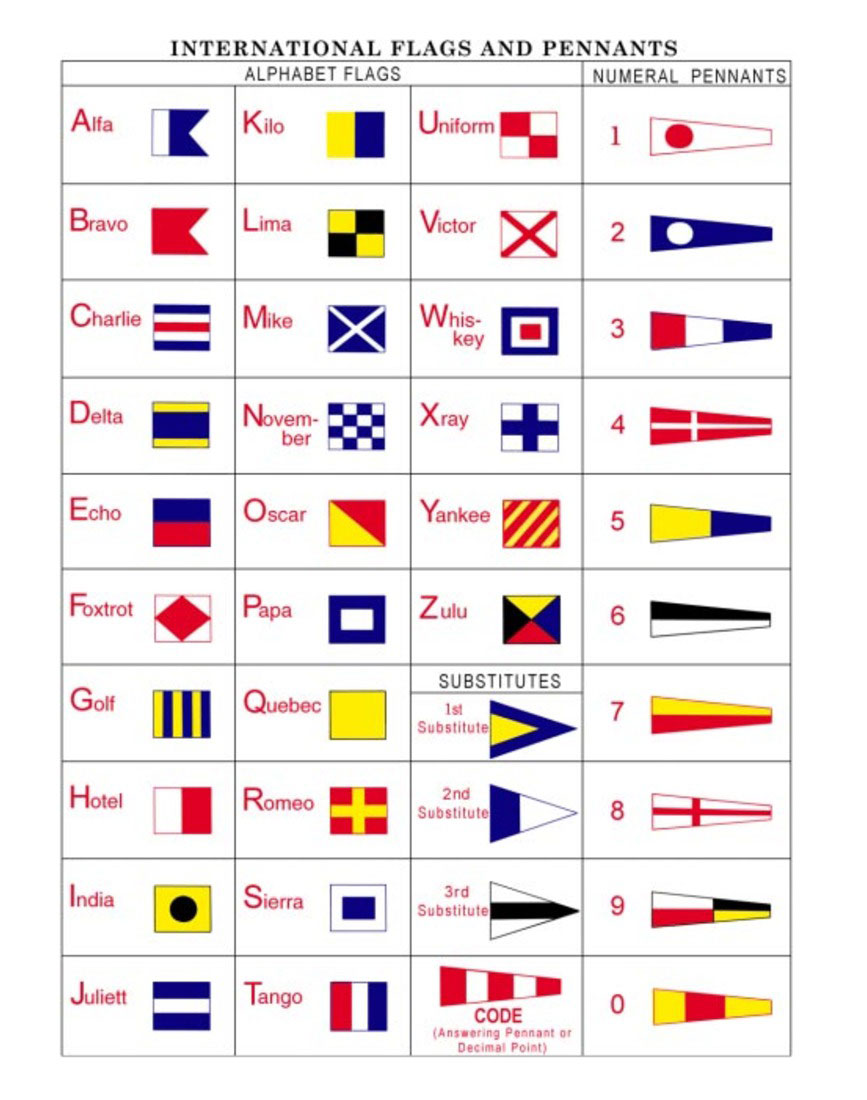
The complete set consists of 26 alphabetical flags (one for each letter), 10 numeral pennants (0 through 9), 3 substituter or “repeater” pennants, and 1 code and answering pennant. Together, these 40 pieces of fabric create a flexible, multilingual communication system that works across wind, distance, and language barriers. A single flag like “Q” (Quebec) tells port authorities your vessel is healthy and requesting free pratique. Four flags hoisted together can declare a medical emergency in any language.
Despite the omnipresence of VHF radios, AIS transponders, and satellite communications in modern boating, nautical signal flags remain legally and practically relevant. Many flag signals are mandatory — the “Q” flag for customs clearance, national courtesy flags, and certain distress signals all have real-world enforcement backing. Understanding nautical signal flags is not an anachronistic hobby; it is a core competency for any serious mariner.
There is also a profound cultural dimension. Signal flags appear on marine charts, port entrance signs, and nautical artwork. Organizations like the International Maritime Organization (IMO) continue to maintain and update the code, and institutions such as the Royal Yachting Association (RYA) include flag recognition in their training curricula. The flags connect every modern sailor to a living, unbroken tradition of maritime communication stretching back centuries.
“At sea, a single flag hoisted correctly can save a life, open a harbor, or declare a nation. No other symbol carries that much weight per square inch of fabric.”
The International Code of Signals: Deep Dive
The International Code of Signals (ICS) is the global standard governing nautical signal flags. First codified in 1857 under the British Board of Trade, the system was revised and internationally adopted in 1969 under IMO oversight, ensuring consistent meaning across every maritime nation. The code is published as a comprehensive reference book available in nine official languages, and its signals cover everything from distress and navigation to medical emergencies and cargo handling.
Single-Letter Signals: The Most Urgent Messages
The most important signals in the entire code are single-letter hoists. Each letter flag has its own standalone meaning when flown alone, and these meanings are specifically assigned to the most urgent, common, or important maritime situations. “Alpha” (A) means a vessel has a diver down and other craft must keep clear at slow speed. “November” (N) means “No.” “Oscar” (O) means “Man overboard.” These single-letter codes are designed to be read at maximum distance with minimum ambiguity — which is why their visual design features the boldest, most contrasting color combinations in the entire set.
Two-Letter Signals: Tactical and Operational Messages
Two-letter combinations dramatically expand the code’s vocabulary. The ICS organizes these into groups by subject — medical, distress, navigation, and operations — so a trained mariner can quickly narrow down the meaning of an unfamiliar hoist. For example, “NC” is the international distress signal meaning “I am in distress and require immediate assistance.” “CP” means “I am proceeding to your assistance.” Two-letter signals cover the vast majority of practical day-to-day flag communication between vessels and between ships and port authorities.
Three and Four-Letter Signals: Ship Identity and Medical
Three-letter combinations beginning with “M” are reserved for medical signals — a critical category given the challenges of providing healthcare at sea. Four-letter hoists are primarily used to signal a vessel’s call sign, essentially broadcasting the ship’s registered identity to other vessels and coast stations. Understanding call sign flags is important for anyone communicating with commercial shipping or Coast Guard vessels, as the call sign determines which vessel is being addressed in a crowded anchorage or busy shipping lane.
Types of Nautical Signal Flags: A Complete Overview
Not all flags flying from a vessel are part of the ICS signal system. Maritime flags fall into several distinct categories, each with its own purpose, placement convention, and etiquette. Understanding the differences is essential to reading any anchored or underway vessel correctly, and to flying your own flags correctly without inadvertently sending the wrong message.
| Flag Type | Purpose | Typical Position | Example | Knowledge Level |
|---|---|---|---|---|
| ICS Letter Flags | Encoded single or multi-flag maritime messages | Signal halyard or spreader | Alpha (Diver Down), Oscar (Man Overboard) | Essential |
| Courtesy Flags | Show respect for the nation whose waters you are entering | Starboard spreader | Miniature national ensign of host country | Essential |
| Numeral Pennants | Spell out numbers in hoisted messages or racing signals | Signal halyard (combined with letters) | Pennant 1–0 in racing start sequences | Intermediate |
| Substituter Pennants | Repeat a flag already in the hoist without needing a duplicate | Any position in a multi-flag hoist | First Substitute repeats top flag; Second repeats second | Intermediate |
| Racing / Regatta Flags | Signal race committee instructions to competing vessels | Committee boat signal mast | AP (Postponement), X (Individual recall), Y (Life jacket) | Intermediate |
National ensigns — the flag representing a vessel’s country of registration — sit in their own category and are flown from the stern staff or the peak of a gaff rig. These are not signal flags, but they carry enormous legal and cultural weight. Flying the wrong ensign or failing to dip your ensign in salute to a naval vessel are breaches of maritime etiquette that can draw official attention in many parts of the world. The more you understand the full taxonomy of maritime flags, the easier it becomes to interpret everything flying from any vessel at a glance.
Rules, Protocols & Maritime Law for Nautical Signal Flags
Flying nautical signal flags is not merely a matter of tradition and courtesy — in many situations it carries the force of maritime law. International conventions, national maritime codes, and port authority regulations all govern when, where, and how certain flags must be displayed. Ignorance of these rules is not accepted as a defense in admiralty courts, so every sailor needs a working knowledge of flag protocol before leaving the dock.
COLREGS and Distress Signals
The International Regulations for Preventing Collisions at Sea (COLREGS) — maintained by the IMO — specify certain visual distress signals that every vessel must be capable of making. These include the “NC” two-flag signal (International Distress) and the waving of arms extended horizontally. Misuse of distress signals is illegal and can result in serious penalties, including criminal prosecution. The regulations are updated periodically, and any serious mariner should keep a current copy aboard.
Courtesy Flag Protocol for Cruisers
When entering the territorial waters of a foreign nation, maritime custom — and in many countries, law — requires you to fly that nation’s courtesy flag from your starboard spreader. The courtesy flag should be the most prominent flag on that halyard and should be in good condition. Flying a faded, torn, or incorrect flag is considered an insult to the host nation. Some countries, including many in the Caribbean and Mediterranean, have customs officials specifically watching for this flag as vessels approach.
Etiquette: Dipping, Striking, and Timing
- Dipping the ensign: When passing a naval vessel, merchant ships traditionally dip their national ensign to half-mast momentarily as a salute. The warship dips and re-hoists in acknowledgment. This custom dates to the age of sail and remains standard worldwide.
- Morning and evening colors: Most formal yacht clubs observe colors — raising the national ensign at 0800 and lowering it at sunset. Vessel flags should follow the same timing when in a club anchorage.
- Order of precedence: When multiple flags are flown, their order communicates status. The national ensign ranks highest, followed by club burgees, then officer pennants, and finally ICS signal flags. Mixing this order sends confusing signals to other mariners.
- Distress flag misuse: Flying a signal that falsely implies distress — including flying the “NC” hoist unnecessarily — is a criminal offense in most maritime jurisdictions and can result in substantial fines and imprisonment.
- Racing flag rights-of-way: In a formal regatta, certain flag signals from the committee boat override normal COLREGS rules within the defined race area. Knowing your racing flags is a safety matter, not just a competitive one.
How to Read Nautical Signal Flags: Step-by-Step Process
Reading a flag hoist correctly requires a systematic approach. Experienced mariners develop the ability to scan and decode a full four-flag hoist in seconds, but the underlying process is straightforward and learnable by anyone with patience and a reference chart. Follow these steps every time you encounter an unfamiliar hoist.
Identify the Hoist Position and Vessel Type
Before reading the flags themselves, note where they are flown. A hoist on the signal halyard between the masts is an ICS message. A flag on the starboard spreader is likely a courtesy flag or Q flag. A flag at the stern staff is the national ensign. Context tells you which code book to reference before you even look at the flag’s design.
Read the Hoist Top to Bottom
In a multi-flag hoist, flags are always read from top to bottom — the topmost flag is the first character of the message. This is an iron rule with no exceptions. Misreading the order completely changes the signal’s meaning. If a hoist appears diagonal due to wind, mentally straighten it and identify each flag from its highest attachment point downward.
Identify Each Flag by Its Color and Pattern
Each ICS flag has a unique combination of colors and geometric shapes — stripes, chevrons, crosses, quadrants — chosen specifically to be distinguishable at distance. Begin by noting the dominant color, then the secondary color, then the pattern. For example, a flag that is yellow with a blue rectangle in the center is “Golf” (G), signaling a pilot request. A red flag with a white cross is “November” (N), meaning “No.” Use a physical reference card or the ICS book for confirmation until the patterns become second nature.
Apply Substituter Pennant Logic
If the hoist contains one of the three substituter pennants (First, Second, or Third Substitute), replace it with the flag it represents before looking up the message. The First Substitute repeats the first (top) flag in the hoist. The Second Substitute repeats the second flag, and so on. This allows a vessel to hoist the same letter twice without carrying duplicate flags. Failing to account for substituters leads to completely wrong message decoding.
Look Up the Signal in the ICS Code Book
Once you have identified the complete letter or letter combination, cross-reference it with your copy of the International Code of Signals. The book is organized by signal group, with single-letter signals first, then two-letter combinations organized by subject, then three-letter medical signals. With practice, you will memorize the most common signals and only need to reference the book for unusual or complex hoists.
Consider the Context Before Responding
A signal flag’s meaning is always filtered through context. A “Q” flag from a vessel just entering the harbor means it wants customs clearance. The same flag waving alone from a vessel anchored for a week has no operational meaning — the skipper may have forgotten to strike it. Always consider the vessel’s situation, location, and recent movement before interpreting a flag signal as an actionable message requiring a response.
Essential Gear for Nautical Signal Flag Signaling
Learning to read nautical signal flags is only half the equation — you also need the right equipment to fly them correctly aboard your own vessel. The quality and completeness of your flag kit directly affects how effectively you can communicate and how seriously other mariners and port officials take your vessel.
A full 40-piece set including all 26 letter flags, 10 numeral pennants, 3 substituters, and the code/answer pennant. Marine-grade nylon is the minimum; acrylic canvas lasts longer in UV and salt spray.
The official International Code of Signals publication is an indispensable onboard reference. Available in nine languages, it covers every signal combination with precise meanings and usage guidance.
A dedicated signal halyard separate from your sail halyards is essential for clean, unobstructed flag hoisting. UV-resistant polyester braid and low-friction blocks allow quick, snag-free deployment at sea.
Reading another vessel’s flag hoist requires magnification in all but the closest encounters. 7×50 binoculars with individual focus are the traditional marine standard — the exit pupil is optimized for low-light conditions at sea.
Laminated quick-reference cards showing all 40 ICS flags with their single-letter meanings are invaluable at the helm. Several marine publishers produce these in a compact chart-table size that stows flat and withstands spray.
Marine-grade stainless or brass flag snaps allow rapid attachment and removal of flags from halyards. Nylon snaps corrode and jam in saltwater; invest in quality metal hardware to ensure flags can be struck quickly in an emergency.
Best Places to Practice Reading Nautical Signal Flags
Theoretical knowledge of nautical signal flags is only as valuable as your ability to recognize them in the real world, often at distance, in poor light, with flags snapping in the wind. These locations offer excellent opportunities to observe flags in active use and build genuine fluency.
- Major international yacht clubs and marinas: Clubs like the Royal Bermuda Yacht Club, the New York Yacht Club, or the Royal Sydney Yacht Squadron regularly fly full courtesy and signal flag displays, host flag-recognition events for junior sailors, and maintain active flag etiquette that gives visitors a living classroom experience.
- Naval base open days: Many naval vessels participate in public open days where full dress flags — every ICS flag displayed simultaneously — are flown from bow to stern. These events offer a rare chance to see and identify every flag in the code in one concentrated display.
- Offshore sailing races and regattas: Committee boats at events like the Newport–Bermuda Race or the Rolex Fastnet Race fly a steady sequence of racing flag signals throughout the race. Spectating from a nearby powerboat while tracking the signals against the ISAF Racing Rules is an outstanding practical exercise.
- Active commercial harbors and ferry terminals: Busy ports like Rotterdam, Hong Kong, or Long Beach regularly see commercial vessels flying “Q” flags on arrival, pilotage request signals, and occasionally full message hoists. A day spent on a harbor tour or waterfront with binoculars and a reference card is enormously educational.
- Maritime museums with preserved vessels: Institutions like the San Francisco Maritime National Historical Park or the National Maritime Museum in Greenwich maintain historic vessels and often recreate historical flag hoists. Many have interactive exhibits where visitors can practice identifying and hoisting flags.
- Sailing schools and offshore passage courses: Accredited sailing schools — particularly those offering offshore or coastal master certifications — include flag signaling in their curricula. Taking a structured course is the fastest route to confident flag literacy, and the practical sessions aboard training vessels are invaluable.
Visual Flag Communication vs. Radio: Comparing Two Approaches
Modern mariners have access to sophisticated electronic communication tools, yet nautical signal flags have not been retired. Understanding when each system is superior — and why — is a mark of true seamanship. The best mariners know both systems intimately and choose the right tool for the situation.
Signal flags require zero electronics, zero battery power, and zero radio frequency coordination. They function in any weather, across language barriers, and in electromagnetic environments where radio silence is required (such as near certain naval operations or in the vicinity of blasting operations). Their visual nature makes them immediately apparent to all observers within visual range simultaneously — no channel selection needed. Flags also carry legal and cultural weight: a “Q” flag speaks louder to a customs officer than a VHF call. Their limitation is range — practical reading distance for flags is roughly 1–2 nautical miles even with binoculars, and fog or heavy rain can reduce that to zero.
VHF marine radio offers range far beyond visual flag signals — typically 20–30 nautical miles for vessel-to-vessel communication and much more for vessel-to-shore. Channel 16 is the internationally recognized distress and calling channel, monitored continuously by coast guards worldwide. Radio communication allows complex, nuanced information exchange that no flag system can match — you can describe a medical emergency in full detail, request a specific berth, or report a hazard with precise coordinates. The weaknesses are power dependency, potential equipment failure, and the need for a shared language in non-coded voice communication. Radio silence situations and electronics failures underscore why flags remain the legal backup distress signal method.
The wisest approach treats flags and radio as complementary layers of a redundant communication system. Fly your “Q” flag on approach to a foreign port while simultaneously calling on VHF Channel 16. Hoist “Oscar” the instant someone goes overboard while also activating your DSC distress button. Redundancy is not inefficiency at sea — it is survival strategy. Sailors who understand traditional navigation tools like the compass and flags alongside their modern electronics are fundamentally safer mariners than those who rely on electronics alone.
Ethics, Conservation & Advanced Considerations in Maritime Signaling
The practice of flying nautical signal flags carries responsibilities beyond simply knowing which flag is which. Ethical seamanship, environmental awareness, and cultural respect all intersect with flag protocol in ways that every mariner should understand and honor.
Respecting Host Nations and Maritime Sovereignty
Courtesy flags are not a bureaucratic formality — they are a tangible expression of respect for the sovereignty of nations whose waters you enter. Flying a damaged, sun-bleached, or incorrect courtesy flag sends a message that you do not value that respect. Many island and coastal communities depend on cruising sailors for economic activity and cultural exchange; treating their national flag with the same care you give your own vessel’s ensign builds goodwill and contributes to the continued welcome sailors receive in ports around the world. Some nations in the South Pacific and Indian Ocean have local customs around flag flying that go beyond the standard ICS conventions — researching these before arrival is a mark of a conscientious cruiser.
Accurate Use of Distress Signals: A Life-or-Death Ethical Issue
The “NC” distress hoist and other emergency flag signals must never be flown casually, mistakenly, or as a joke. When a coast guard or nearby vessel sees a distress signal, they are legally and morally obligated to respond — diverting time, resources, and crew from other duties or from their own voyages. False distress signals cause real harm, including deaths where response resources were diverted away from genuine emergencies. If you discover you have accidentally hoisted a distress combination, strike it immediately and broadcast a clear “Cancel Distress” call on VHF Channel 16.
- Synthetic flag materials and ocean pollution: Most modern signal flags are made from nylon or polyester — both petroleum-derived synthetic fabrics that shed microfibers in the marine environment. Choose flags from manufacturers committed to responsible production practices, and retire worn flags through textile recycling programs rather than discarding them at sea or in landfills.
- Flag replacement cycles: A sun-bleached, frayed flag is an environmental problem waiting to happen and a professional embarrassment at any serious marina. Replace flags annually if you sail in tropical UV conditions, and inspect all flags for fraying before any offshore passage.
- Protecting maritime cultural heritage: Signal flags are a living piece of oceanic history. Teaching flag recognition to the next generation of sailors — through junior sailing programs, family cruising education, and mentorship — ensures that this irreplaceable knowledge system survives the digital age intact.
- Anchoring near sensitive habitats: Many of the best flag-watching anchorages — Caribbean bays, Pacific atolls, Mediterranean coves — overlie fragile coral and seagrass ecosystems. The same ethical awareness that makes a good flag sailor also informs responsible anchoring, waste management, and wildlife interaction practices.
Ethical seamanship begins with knowledge and deepens into practice. A sailor who flies the right flags, at the right times, in good condition, and who respects every aspect of maritime signaling culture contributes to a safer, more respectful ocean community for every mariner who follows. The sea is shared space; every act of competence and courtesy raises the standard for all who sail it.
Frequently Asked Questions About Nautical Signal Flags
What is the most important nautical signal flag every sailor should know?
The single most important flag is “Oscar” (O) — a yellow and red diagonal flag that means “Man Overboard” when hoisted alone. Every person who steps aboard any vessel should recognize this flag on sight, and every skipper should be able to find and hoist it within seconds of someone entering the water. After Oscar, the “Quebec” (Q) flag — solid yellow — is the second most practically important for recreational sailors, as it is legally required when entering foreign ports to indicate a clean bill of health and request customs clearance. Memorizing these two flags alone will make you a meaningfully safer mariner.
How many flags are in the International Code of Signals?
The complete ICS set contains 40 flags: 26 alphabetical letter flags (Alpha through Zulu), 10 numeral pennants (0 through 9), 3 substituter or “repeater” pennants, and 1 code-and-answer pennant. Together these 40 flags can encode thousands of distinct messages by hoisting them in single-flag, two-flag, three-flag, or four-flag combinations. The ICS code book itself contains over 1,500 pre-defined signals organized by subject category, from distress and medical emergencies to navigation warnings and pilot requests.
Are nautical signal flags still used today, or are they obsolete?
Nautical signal flags are very much still in active use and are far from obsolete. The “Q” flag is legally required when entering many foreign ports. Courtesy flags are expected in virtually every international cruising destination. Racing flags are essential at any formal regatta. Commercial shipping still uses flag signals for pilot requests and port communications. Beyond legal requirements, flags serve as a critical backup communication system when electronics fail — and electronics do fail at sea. The International Maritime Organization continues to maintain and update the International Code of Signals, and flag recognition remains a component of formal maritime qualification curricula worldwide.
How do you read a nautical flag hoist with multiple flags?
Multi-flag hoists are always read from top to bottom — the topmost flag is the first character of the message. Once you have identified each flag by its color and pattern, you combine the letters to form a code and look it up in the International Code of Signals reference book. If the hoist contains a substituter pennant, replace it with the flag it represents (the First Substitute repeats the first flag in the hoist, etc.) before looking up the code. With practice and a good reference card, decoding a four-flag hoist takes only a few seconds. The key is knowing your individual flags well before attempting to decode combinations.
What is the difference between a nautical signal flag and a courtesy flag?
A nautical signal flag is part of the International Code of Signals system and conveys a specific encoded message — such as “diver down,” “pilot required,” or “man overboard.” A courtesy flag, by contrast, is the national ensign (national flag) of a foreign country flown by a visiting vessel to show respect for the host nation’s sovereignty. Courtesy flags are flown from the starboard spreader of the visiting vessel and have no ICS meaning — they are purely a display of diplomatic respect and maritime good manners. The two types of flags have completely different functions, fly in different positions on the vessel, and are governed by different sets of rules.
Can I learn nautical signal flags on my own, or do I need a formal course?
You can absolutely begin learning nautical signal flags through self-study using the official IMO International Code of Signals publication, laminated flag reference cards, and online resources from organizations like the US Sailing Association or the Royal Yachting Association. However, a formal course — such as the RYA Day Skipper or USCG-approved offshore training — provides structured instruction, practical flag recognition exercises, and examination validation that self-study cannot fully replicate. The most effective approach for serious sailors is to use self-study materials to build a foundation, then consolidate that knowledge through a recognized certification course that includes hands-on flag work. Understanding the broader context of traditional maritime tools — including how to use a sailor’s compass — enhances your overall seamanship competency significantly.
