


🤿 Scuba & Free Diving
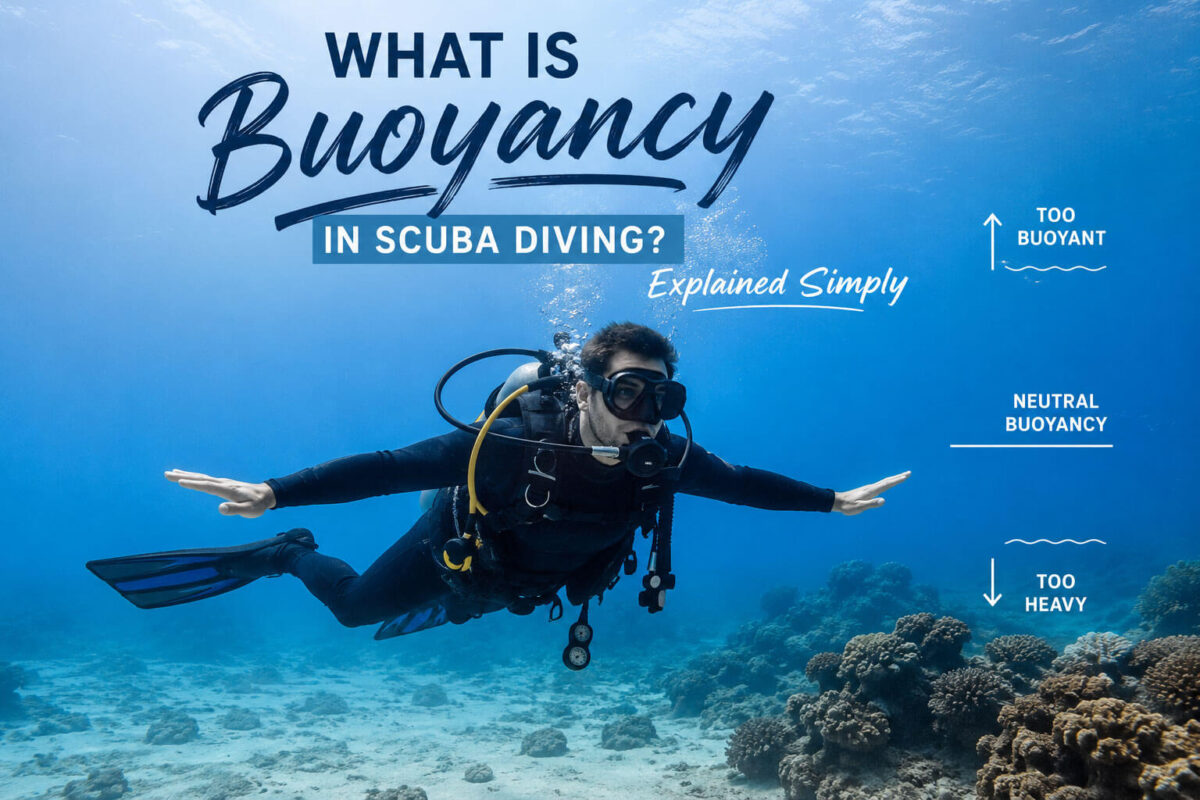
What Is Buoyancy in Scuba Diving? Explained Simply
Jun
🤿 Scuba Diving Skills
What Is Buoyancy in Scuba Diving? Explained Simply
The single most important skill in all of scuba diving — mastered by few, misunderstood by many. Here is everything you need to know about buoyancy, explained clearly for divers at every level.
What is buoyancy in scuba diving?
Buoyancy is the upward force exerted by water on any object submerged within it. In scuba diving, buoyancy control is the ability to hover effortlessly at any depth — neither sinking toward the seafloor nor floating uncontrollably toward the surface — using nothing but small adjustments to your BCD and the rhythm of your own breathing.
It is, without question, the most important skill in recreational scuba diving. A diver with perfect buoyancy glides through the water like a marine animal — calm, precise, and completely in control. A diver with poor buoyancy kicks up sand, damages coral, burns through air twice as fast, and exhausts themselves on every dive.
“Good buoyancy is not something you learn in a pool. It’s something you earn over dozens of dives in open water — and it changes everything.”
The good news is that buoyancy is a learnable skill. With the right understanding of the physics involved, proper weighting, and deliberate practice, any diver can achieve the effortless neutrality that makes scuba diving the extraordinary experience it is meant to be.
The three types of buoyancy
Every diver needs to understand the three states of buoyancy — and know intuitively which one they are in at any given moment during a dive.
The goal of every recreational diver is to achieve and maintain neutral buoyancy throughout the dive — after the initial descent and before the final ascent. At the surface, you want to be positively buoyant. On the seafloor for a specific reason, slight negative buoyancy is acceptable. Everywhere else: perfectly neutral.
The science behind buoyancy
You don’t need a physics degree to dive well — but understanding a few fundamental principles will immediately improve your control underwater. Two laws govern everything that happens with buoyancy in scuba diving.
Why buoyancy changes at depth
This is what confuses many beginner divers: your buoyancy is not fixed. It changes constantly as you move through the water column, and here is why:
- Your wetsuit compresses — a 5mm wetsuit at 30 metres has roughly one-third the buoyancy it had at the surface. As you go deeper, your suit becomes less buoyant and you begin to sink more easily.
- Your lungs change volume — inhaling expands your chest and increases your displacement, making you more buoyant. Exhaling shrinks it, making you less buoyant. Your breathing is a live buoyancy control system.
- Your tank gets lighter — a full steel 12-litre cylinder is negatively buoyant. As you consume the air inside, the tank becomes lighter, gradually making you more positively buoyant over the course of a dive.
Understanding these changes means you can anticipate them — adding a small amount of air to your BCD as you descend to compensate for wetsuit compression, for example, rather than being surprised when you start sinking at 20 metres.
What controls your buoyancy?
Four factors control your buoyancy underwater. A skilled diver manages all four simultaneously — though with practice, most of this becomes entirely instinctive.
Your BCD (Buoyancy Control Device)
The primary mechanical control. By adding air via the inflator hose or releasing air via the dump valves, you adjust your overall displacement and therefore your buoyancy. Used for gross adjustments — descending, ascending, and compensating for depth changes.
Your breathing
The fine control. Inhaling slowly increases your lung volume and makes you slightly more buoyant. Exhaling decreases it. An experienced diver barely needs to touch their BCD — they use breath to make continuous micro-adjustments while hovering.
Your weight system
Lead weights on your weight belt or integrated BCD pockets provide the negative buoyancy needed to offset your positively buoyant wetsuit and equipment. Getting your weighting correct is the foundation of good buoyancy — everything else builds on it.
Your body position
Your horizontal trim — the angle of your body in the water — affects how efficiently you move and how easily you maintain depth. A horizontal, streamlined position is far easier to control than a head-up, feet-down posture, which causes the infamous “bicycle kick” that ruins buoyancy.
How your BCD controls buoyancy
Your BCD — Buoyancy Control Device — is an inflatable jacket connected to your tank via a low-pressure inflator hose. It has two controls you will use constantly on every dive.
The inflator button (add air)
Pressing the inflator button adds air from your tank into the BCD bladder, increasing your volume without changing your weight. More volume means more water displaced means more upward force — you become more positively buoyant and rise. Use this when you are sinking too deep or need to ascend.
The dump valves (release air)
Your BCD has at least two dump valves — one at the top of the left shoulder (on the corrugated hose) and one at the lower right side or rear of the jacket. Pressing or pulling these releases air from the bladder, reducing your volume, reducing buoyancy, and allowing you to sink or maintain position. Use these when you are floating up unintentionally or need to descend.
The golden rule of BCD use
Make small, gradual adjustments and wait for the effect before making another change. The biggest mistake new divers make is over-correcting — adding too much air when they sink, then releasing too much when they float, creating a constant up-and-down yo-yo effect that wastes air and prevents controlled hovering.
Breathing as buoyancy control
This is the secret that separates good divers from great ones. Once your weighting is correct and your BCD is approximately right, breathing becomes your primary buoyancy control tool — not the BCD buttons.
Think of it this way: your lungs are a built-in, continuously variable buoyancy device. Every breath you take makes a small but real difference to your position in the water.
- Inhale slowly and fully → your chest expands → you displace more water → you gently rise
- Exhale slowly and fully → your chest contracts → you displace less water → you gently sink
- Hold at mid-breath → you hover at a fixed point in the water column
- Breathe in a slow, rhythmic cycle → you rise and fall gently with each breath, hovering at a consistent average depth
Why slow breathing improves everything
Slow, deep, rhythmic breathing does more than control buoyancy. It also dramatically reduces your air consumption — because anxious, rapid breathing wastes oxygen and adds CO2 to your system faster. The calmer you are, the less air you use, the longer your dive lasts, and the better your buoyancy becomes. It is a virtuous cycle that improves with every dive.
“The moment you stop thinking about buoyancy and start breathing for it, everything changes.”
How to get your weighting right
Correct weighting is the foundation of good buoyancy. If you are carrying too much weight, you will spend the entire dive fighting to stay up. Too little, and you will struggle to descend and constantly float at the surface. Getting it exactly right transforms your diving.
The surface buoyancy check — step by step
Enter the water fully kitted
Wear your full wetsuit, BCD, tank, and weights. Hold a normal breath and completely deflate your BCD by pressing and holding the dump valve.
Check your eye level
With a normal inhale and empty BCD, you should float with the water at approximately eye level or mid-forehead. If you are floating higher than this, you need more weight. If you are already sinking, you need less.
Exhale and observe
Exhale fully. You should begin to slowly sink beneath the surface. If you remain floating after a complete exhale, add 0.5–1kg and repeat. If you sink immediately on an inhale, remove 0.5–1kg.
Account for tank level
A full tank is heavier than an empty one. At the end of a dive (around 50 bar remaining), you will be more positively buoyant. Add 1–2kg extra weight to compensate, or perform your check with a near-empty tank.
Saltwater vs freshwater
Saltwater is denser than freshwater — you need approximately 2–3kg more weight when diving in the sea compared to a swimming pool or freshwater lake. Always recheck your weighting when changing between environments.
Common buoyancy mistakes — and how to fix them
These are the buoyancy problems that appear most frequently in beginner and intermediate divers. Recognising your own pattern is the first step to fixing it.
How to actively improve your buoyancy
Buoyancy does not improve automatically with dive count. It improves with deliberate practice. Here is a structured path from beginner to expert buoyancy control.
The PADI Peak Performance Buoyancy course
If you want to accelerate your buoyancy development dramatically, the PADI Peak Performance Buoyancy specialty course is one of the best investments any diver can make. In a single day, a qualified instructor will work with you one-on-one on your weighting, trim, BCD technique, and breathing patterns — identifying and fixing the specific habits holding you back. Most divers describe it as transformative.
- Hovering drill: Pick a depth, cross your fins, fold your arms, and hover for 60 seconds using breath only. No BCD adjustments allowed.
- The fin pivot: Lie face down on the sand (gently), fingertips touching the bottom. Use breath to rise and sink without touching the bottom again.
- Buoy run: Follow a fixed reference line (a mooring line or anchor line) and maintain perfect neutral buoyancy the entire way up and down.
- Slow ascent challenge: Ascend from 10 metres to 5 metres in 2 full minutes using only breath control — no BCD changes.
- No-hands hover: Remove all fins from your body position equation and hover horizontally for 30 seconds using only breathing and a perfectly dialled BCD.
Frequently asked questions
Wear the ocean between dives
SEASPORTEES makes premium ocean-inspired graphic tees for scuba divers, freedivers, and everyone who lives for the underwater world. Explore our collections.
Shop the Scuba & Freediving Collection → Or explore our full ocean lifestyle range ↗Related articles
