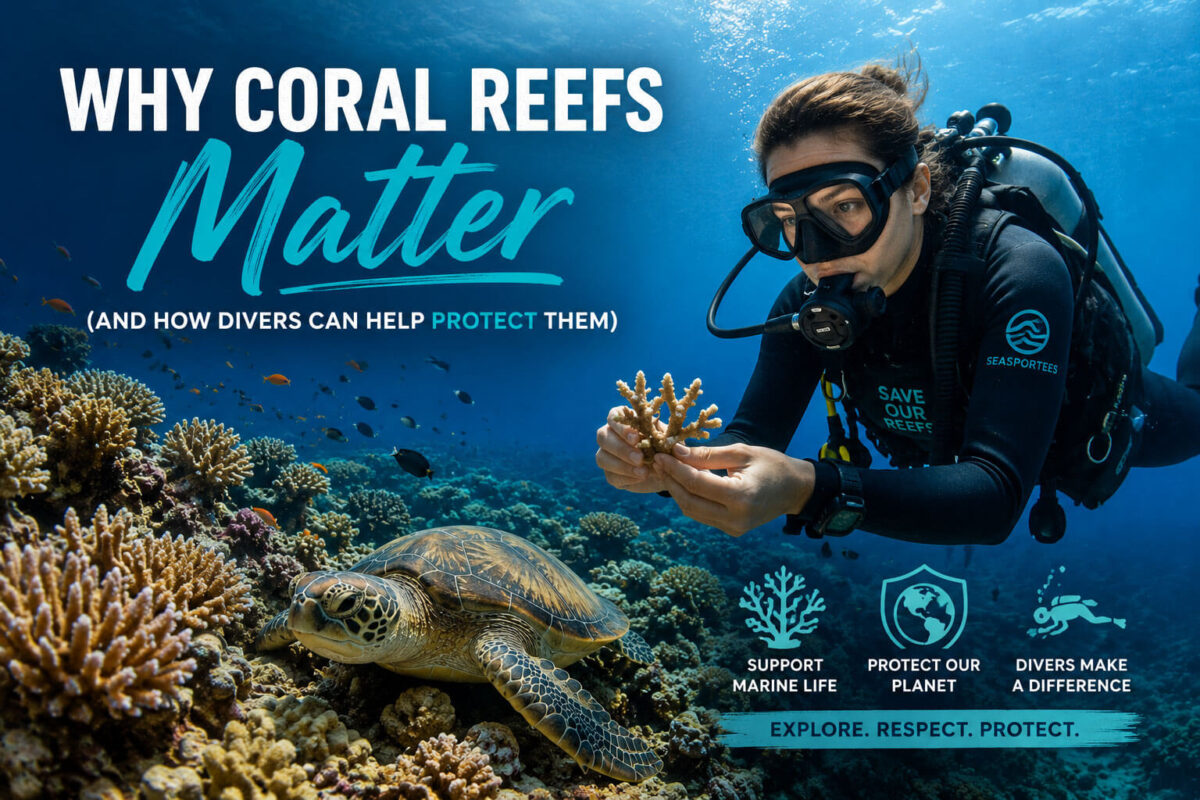
Why Coral Reefs Matter — And How Divers Can Help Protect Them
Coral reefs cover less than 1% of the ocean floor — yet they sustain 25% of all marine life. Here is everything you need to know about why reefs matter, what threatens them, and the concrete actions every diver can take to protect them.
⏱ 11 min read📅 Updated June 2026ConservationEvery Diver
25%
Of all marine species depend on coral reefs
50%
Of the world’s coral reefs have been lost since 1950
1B+
People worldwide depend on reefs for food and income
Section 01
What are coral reefs?
Coral reefs are among the oldest and most complex ecosystems on Earth — living structures built over thousands of years by tiny animals called coral polyps. Each polyp is a soft-bodied creature, related to jellyfish and sea anemones, that secretes a hard calcium carbonate skeleton around itself. Billions of these skeletons, accumulated over millennia, form the extraordinary three-dimensional architecture of a reef.
Despite their rock-like appearance, corals are living animals — not plants, not rocks. They are in a symbiotic relationship with microscopic algae called zooxanthellae, which live within coral tissue and provide up to 90% of the coral’s energy through photosynthesis. This partnership is what gives healthy coral its vivid colour — and what makes coral reefs so extraordinarily sensitive to changes in temperature and water quality.
“Coral reefs are the rainforests of the sea — impossibly diverse, irreplaceable, and under grave threat from human activity.”
🌍
Global coverage
Coral reefs cover approximately 285,000 km² of the ocean floor — less than 1% of the total area, yet supporting the greatest concentration of biodiversity in the marine world.
⏳
Ancient ecosystems
Some coral reef structures are over 50 million years old. The Great Barrier Reef began forming approximately 20,000 years ago. Individual coral colonies can live for hundreds of years.
🐠
Biodiversity hotspots
A single coral reef can support more species of fish per square metre than any other marine habitat. The Coral Triangle alone contains over 600 species of reef-building coral and 2,000 species of fish.
🌱
Growth rate
Most reef-building corals grow between 1–3cm per year. Massive corals like brain coral grow as little as 5mm annually. The destruction of a reef in minutes can represent thousands of years of growth.
Section 02
Why coral reefs matter
The importance of coral reefs extends far beyond their extraordinary beauty. They are foundational ecosystems that underpin the health of the entire ocean — and the livelihoods of hundreds of millions of people worldwide.
1. Biodiversity
Coral reefs support approximately 25% of all known marine species despite covering less than 1% of the ocean floor. Fish, invertebrates, marine mammals, sea turtles, and thousands of other species depend on reefs for food, shelter, breeding grounds, and nurseries. Remove the reef, and entire food chains collapse.
2. Food security
Over one billion people worldwide depend on coral reefs as a primary source of protein. Reef fisheries provide food and income for coastal communities across the Pacific, Indian Ocean, Caribbean, and Red Sea. In some island nations, reef fish account for the majority of animal protein consumed.
3. Coastal protection
Coral reefs act as natural breakwaters, absorbing up to 97% of wave energy before it reaches the shore. Without reef protection, coastlines become catastrophically vulnerable to storms, erosion, and flooding. Entire island nations — including the Maldives and many Pacific island communities — rely on reef barriers for their physical existence.
4. Medicine and science
Reef organisms have already contributed compounds used in treatments for cancer, HIV, cardiovascular disease, and pain management. Cone snail venom, for example, has led to the development of ziconotide — a powerful non-opioid painkiller. Scientists estimate that the majority of reef species have not yet been studied for their pharmaceutical potential.
5. Tourism and economy
Coral reef tourism — including scuba diving, snorkelling, and reef fishing — generates an estimated $36 billion USD annually worldwide. The Great Barrier Reef alone contributes approximately $6.4 billion AUD per year to the Australian economy. Healthy reefs are an economic asset of enormous value to coastal nations.
💡
As a diver, you have a direct relationship with coral reefs. Every dive you take on a healthy reef is a privilege built on millions of years of biological engineering. That relationship carries responsibility — and enormous power to protect.
Section 03
The zones of a coral reef
Understanding reef structure helps you dive more intelligently — knowing where different species live, why certain areas are more fragile, and how to position yourself without causing damage.
🌊
Reef Flat
0–3 metres
Shallow, often exposed at low tide. High wave energy. Dominated by tough, wave-resistant coral species and seagrass beds that serve as nurseries for juvenile fish.
🪸
Reef Crest
1–5 metres
The highest point of the reef — often the most biodiverse zone, with maximum sunlight and current bringing food. Most vulnerable to physical damage from divers and boat anchors.
🐠
Fore Reef / Reef Face
5–30 metres
The main dive zone — richest coral diversity and fish life. Coral growth is densest here, with caves, overhangs, and swim-throughs creating complex habitat structure.
🦈
Reef Wall / Drop-off
20–100+ metres
A near-vertical face descending into deep water. Home to pelagic species, sharks, large rays, and deep-water coral. Dramatic diving — and excellent buoyancy is essential here.
🏜️
Reef Slope / Sandy Bottom
15–40 metres
Coral thins out toward the sandy base. Home to garden eels, rays, flatfish, and cleaning stations where fish queue for parasites to be removed by cleaner wrasse.
🌑
Deep Reef / Mesophotic
30–150 metres
Beyond recreational diving limits. Low light, specialised coral species adapted to darkness, and many undiscovered organisms. Currently being explored by rebreather and technical divers.
Section 04
What threatens coral reefs?
Coral reefs face threats from multiple directions simultaneously — and the combination of stressors is what makes their situation so urgent. Each individual threat would be manageable. Together, they are devastating.
🌡️
Ocean warming and climate change
Rising sea temperatures — even by 1–2°C above normal seasonal maximums — cause coral bleaching events that can kill entire reef systems within weeks. This is the single largest threat to coral reefs worldwide, and the one most directly connected to global carbon emissions.
↑ 50% of the Great Barrier Reef bleached in 2016 and again in 2022
🧪
Ocean acidification
As oceans absorb CO2 from the atmosphere, seawater becomes more acidic — dissolving the calcium carbonate skeletons that corals depend on. More acidic oceans make it harder for corals to build and maintain their structures, and make existing reefs more fragile.
↑ Ocean pH has dropped by 0.1 units since industrialisation — a 26% increase in acidity
🏭
Pollution and runoff
Agricultural runoff carrying fertilisers and pesticides, coastal sewage discharge, and plastic pollution all reduce water quality, promote algae blooms that smother coral, and introduce toxic chemicals into reef ecosystems. Sunscreen chemicals — particularly oxybenzone — have also been shown to damage coral DNA.
↑ An estimated 8 million tonnes of plastic enter the ocean annually
🎣
Destructive fishing practices
Blast fishing (using explosives to stun fish), cyanide fishing, and trawling across reef systems cause catastrophic physical destruction that can take decades to recover from — if it recovers at all. These practices remain common in parts of Southeast Asia and the Pacific.
↑ Blast fishing destroys up to 64 m² of reef per explosion
⚓
Careless tourism and diving
Boat anchors dropped on reef, divers touching and standing on coral, fins kicking reef structures, and tour operators overcrowding sensitive sites all cause cumulative physical damage. This is one threat that divers have direct and immediate power to reduce.
↑ Studies estimate 80% of reef damage in tourist areas is caused by diver contact
Section 05
What is coral bleaching?
Coral bleaching is one of the most visible signs of reef stress — and one of the most heartbreaking sights any diver will ever witness. Understanding what causes it, and what it means for the reef, is essential knowledge for any ocean-conscious diver.
What happens during bleaching
When water temperatures rise above a coral’s tolerance threshold — typically just 1°C above the seasonal maximum for an extended period — coral polyps become stressed and expel the zooxanthellae algae living in their tissue. Without those algae, the coral loses its primary food source and its colour, turning stark white — hence “bleaching.”
A bleached coral is not dead. It is severely stressed and starving. If temperatures return to normal relatively quickly, zooxanthellae can recolonise the coral and it can recover. But if elevated temperatures persist for weeks or months, the coral dies — and dead coral is rapidly colonised by algae, turning grey-green and preventing new coral larvae from settling.
⚠️
The urgency: Mass coral bleaching events were once rare — occurring roughly once per decade before 1980. Since 2016, the Great Barrier Reef has experienced four mass bleaching events in seven years. Scientists warn that without urgent action on carbon emissions, annual bleaching events will become the norm for most tropical reefs by 2050.
What divers can do about bleaching
Individual divers cannot stop ocean warming. But they can document bleaching events and report them to reef monitoring programs like the Coral Triangle Initiative and GBRMPA, reduce their personal carbon footprint, avoid diving on actively bleaching reefs where possible to reduce additional stress, and support organisations working on reef restoration and coral resilience research.
Section 06
How divers accidentally damage reefs
Most diver-caused reef damage is unintentional. New divers with poor buoyancy, careless fin placement, or an innocent impulse to touch a fascinating organism can cause damage they are completely unaware of. This section is not about blame — it is about awareness.
🪸
Remember: A piece of branching coral that breaks under a single fin kick may have taken 10–50 years to reach that size. The damage takes seconds. The recovery — if it happens at all — takes decades.
Fin kicks on coral — the most common cause of diver-related reef damage. Poor buoyancy forces divers to use their fins to maintain position, and downward kicks fracture coral branches, overturn fragile structures, and stir up sediment that smothers coral polyps.
Standing or kneeling on reef — even touching the sandy bottom next to coral disturbs sediment that settles on and smothers adjacent reef. Never kneel, stand, or rest on any reef substrate.
Touching marine animals — handling sea turtles, riding sharks, touching stingrays, and picking up marine invertebrates all cause stress responses in animals and can damage protective skin coatings. The “no touch” rule applies to every living thing on the reef.
Feeding fish — fish feeding disrupts natural reef ecology, creates unnatural aggregations of aggressive species, and alters the behaviour of animals that divers then report as “friendly.” It is banned in most marine protected areas.
Collecting souvenirs — taking shells, coral fragments, sea glass, or any natural material from a reef is illegal in most marine protected areas and ecologically harmful everywhere. Leave everything exactly where you find it.
Chemical sunscreen in the water — oxybenzone and octinoxate found in most standard sunscreens wash off in water and have been shown to cause DNA damage in coral larvae and contribute to bleaching. Always use reef-safe mineral sunscreen when diving.
Section 07
How divers can actively protect coral reefs
Divers are uniquely positioned to be among the ocean’s most powerful advocates. You visit reefs that most humans will never see. You witness their health and their decline with your own eyes. And you have the skills, the knowledge, and the community to make a genuine difference.
1
Master your buoyancy
Perfect buoyancy is the single most powerful reef protection tool any diver possesses. A neutrally buoyant diver who never touches the reef does more for coral conservation than any campaign. Read our complete buoyancy guide and consider the PADI Peak Performance Buoyancy course.
2
Switch to reef-safe sunscreen
Replace any sunscreen containing oxybenzone or octinoxate with a mineral-based, reef-safe alternative. Brands like Stream2Sea, Raw Elements, and Badger are well-regarded options. This single change removes a chemical stressor every time you enter reef waters.
3
Participate in reef monitoring
Programs like Reef Check, PADI’s Dive Against Debris, and CoralWatch train recreational divers to monitor reef health, record species abundance, and report bleaching events. Your dive data contributes directly to conservation science.
4
Choose responsible dive operators
Book with dive centres that use mooring buoys instead of anchors, limit group sizes on sensitive sites, brief divers on reef etiquette before entry, and hold conservation certifications like Green Fins or PADI Eco certification.
5
Reduce single-use plastic
Carry a reusable water bottle, refuse single-use plastic bags and straws, and participate in beach and dive site clean-ups. An estimated 80% of marine plastic pollution originates from land — individual plastic reduction matters at scale.
6
Support coral restoration projects
Organisations worldwide are growing coral fragments on underwater nurseries and transplanting them to damaged reefs. Many accept volunteer divers and financial donations. Coral Restoration Foundation, SECORE International, and the Coral Triangle Initiative all accept support.
7
Educate other divers
Gently reminding fellow divers about buoyancy, the no-touch rule, and sunscreen choices is one of the most direct ways to protect reefs. A word from a fellow diver often lands more powerfully than a sign on the dive centre wall.
8
Reduce your carbon footprint
Ocean warming is the single greatest threat to coral reefs — and it is driven by carbon emissions. Reducing your own emissions, supporting clean energy, and advocating for climate policy is the highest-leverage action any individual ocean lover can take.
The Responsible Diver Pledge
I will master my buoyancy before diving on sensitive reefs
I will never touch, stand on, or collect from any reef
I will use reef-safe sunscreen every time I enter reef water
I will never feed, handle, or disturb marine animals
I will choose dive operators who use mooring buoys
I will participate in at least one reef clean-up per year
I will reduce my single-use plastic consumption
I will share what I know with other divers and non-divers
Section 08
The world’s best coral reefs to dive
Despite the threats they face, the world still hosts extraordinary coral reef systems that take the breath away — above and below the surface. These are the reefs every diver should experience at least once.
🇦🇺
Great Barrier Reef, Australia
The world’s largest coral reef system — 2,300km of living reef, 1,500 species of fish, and 4,000 types of mollusc. Dive from Cairns or the Whitsundays. Under serious threat but still extraordinary.
Best season: June–October
🇮🇩
Coral Triangle, Indonesia
The global epicentre of marine biodiversity. Raja Ampat, Komodo, and Banda Sea offer reef diving found nowhere else on Earth — manta rays, whale sharks, pygmy seahorses, and walls of fish.
Best season: October–April
🇲🇻
The Maldives
Overwater bungalows meet world-class reef diving. Manta rays, hammerhead sharks, whale sharks, and technicolour soft corals in gin-clear water. Best explored on a liveaboard.
Best season: November–April
🇪🇬
Red Sea, Egypt
Extraordinary reef biodiversity, exceptional visibility, and warm water year-round. Ras Mohammed National Park and the Brothers Islands offer some of the world’s finest reef and wreck diving, accessible from Hurghada and Sharm el-Sheikh.
Best season: March–May, September–November
🇲🇽
Mesoamerican Reef, Mexico
The second largest reef system in the world, stretching from Mexico through Belize, Guatemala, and Honduras. Cozumel and Belize’s Blue Hole are diving landmarks — superb reef diversity and crystal-clear Caribbean water.
Best season: May–September
🇵🇭
Tubbataha Reef, Philippines
A UNESCO World Heritage Site and one of the most pristine reef systems in Asia — so remote it can only be reached by liveaboard. Sharks, rays, turtles, and walls of coral in near-perfect condition.
Best season: March–June
Section 09
Reef conservation organisations worth supporting
These organisations are doing the most important work in coral reef science, restoration, and advocacy. Every diver can support them — through volunteering, donation, or simply amplifying their work.
Reef Check — trains and coordinates a global network of recreational diver volunteers to monitor reef health using a standardised scientific protocol. One of the largest citizen science reef monitoring programmes in the world.
Coral Restoration Foundation — operates the world’s largest coral restoration programme, growing corals in underwater nurseries and transplanting them to degraded reefs in the Florida Keys and Caribbean. Accepts volunteer diver applications.
SECORE International — focuses on coral sexual reproduction research, developing techniques to breed genetically diverse corals that are more resilient to warming waters. A scientific pioneer in reef restoration.
The Ocean Agency — the organisation behind the Coral Reef Life project and the XL Catlin Seaview Survey, using technology to document and monitor reefs worldwide for scientific and conservation purposes.
Green Fins — a UNEP initiative that works with dive operators to reduce the environmental impact of dive tourism through a code of conduct and certification scheme. Look for Green Fins certified dive centres when booking.
PADI AWARE Foundation — PADI’s conservation arm, funding reef monitoring, marine debris removal, and shark and ray protection worldwide. Every PADI diver can contribute through AWARE’s Dive Against Debris programme.
Section 10
Frequently asked questions
❓Are coral reefs really dying?
Yes — significantly. Scientists estimate that 50% of the world’s coral reefs have been lost since 1950, and projections suggest that 70–90% of remaining reefs could be severely damaged by 2050 if current warming trends continue. However, reefs are resilient ecosystems that can recover when stressors are reduced. Conservation efforts, marine protected areas, and coral restoration programmes are all producing positive results in localised areas.
❓Can coral reefs recover after bleaching?
Yes — if temperatures return to normal quickly enough and other stressors are minimised. Studies of reefs that experienced bleaching events show that partial recovery within 10–15 years is possible in protected areas with good water quality. However, reefs that experience repeated bleaching events in quick succession — as is increasingly common — have far less time to recover and face a much harder path.
❓Is it okay to touch coral if it looks dead?
No. What appears to be dead coral may still support live tissue in crevices, or may be in the process of recovery from bleaching. Dead coral structures also serve as critical substrate for new coral larvae to settle on — physical damage to these structures prevents reef regeneration. The rule is simple: never touch any reef structure, living or apparently dead.
❓Does diving damage coral reefs?
Poorly practised diving does. Well-practised diving — with perfect buoyancy, no contact with the reef, reef-safe sunscreen, and responsible operator selection — causes negligible damage. The economic value of dive tourism also provides a powerful incentive for local communities and governments to protect and manage reef ecosystems. Responsible diving is ultimately more beneficial to reefs than harmful.
❓What is the most important thing I can do to help coral reefs?
At the individual level: master your buoyancy so you never touch the reef, switch to reef-safe sunscreen, and reduce your plastic consumption. At the systemic level: the most impactful action is supporting policies and practices that reduce carbon emissions — because ocean warming is the single greatest threat to coral reefs globally, and it is directly caused by atmospheric CO2 levels.
❓Can I grow coral at home to help reefs?
Coral aquaculture at home is technically possible but has limited conservation value without a clear path to reef transplantation. The most effective way to support coral restoration is to donate to or volunteer with established reef restoration organisations like the Coral Restoration Foundation or SECORE, which have the scientific protocols, nursery infrastructure, and reef placement programmes to make restoration efforts truly effective.
Wear your love for the ocean
Every SEASPORTEES tee is a statement of ocean love. Ocean-inspired graphic apparel for divers, freedivers, and everyone who believes the reef is worth protecting.