


⛵ Sailing & Nautical
Points of Sail Explained: Master Wind on the Water (2026)
Aug
Points of Sail Explained: Master Wind on the Water
Understanding the points of sail is the single most transformative skill in all of sailing — learn exactly where the wind is coming from and how every angle unlocks a different way to move through the water.
What Wind Actually Means on the Water: Points of Sail Foundations
Before you touch a sheet or a tiller, you need to understand one foundational truth about sailing: every decision you make on the water is a negotiation with the wind. The points of sail are the formal language of that negotiation — a precise system that describes the angle of your boat relative to the direction the wind is coming from. Once you internalize this system, sailing stops feeling chaotic and starts feeling like geometry you can actually feel.
Wind on land and wind on water behave differently in ways that surprise even seasoned outdoor enthusiasts. On a lake or ocean, the surface has almost no friction, so gusts travel faster and shift direction with far less warning. The water itself moves in currents that interact with the wind, creating a layered environment where what you feel on your cheek and what your boat actually experiences can be two entirely different things. This distinction — between the wind you sense and the wind your boat moves through — is why understanding points of sail at a deep level matters so much.
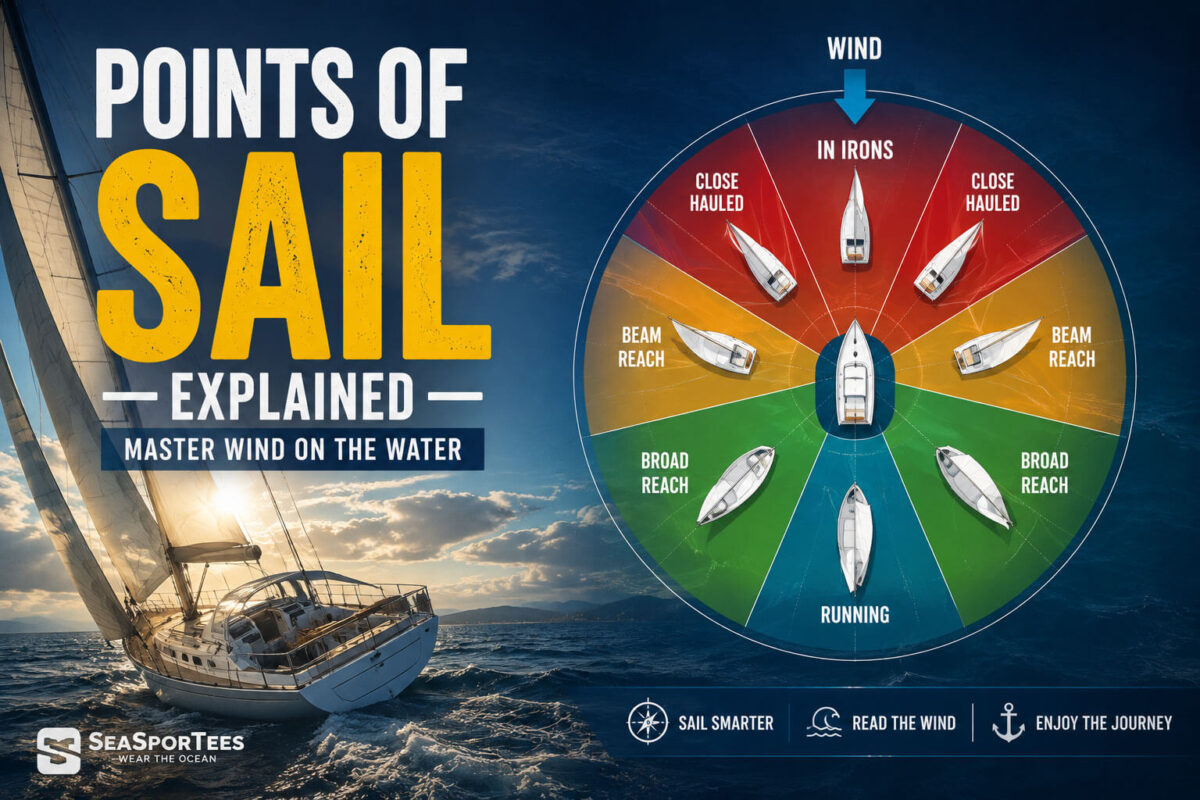
The points of sail divide the compass rose into named zones based on where the wind originates relative to the bow of your boat. Think of standing in the center of a clock face, with the wind always blowing from 12 o’clock. The zones to your left and right are sailing territory. The zone directly into the wind — from about 10 o’clock to 2 o’clock — is where sails cannot generate power, a region sailors call “in irons” or the no-go zone. Everything outside that cone is where sailing happens, each zone with its own sail trim, boat behavior, and tactical demands.
According to the US Sailing educational framework, mastery of points of sail is considered the prerequisite for every other sailing skill. Without it, concepts like tacking, gybing, sail trim, and right-of-way rules are impossible to apply consistently. The good news is that the system is elegant — learn it once, properly, and it becomes instinctive within a few hours on the water. This guide will take you through every point in detail, with the practical nuance that textbook diagrams rarely provide.
“Sailing is not about fighting the wind — it is about understanding it well enough to make it do exactly what you need. The points of sail are your map to that understanding.”
The Wind Clock: Reading Wind Direction Like an Experienced Sailor
Every sailor develops an internal sense of wind direction — an intuitive awareness that doesn’t require instruments but comes from learning to read a set of reliable physical signals. The wind clock is a mental model that helps you always know where the wind is coming from relative to your boat, which in turn tells you which point of sail you are on and what your options are.
How to Find the Wind Direction
The most reliable method for reading wind direction on the water is to head directly into the wind until your sails luff (flutter uselessly), then note your compass heading. That heading is your wind direction. Beyond this formal method, experienced sailors use a cascade of environmental cues: the feel of the breeze on their face and neck, the behavior of the telltales (lightweight yarn or ribbon tied to the sail or shrouds), ripples on the water surface called “catspaws,” flag direction on nearby vessels or docks, and the motion of smoke or sea birds. Each of these cues provides a cross-reference that makes your wind-reading increasingly accurate over time.
True Wind vs. What Your Body Feels
When your boat is stationary, the wind your body feels is the true wind — the actual movement of air across the water’s surface. The moment your boat starts moving, you generate your own breeze simply by moving through the air, just as you feel wind on a bicycle even on a calm day. The combination of true wind and your boat’s movement wind is called apparent wind, and it is always angled forward relative to the true wind when you are sailing across or toward the wind. This forward shift of apparent wind is why, when you speed up, it feels as though the wind has come ahead — and why faster boats like racing dinghies and modern foilers must sail significantly closer to the wind to account for the strong apparent wind they generate.
Using Telltales to Read the Sail’s Interaction with Wind
Telltales are the sailor’s most immediate feedback tool for understanding the relationship between your current point of sail and sail trim. When attached to both sides of a sail near the leading edge (luff), they should stream horizontally aft on both sides simultaneously when the sail is perfectly trimmed. If the windward telltale lifts, the sail is stalled from too much angle to the wind — ease the sheet or bear away. If the leeward telltale droops or curls under the sail, you are sailing too far from the wind or the sail is over-trimmed — harden up or pull in the sheet. Telltales turn abstract theory into real-time, visible feedback that makes learning points of sail dramatically faster.
All Points of Sail: A Complete Overview of Every Angle
The points of sail cover the full arc of sailing angles — from the edge of the no-go zone all the way around to sailing directly downwind. Each point has a name, a characteristic wind angle, a typical sail position, and a distinct performance profile. The table below gives you a comprehensive reference for all seven positions, from the upwind angles to the deep downwind runs, including their typical challenge level for beginners.
| Point of Sail | Wind Angle (approx.) | Sail Position | Speed Profile | Difficulty |
|---|---|---|---|---|
| In Irons (No-Go Zone) | 0°–45° off bow | Sails luff freely | No forward motion | Critical to avoid |
| Close-Hauled | ~45° off bow | Sails pulled hard in | Moderate, heeled | Intermediate |
| Close Reach | ~60°–70° off bow | Sails slightly eased | Fast and stable | Beginner-friendly |
| Beam Reach | ~90° off bow | Sails at 45° out | Fastest point | Ideal for beginners |
| Broad Reach | ~135° off bow | Sails well eased out | Fast, surfable | Comfortable |
| Training Run | ~150°–160° off bow | Sails nearly square | Moderate, gybe risk | Requires care |
| Running | 180° (dead downwind) | Sails fully squared out | Slower, unstable | Intermediate |
The beam reach is frequently described by sailing instructors as the “sweet spot” for new sailors — the boat is upright, responsive, and generating strong forward drive without the intense heel and precision of close-hauled sailing or the gybe risk of the downwind angles. The Royal Yachting Association recommends new students spend their first several sessions specifically practicing beam reach and close reach sailing before attempting close-hauled or running angles.
In Irons, Right of Way, and the Safety Rules Every Sailor Must Know
Understanding the points of sail isn’t purely about speed and performance — it is also the foundation of safety and rules-of-the-road compliance on the water. Many collision situations and near-misses at sea originate from one or both sailors not understanding which point of sail they are on, what that implies about their maneuverability, and who has right of way as a result. The international rules governing these situations — COLREGs, or the International Regulations for Preventing Collisions at Sea — are built directly on the concept of points of sail.
What “In Irons” Means and How to Escape
Being in irons means your bow is pointed directly into the wind and your boat has lost steerage. The sails are slatting uselessly, and without the ability to steer effectively, you are at the mercy of wind and current. Getting in irons is one of the most common mistakes new sailors make when attempting to tack. The escape maneuver involves pushing the boom to one side while simultaneously using the rudder to help the bow fall off the wind. Once the bow drops below about 45° to the wind, the sail fills and steerage returns. Practicing this recovery is essential for any sailor, as even experienced crews get caught in irons in light and shifty conditions.
Port vs. Starboard Tack and Right of Way
Your point of sail interacts directly with whether you are on port tack (wind coming over the left/port side of the boat) or starboard tack (wind from the right/starboard side). Under COLREGs Rule 12, when two sailing vessels meet, a boat on port tack must give way to a boat on starboard tack. When both boats are on the same tack, the windward boat — the one closer to the wind — must give way to the leeward boat. Understanding your tack at any given moment is therefore a safety-critical aspect of points of sail knowledge.
Key Safety Principles When Changing Points of Sail
- Always announce tacks and gybes: Call “ready about” before tacking and “gybe ho” before gybing so crew can prepare. These transitions involve the boom swinging across the boat and can cause serious head injuries without warning.
- Watch for accidental gybes on a run: When sailing at or near a running angle, a wind shift or steering error can cause the boom to swing violently across the boat without warning. This is the most dangerous accidental maneuver in sailing.
- Reduce sail in increasing winds: Bearing away to a broader point of sail reduces heel and power — but know when the right answer is to reef rather than simply ease sheets.
- Maintain a lookout at all points of sail: Downwind sailing in particular creates blind spots behind large sails. Post a forward lookout or use the window panels in your headsail.
- Know your boat’s limits on each point: Every boat has a point of sail where it becomes overpowered before others. Keelboats heel; dinghies capsize. Know yours before you push limits in strong breeze.
How to Tack, Gybe, and Move Between Points of Sail: A Step-by-Step Process
Knowing the names of the points of sail is one thing — being able to move between them smoothly and intentionally is the real skill. Tacking and gybing are the two fundamental maneuvers that allow you to change direction when the wind won’t let you sail a straight line to your destination. Here is the step-by-step process for executing both, starting from a close-hauled angle.
Check Your Surroundings and Announce the Maneuver
Before initiating any change between points of sail, scan a full 360° for other vessels, swimmers, obstacles, and shallow water. If you have crew, call “ready about” (for a tack) clearly and wait for an acknowledgment before proceeding. In racing situations, this check also includes planning your new tack’s layline and any competing boats.
Bear Away or Head Up to Your Target Point of Sail
Push the tiller toward the sail (or turn the wheel away from the sail) to head up toward the wind — this is how you initiate a tack. To bear away to a broader point of sail like a beam reach or broad reach, pull the tiller to weather or turn the wheel into the wind. Make these steering adjustments gradually; sudden inputs stall the boat and can send you into irons.
Pass Through the No-Go Zone During a Tack
As the bow swings through the eye of the wind, the sails will luff and the boat will slow. This is normal and expected. Maintain your steering input and keep the bow moving through the wind — this is where hesitation causes boats to stall in irons. Carry enough speed before the tack (especially in light winds) to power through the no-go zone without stopping.
Trim Sails for Your New Point of Sail
Once the bow is through the wind and the sails fill on the new tack, center your steering and trim the sails to match your new point of sail. If you have tacked onto a close-hauled angle, pull the sheets hard in. If you have borne away to a reach, ease the sheets until the telltales stream properly. The new point of sail dictates everything about how the sheets should be set.
Execute a Controlled Gybe When Changing to Downwind Points
When moving from a broad reach on one tack to a broad reach or running angle on the other, you must gybe — passing the stern through the wind rather than the bow. Call “gybe ho,” center the mainsail briefly by hauling in the main sheet, then let it swing to the new side in a controlled manner. Never let the boom freewheel through a gybe in any significant breeze — a controlled gybe is always faster and safer than an accidental one.
Confirm Your New Point of Sail with Telltales and Feel
After any maneuver, re-establish your wind awareness. Check your telltales, feel the breeze on your face, note your heel angle and boat speed. Compare them to what you expect for the point of sail you intend to be on. New sailors are often surprised to find they have not borne away as much as they intended — the compass, telltales, and feel together create a reliable confirmation system that you will develop rapidly with practice.
Essential Sail Trim Gear for Mastering Points of Sail
Every point of sail demands different things from your sails and your boat’s controls. The right gear not only makes sailing safer and more efficient — it makes the feedback loop between wind, sail, and sailor tangible enough to accelerate your learning dramatically. Here are the six essential tools and instruments every sailor should understand when working with points of sail.
Lightweight yarn or ribbon attached to the sail’s luff and shrouds. The most immediate feedback tool for sail trim at any point of sail. Watch both windward and leeward telltales simultaneously.
Essential for tracking wind shifts on longer passages. When your compass heading changes without you changing course, the wind has shifted — this directly changes your effective point of sail. Explore the history of the sailor’s compass.
A rotating arrow mounted at the top of the mast that shows apparent wind direction. Visible from the cockpit at all times, it provides a constant reference for which point of sail you are on relative to the wind.
The mainsheet controls how far the boom swings out — the primary adjustment for moving between close-hauled and reaching angles. The traveler allows fine-tuning of boom angle without changing sail tension, critical for close-hauled sailing.
The headsail’s trim controls work in tandem with your point of sail — close-hauled requires the jib car forward and sheets pulled hard; reaching moves the car aft and eases the sheet to open the leech and reduce twist.
A paddlewheel or ultrasonic sensor that measures speed through water. Each boat has a target speed for each point of sail called “VMG” (velocity made good). Knowing your target speeds tells you instantly whether your trim is correct for your current sailing angle.
Best Waters to Practice Every Point of Sail
Not all sailing environments are equally suited to learning the points of sail. Ideal practice grounds offer consistent, moderate wind, manageable sea state, and enough open water to complete multiple tacks and gybes without obstacles. These six locations around the world — and the types of water they represent — offer outstanding conditions for building solid points-of-sail instincts.
- San Francisco Bay, California, USA: Legendary for its consistent afternoon thermal winds of 15–25 knots, the Bay delivers a world-class classroom for every point of sail. The combination of strong pressure and flat-to-moderate chop means you’ll encounter real VMG challenges on every upwind beat. The Golden Gate and Alcatraz provide unmistakable landmarks for orienting your apparent wind angles on long tacking duels.
- The Solent, Hampshire, UK: One of the most tactically complex sailing venues on Earth, the Solent offers tidal currents, frequent wind shifts, and heavy commercial traffic that forces sailors to develop sharp situational awareness about their point of sail and right-of-way position. The RYA offers a full range of on-water training courses here. The sheltered western Solent is particularly ideal for beginners learning beam-reach sailing.
- Lake Garda, Italy: Thermal winds on Lake Garda are famously reliable — the Pelér blows from the north in the morning, the Ora from the south in the afternoon, creating a daily cycle that allows sailors to practice both upwind close-hauled sailing and downwind running in the same session. The dramatic mountain backdrop also provides fixed wind-direction references that help learners internalize apparent wind shifts.
- Chesapeake Bay, Maryland/Virginia, USA: America’s largest estuary offers hundreds of miles of protected sailing water with enormous variety. Summer sea breezes build steadily to 10–15 knots, ideal for comfortable beam-reach practice. The Bay’s geography also creates natural wind shadows and acceleration zones that teach sailors how geography modifies wind — a real-world extension of points-of-sail theory.
- The Whitsundays, Queensland, Australia: The southeast Trade Winds that blow through the Whitsundays are among the most consistent sailing breezes in the Southern Hemisphere, averaging 15–20 knots from a predictable direction between May and October. The island-studded geography creates natural downwind corridors perfect for practicing broad reach and running angles in warm, clear water.
- Aegean Sea, Greece: The Meltemi wind — a strong, dry northerly that blows reliably from July through September — provides excellent conditions for experienced sailors ready to practice close-hauled performance sailing in genuine ocean conditions. The Cyclades island group provides natural waypoints for practicing tacking strategy on long upwind legs, with numerous protected anchorages for overnight stops between practice days.
Apparent vs. True Wind: Two Completely Different Sailing Realities
The distinction between apparent and true wind is the single concept that separates beginning sailors who understand points of sail theoretically from intermediate sailors who can apply them reliably on the water. Grasping this difference explains a host of phenomena that otherwise seem contradictory — why the wind seems to come ahead when you speed up, why you feel less wind when running downwind than you expect, and why high-performance boats sail at angles that seem physically impossible.
True wind is the actual movement of air across the earth’s surface — what you would measure with a stationary weather station or feel standing still on a dock. It has a fixed direction and speed that is independent of your boat’s movement. True wind is the reference point for weather forecasting, tide planning, and strategic sailing decisions. On a GPS chartplotter or a fixed weather station, true wind data is what’s displayed. When your boat is at rest — anchored or hove-to — the wind you feel on your face is the true wind.
Apparent wind is the wind your moving boat actually experiences — the combination of the true wind and the wind generated by your boat’s own forward motion. It is always angled further forward than the true wind when sailing across or into the wind (because your boat’s motion vector adds to the wind from ahead). This is why your masthead fly and telltales always show apparent wind, not true wind. Racing sailors optimize their sail trim entirely to apparent wind, which is why high-performance boats often look like they are sailing closer to the wind than physics should theoretically allow.
The practical implication of apparent wind for points of sail is significant. If you are sailing a beam reach in 12 knots of true wind and your boat is doing 6 knots, your apparent wind will be roughly 14 knots and angled about 25° forward of your true beam-reach angle. This means that to keep your sails correctly trimmed and telltales streaming, you need to sheet in slightly more than you would if the boat were stationary. As boat speed increases further — particularly on high-performance boats in a breeze — the apparent wind angle becomes so far forward that sailors must effectively sail a close reach even when their true-wind angle is a broad reach. This phenomenon is the entire basis of foiling boats’ extraordinary performance, since foil-born speed creates such strong apparent wind that they can sail upwind faster than the true wind is actually blowing.
Right of Way, Ocean Ethics, and Advanced Points of Sail Considerations
Sailing is conducted on a shared commons — the ocean, bays, and waterways that every water user has a stake in protecting and navigating responsibly. Understanding the points of sail is not only a performance skill but an ethical and legal one. The international rules of the road, environmental responsibilities, and the culture of sailing all connect back to how well you understand your position relative to the wind.
COLREGs and the Points of Sail Right-of-Way Hierarchy
The International Regulations for Preventing Collisions at Sea (COLREGs) establish a clear hierarchy of right-of-way rules that directly depend on your point of sail and tack. Rule 12 states that when two sailing vessels are approaching each other, the vessel on port tack gives way to the vessel on starboard tack. When both are on the same tack, the windward vessel gives way to the leeward vessel. A vessel bearing away — moving to a broader point of sail — is considered less maneuverable than one heading up, creating an additional layer of situational courtesy even beyond the legal rules. Knowing these rules matters enormously because ignorance of them is not a legal defense in any maritime jurisdiction.
Environmental Responsibility at Every Point of Sail
Each point of sail brings different proximity to sensitive marine environments. Close-hauled sailing often takes boats through narrow channels where anchoring restrictions and seagrass protection zones apply. Running and broad reaching in shallow anchorages requires careful depth awareness. Responsible sailors check charts before approaching new anchorages, use designated mooring balls instead of anchoring in coral zones, and maintain minimum wake speeds near shore regardless of what point of sail they are on.
- Avoid anchoring in seagrass meadows: Even a single anchoring event can destroy decades of seagrass growth, which is a critical nursery habitat for commercially important fish species.
- Respect marine protected areas: Many of the world’s finest sailing destinations — the Whitsundays, the BVI, the Greek islands — sit within or adjacent to MPAs where speed limits, anchoring restrictions, and no-go zones apply regardless of your point of sail.
- Manage your waste at every point: COLREGs prohibit discharge of garbage, plastics, and sewage within defined distances from shore. Know your holding tank capacity before heading offshore on a downwind run far from pump-out facilities.
- Wildlife awareness on downwind runs: When running with the wind, boats are quiet and fast — a combination that means whales and dolphins may not hear your approach. Maintain a watch and alter course well before approaching any marine mammal, always passing astern rather than ahead.
- Educate other water users: Powerboats, paddlers, and swimmers often don’t understand right-of-way rules or why a sailing vessel cannot instantly change course. Courteous early action — rather than demanding your right of way at the last moment — prevents accidents and builds goodwill on the water.
Advanced sailors understand that the points of sail are not just a technical system but a framework for making good decisions in a shared, fragile environment. The more precisely you understand your boat’s angle to the wind, the more confidently you can give way early, choose a responsible anchorage approach, and navigate sensitively through areas where marine life and other water users depend on sailors making thoughtful choices. The ocean rewards those who treat it with respect — and punishes those who don’t.
Frequently Asked Questions About Points of Sail
The seven points of sail, moving from directly into the wind to directly downwind, are: In Irons (the no-go zone), Close-Hauled, Close Reach, Beam Reach, Broad Reach, Training Run, and Running. Each represents a named angular zone relative to the direction the wind is coming from, and each demands different sail trim and boat handling technique. Mastering all seven in sequence gives a sailor complete control over where and how fast the boat can travel in any wind direction.
Sails generate power through aerodynamic lift — the same principle that makes aircraft wings work. For lift to be generated, air must flow smoothly and continuously over both sides of the curved sail. When the sail is pointed directly into the wind, airflow collapses and the sail simply flaps uselessly (luffs) without generating lift in any direction. This “stall” condition begins at approximately 45° off the wind and gets progressively worse as you point closer to dead upwind. The only way to reach a destination directly upwind is to tack — zigzagging at close-hauled angles on alternating tacks until you reach your waypoint.
For most monohull sailing boats, the beam reach — sailing with the wind directly at 90° to the boat — is the fastest point of sail. This is because the apparent wind is strong and well-angled, the sails generate maximum lift, and the boat is not fighting directly against the wind’s resistance. However, for high-performance multihulls and foiling boats, the fastest angles are often broad reaches where they can generate enormous apparent wind by sailing at speeds that far exceed the true wind speed. Modern foiling America’s Cup boats, for example, regularly reach speeds of three to four times the true wind speed on a broad reach.
Both tacking and gybing are maneuvers that change the tack of the boat — moving from having the wind on one side to having it on the other — but they achieve this by rotating the boat in opposite directions through the compass. Tacking turns the bow through the wind (heading up and through the no-go zone), and is used when sailing on upwind points of sail like close-hauled or close reach. Gybing turns the stern through the wind, and is used when sailing on downwind points like broad reach or running. Gybing is considered the more dangerous maneuver because the boom swings with significant force and speed — it demands more preparation, crew communication, and control than tacking.
You can reliably determine your point of sail using a combination of body-feel, telltales, and simple observation. First, feel where the wind is striking your face — if it’s hitting your cheeks equally on both sides, you’re close to beam reach. If it’s only on one cheek and slightly from behind, you’re on a reach or run. Second, watch your telltales: if both windward and leeward telltales stream cleanly aft, your trim is correct for your current point of sail. Third, note your heel angle — close-hauled sailing produces the most heel, while running produces almost none. Combining these three observations gives you a reliable, instrument-free point-of-sail assessment within seconds.
The true wind speed does not change based on your point of sail, but the apparent wind you experience absolutely does. When sailing close-hauled into the wind, your forward motion adds to the true wind, making the apparent wind feel stronger than the actual breeze. When running downwind, your boat’s forward speed partially cancels out the true wind — so a 20-knot breeze can feel like only 10 or 12 knots apparent when you are running directly before it, which is why experienced sailors never underestimate conditions on a downwind run. This deceptive reduction in felt wind is one reason accidental gybes in a downwind breeze catch so many sailors off guard — the boat can be carrying far more wind power than the crew perceives.
