


🤿 Scuba & Free Diving
The Rise Of Free Diving Culture
Jul
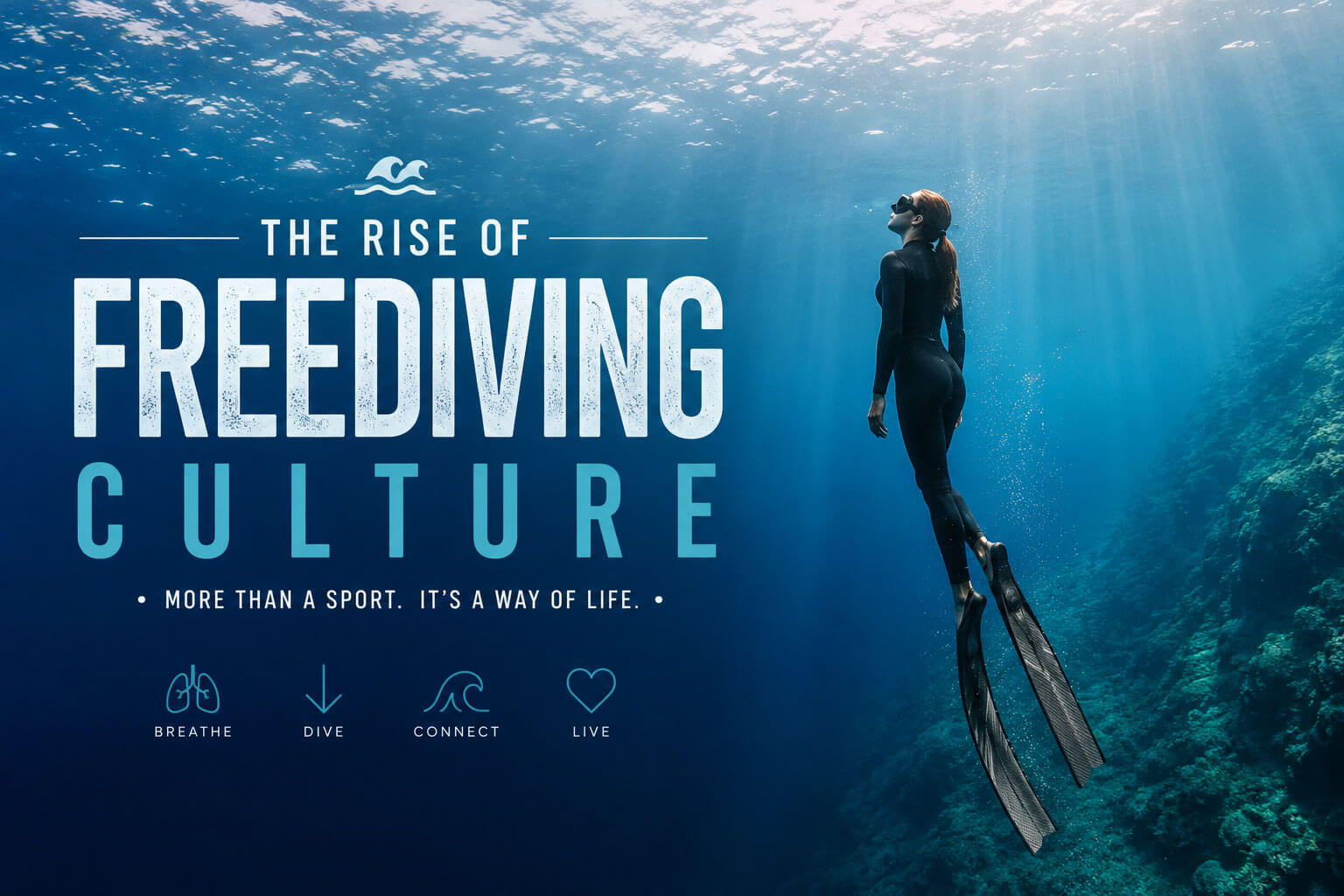
The Rise of Free Diving Culture: 7 Powerful Reasons the World Is Going Breathless
Free diving culture has exploded from a niche pursuit into a global movement — blending mindfulness, athleticism, and a profound connection to the ocean that scuba tanks simply cannot replicate.
What Is Free Diving Culture — and Why Is It Exploding?
Free diving culture is far more than a sport. It is a philosophy — a way of moving through the ocean using only the air in your lungs, the stillness of your mind, and the strength of your body. Unlike scuba diving, which relies on mechanical equipment to extend bottom time, freediving strips the experience down to its most elemental form: a single breath, held in complete silence beneath the waves.
The cultural momentum behind freediving has never been stronger. Social media platforms, particularly Instagram and YouTube, have turned underwater breath-hold athletes into global icons. Figures like Guillaume Néry, Alexey Molchanov, and Hanli Prinsloo have built audiences of millions, inspiring everyday swimmers to explore their breath-hold potential. Freediving is no longer a fringe activity practiced by competitive pearl divers — it is a full lifestyle movement embraced by yogis, photographers, marine conservationists, and adventure athletes alike.
At its core, free diving culture is rooted in the concept of the mammalian dive reflex — a physiological response hardwired into every human body. When you submerge your face in cold water, your heart rate slows, blood shifts to protect vital organs, and your spleen contracts to release oxygen-rich red blood cells. Humans are, in a very literal biological sense, built to dive. Freediving culture has simply awakened this ancient capability in the modern world.
“Freediving is not about holding your breath. It is about releasing everything else — the noise, the weight, the worry — and remembering that the ocean was always home.”
The appeal of free diving culture also intersects powerfully with the wellness movement. Diaphragmatic breathing exercises, meditation, and body awareness — all central to freediving training — translate directly into reduced anxiety, improved focus, and deeper parasympathetic nervous system activation. Training platforms like AIDA International and SSI Freediving report double-digit percentage growth in course enrollments year-over-year since 2020, a trend that shows no signs of slowing. For ocean lovers, freediving offers something no other water sport can: total immersion, total presence, and total silence.
The History & Cultural Evolution of Free Diving
Ancient Roots: Breath-Hold Diving Across Civilizations
Humans have been freediving for at least 7,000 years. Archaeological evidence from coastal cultures in Scandinavia, the Persian Gulf, and Southeast Asia confirms that breath-hold diving was fundamental to survival — harvesting shellfish, sponges, coral, and pearls. The Ama divers of Japan and Korea, predominantly women, built entire village economies around freediving, diving daily to depths of 20 to 30 meters in waters that would terrify most modern swimmers. Their tradition survives today, recognized by UNESCO as an Intangible Cultural Heritage.
In the Mediterranean, Greek sponge divers from the island of Kalymnos were known to reach depths exceeding 30 meters without any equipment — just a flat stone tied to a rope to speed their descent. Their extraordinary physiological adaptations, honed over generations, provided early scientists with critical insights into the human body’s response to depth and pressure.
The Competitive Era: From Enzo Maiorca to Modern Champions
Competitive freediving as a recognized sport began in the 1940s and 1950s, when Italian Raimondo Bucher made the first officially recorded deep freedive, reaching 30 meters in 1949 for a bet. The legendary rivalry between Enzo Maiorca of Italy and Jacques Mayol of France — immortalized in Luc Besson’s 1988 film The Big Blue — brought freediving to mainstream attention and sparked an entirely new generation of breath-hold enthusiasts across Europe. Mayol’s record of 105 meters in 1983 seemed superhuman at the time; today it would barely qualify for competitive intermediate level.
The formation of AIDA International (Association Internationale pour le Développement de l’Apnée) in 1992 standardized freediving competition, establishing the disciplines, safety protocols, and certification pathways that define modern competitive freediving. Today, AIDA sanctions World Championships and maintains the official world records that continue to be broken with remarkable frequency.
The Social Media Era: Free Diving Culture Goes Global
The smartphone and social media revolution transformed free diving culture from an elite athletic pursuit into a widely accessible identity. Stunning underwater photography and slow-motion freediving videos created a visual language that resonated far beyond the diving community. Platforms like Instagram gave birth to a new archetype — the “ocean human” — someone for whom freediving was as much about personal philosophy and aesthetic as it was about performance. The hashtag #freediving has accumulated over 8 million posts on Instagram alone, making it one of the most visually compelling niches in outdoor sports content.
Cultural milestone: Jacques Mayol’s philosophy of “homme dauphin” (dolphin man) — the idea that humans can psychologically and physically return to their aquatic origins — remains the ideological backbone of modern free diving culture, influencing everything from training methodology to the spiritual dimension of the sport.
Free Diving Disciplines: A Complete Comparison of Types
Free diving culture encompasses a wide spectrum of disciplines, each demanding different physiological strengths, mental skills, and equipment. Whether you are a beginner exploring pool apnea or an advanced diver chasing world records in the open ocean, understanding the range of freediving disciplines is essential to finding your place within the culture.
| Discipline | Environment | Key Skill | World Record | Level |
|---|---|---|---|---|
| Static Apnea (STA) | Pool / Surface | Breath-hold duration at rest | 24 min 37 sec (Budimir Šobat) | Beginner Friendly |
| Dynamic Apnea (DYN) | Pool / Horizontal | Horizontal distance on one breath | 300 m (Mateusz Malina) | Intermediate |
| Constant Weight (CWT) | Open Water / Vertical | Depth on single breath, fins only | 131 m (Alexey Molchanov) | Advanced |
| Free Immersion (FIM) | Open Water / Rope | Depth pulling rope — no fins | 125 m (Alexey Molchanov) | Advanced |
| No Limits (NLT) | Open Water / Sled | Maximum depth via weighted sled | 214 m (Herbert Nitsch) | Elite Only |
For the vast majority of freedivers who engage with the sport recreationally, Constant Weight Bi-Fins (CWTB) and Dynamic Apnea with Bifins (DYNB) are the most commonly practiced disciplines. To understand how free diving culture compares to the broader world of underwater sports, our guide on Scuba Diving vs Freediving provides an in-depth side-by-side breakdown.
Pro Tip: Most freediving instructors recommend starting with Static Apnea before attempting open water depth training. Building a relaxed, efficient static breath-hold of 2+ minutes in the pool is considered the foundational milestone before progressing to deeper disciplines.
Free Diving Safety: The Rules That Keep the Culture Alive
Free diving culture is extraordinary, but it is not without risk. Shallow water blackout — a sudden loss of consciousness caused by hypoxia — is the leading cause of freediving fatalities, and it can occur without warning even in experienced divers. AIDA International estimates that the majority of freediving accidents involve solo diving or inadequate supervision. Respect for safety protocols is not optional in free diving culture — it is the ethical foundation every diver owes to themselves and their community.
The Cardinal Rule: Never Dive Alone
No freediver, regardless of experience or skill level, should ever train without a qualified buddy or safety diver present. During static apnea, the buddy watches for early signs of hypoxia — facial twitching, lip changes, involuntary movements. In open water depth sessions, a trained safety diver should be positioned at 10 to 15 meters — the “rescue zone” where most blackouts occur on the ascent. AIDA International’s safety guidelines mandate buddy protocols for all sanctioned training and competition.
Understanding Pressure Equalization
One of the most common injuries in freediving is a middle ear or sinus squeeze, caused by failure to equalize pressure as depth increases. The Frenzel technique — using the tongue and throat as a pump rather than the Valsalva method common in scuba — is the standard equalization method for freedivers and should be mastered in a pool before any open water depth training begins. Persistent equalization difficulty should be evaluated by a dive medicine physician before continuing depth progression.
- Never hyperventilate before a dive: Hyperventilating does not increase oxygen but dangerously reduces CO₂, eliminating the urge to breathe and dramatically increasing blackout risk.
- Always dive with a trained buddy: A qualified safety diver positioned at the right depth can mean the difference between rescue and fatality in a blackout scenario.
- Use progressive depth training: Never attempt a personal depth record without proper warm-up dives and never increase depth more than 5–10 meters beyond your consistent training maximum.
- Respect surface recovery time: The “one-to-two rule” mandates a minimum rest period at the surface equal to at least twice the duration of your dive.
- Know your limits in thermoclines: Cold water at depth can significantly accelerate oxygen consumption — always factor water temperature into your depth planning.
- Complete a certified freediving course: Organizations like AIDA, SSI, and PADI Freediver provide structured safety education that no YouTube tutorial can replace.
Important: The Divers Alert Network (DAN) strongly recommends that all freedivers maintain a current CPR and first aid certification, and that all open water training sessions include an observer on the surface who can activate emergency services if needed.
How to Start Freediving: A Step-by-Step Path Into the Culture
Entering free diving culture is both simpler and more structured than most beginners expect. The path from curious swimmer to confident open water freediver typically unfolds over several months of deliberate practice, and the rewards at each stage are genuinely profound. Here is the most effective step-by-step process for building a safe, sustainable freediving practice.
Master Diaphragmatic Breathing & Relaxation Techniques
Before you even think about underwater time, spend two to four weeks developing conscious breath control on land. Practice “belly breathing” — inhaling to expand the abdomen before the chest — for 10 minutes daily. Incorporate yoga pranayama techniques such as box breathing and alternate nostril breathing. A calm, efficient breath cycle is the non-negotiable foundation of every freediving skill that follows, and divers who skip this step consistently plateau or panic underwater.
Complete a Certified Freediving Course (Level 1 / AIDA2)
Enroll in a beginner freediving course through a recognized certification agency — AIDA, SSI Freediver, or PADI Freediver are the most widely recognized globally. A Level 1 course typically covers physiology, the mammalian dive reflex, equalization, static apnea to 2 minutes, and open water dives to 16–20 meters. Instruction from a qualified freediving instructor is irreplaceable for building safe habits from the very beginning. Most courses run two to three days and include both pool and open water sessions.
Build Your Static Apnea Base in the Pool
After certification, dedicate regular weekly sessions to static apnea practice in a supervised pool environment. Work with a certified buddy and aim to progressively extend your breath-hold from the 2-minute mark toward 3 to 4 minutes over several months. CO₂ tolerance tables — structured breath-hold exercises with shortening recovery periods — are the most effective training methodology at this stage. Do not rush this phase: a solid pool foundation makes open water depth training exponentially safer and more enjoyable.
Develop Open Water Equalization & Finning Technique
Transition to open water with the explicit goal of mastering equalization and streamlined finning technique rather than chasing depth. Practice Frenzel equalization starting from 2 to 5 meters, adding depth incrementally only when equalization is effortless and automatic. Work on your “duck dive” — the surface technique used to initiate descent — and practice long, slow monofin or bifin kicks that generate propulsion with minimal oxygen expenditure. Video feedback from a buddy or underwater camera is enormously useful at this stage.
Join a Freediving Community & Progress to Level 2
Free diving culture is fundamentally communal. Seek out a local or regional freediving club, join online communities, and — when your static apnea and equalization are consistently solid — pursue your Level 2 / AIDA3 certification, which covers depths to 30 meters and advanced safety protocols. Freediving with experienced, safety-conscious divers accelerates your learning dramatically and embeds you authentically in the culture. This is also the stage where many freedivers discover their niche — whether that is competitive depth, underwater photography, or spearfishing.
Essential Freediving Gear: What Every Diver Actually Needs
One of the most appealing aspects of free diving culture is its minimal equipment philosophy. Unlike scuba diving — which requires tanks, regulators, BCDs, and computers — freediving demands surprisingly little gear to get started. What it does demand is that every piece of equipment is properly chosen for the discipline. Here is a complete breakdown of the six core pieces of freediving equipment every diver should own.
Pro Tip: Never purchase a freediving mask with a large internal volume designed for scuba divers. The extra air space requires significantly more mask equalization effort at depth and can cause severe mask squeeze — a painful, potentially vision-damaging injury. Always look for masks specifically labeled “freediving” or “low-volume” on the packaging.
The World’s Best Free Diving Destinations for Every Level
Free diving culture is truly global, and the world’s oceans offer an extraordinary range of environments — from crystal-clear tropical blue holes to dramatic kelp forests and shipwrecks. Whether you are a beginner seeking warm, calm water or an experienced diver hunting world-class depth, these destinations define the freediving bucket list.
- Dean’s Blue Hole, Long Island, Bahamas: At 202 meters deep and just steps from a white sand beach, Dean’s Blue Hole is arguably the most iconic freediving location on Earth. Its exceptional clarity, negligible current, and natural circular opening create near-perfect conditions year-round. It has hosted the Vertical Blue Competition — one of the sport’s premier events — multiple times and continues to attract elite athletes and passionate beginners. Water temperature hovers between 24–28°C, making exposure protection relatively minimal.
- Dahab, Egypt (Red Sea): Dahab is the undisputed capital of free diving culture in the Middle East and Europe. The famous Blue Hole dive site — a 100-meter-deep reef formation accessible from a beach café — has an almost mythological status in the community. Dahab hosts dozens of freediving schools and instructors year-round, and the town’s laid-back atmosphere, warm water, and extraordinary visibility have made it a magnet for long-term freediving pilgrims seeking immersive training environments.
- Sardinia & Corsica, Mediterranean: These Mediterranean islands have produced some of freediving’s greatest champions and continue to draw serious divers with diverse underwater topography, abundant marine life, and a strong local freediving culture rooted in centuries of artisanal fishing. The Sardinian coast features dramatic underwater cliffs, sea caves, and posidonia seagrass meadows that create spectacular environments for training and underwater photography.
- Tulamben, Bali, Indonesia: The waters around Tulamben — home to the USAT Liberty shipwreck — offer freedivers a genuinely transcendent experience. The wreck begins at just 5 meters and descends to 30 meters, making it accessible to intermediate freedivers with the right training. Bali’s broader freediving community, centered around Amed and Sanur, is growing rapidly with warm water, remarkable visibility, and extraordinary marine biodiversity.
- Tenerife, Canary Islands, Spain: Tenerife has established itself as Europe’s premier freediving training hub, combining year-round warm Atlantic water (averaging 21–24°C) with extraordinary depth available just offshore. The island hosts multiple freediving schools and regularly welcomes national teams for winter training camps, making it an ideal destination for serious depth progression.
- Koh Tao, Thailand: Koh Tao has developed a thriving free diving culture that attracts thousands of breath-hold divers annually. The island’s calm, warm Gulf of Thailand waters, combined with a dense concentration of professional freediving instructors and schools, make it the most accessible entry point for travelers wishing to combine a beach holiday with serious freediving education. Several dedicated freediving schools operate year-round, offering everything from beginner courses to competitive coaching.
Top Recommendation: If you can only choose one destination, Dahab, Egypt offers the most complete immersion in free diving culture anywhere in the world — combining affordable professional instruction, legendary dive sites, a tight-knit international freediving community, and a relaxed lifestyle that supports the mental and physical training the sport demands. Many freedivers who visit Dahab for a week end up staying for months.
Freediving Culture vs. Scuba Culture: Two Different Philosophies
Both freediving and scuba diving offer profound access to the underwater world, but they represent genuinely different philosophies, skill sets, and communities. Understanding the contrast helps ocean lovers identify which culture resonates more deeply with who they are and what they seek from the sea.
The tension between freediving and scuba culture is largely friendly rather than competitive — most serious ocean lovers respect both disciplines deeply. Many freedivers speak of a qualitative difference in their underwater experience that is immediately felt: the absence of bubbles, the silence, the way marine animals behave differently around a freediver who moves with grace and stillness. For a detailed technical and experiential comparison of both disciplines, explore our comprehensive article on Scuba Diving vs Freediving.
Free Diving Ethics, Conservation & Ocean Responsibility
The rise of free diving culture has brought millions of new practitioners into intimate contact with marine ecosystems. This proximity comes with profound ethical responsibilities that the most respected voices in the freediving community take seriously. As ocean lovers who enter the water as guests of marine life, freedivers have a unique opportunity and obligation to model the highest standards of ocean stewardship.
Marine Life Interaction: Where the Line Must Be Drawn
The viral nature of underwater content has created troubling incentives for irresponsible marine life interaction. Freedivers riding whale sharks, touching coral, chasing sea turtles, or interfering with marine mammal behavior for social media content represent a damaging fringe of the culture that the community actively works to correct. The established ethical standard — reinforced by organizations like Ocean Conservancy — is strict non-interference: observe without approaching closer than 3 meters, never block an animal’s path, and never touch marine life for any reason.
Practical Conservation Commitments Every Freediver Should Make
Responsible free diving culture promotes the following specific conservation commitments that every practitioner should adopt from day one:
- Reef-safe sunscreen only: Oxybenzone and octinoxate — chemicals found in most conventional sunscreens — are severely toxic to coral larvae. Every freediver who dives near coral should use mineral-based (zinc oxide or titanium dioxide) sunscreen or a full UV-protective wetsuit.
- Buoyancy discipline: Poor buoyancy control is the leading cause of accidental coral contact. Freedivers should practice precise neutral buoyancy at all depth ranges before diving in sensitive reef environments.
- Ocean cleanup participation: Many freediving clubs worldwide organize regular underwater cleanup dives, removing ghost fishing gear, single-use plastics, and debris from dive sites. Participating is one of the most direct ways to give back to the ecosystems that make freediving possible.
- Spearfishing ethics: Freedivers who spearfish bear additional obligations — targeting only invasive species like lionfish in non-native ranges, respecting size and bag limits, and never spearfishing in marine protected areas.
- Leave-no-trace principles: All freediving equipment, packaging, and any marine life documented for photography should be handled with the greatest care and the smallest possible ecological footprint.
Key Statistic: According to IUCN research, over 14 million tonnes of plastic enter the world’s oceans annually. Free diving culture, with its close physical relationship to the underwater world, positions freedivers as uniquely effective ocean ambassadors — capable of documenting and helping remediate plastic pollution in ways land-based observers cannot. If you want to carry your ocean values beyond the water, discover how ocean lovers express their lifestyle identity through marine graphic tees.
Free diving culture is at its most powerful when it functions as a bridge between human experience and ocean awareness. Every diver who surfaces with a deeper appreciation for the marine world — who speaks about what they saw, who advocates for ocean protection, who inspires a friend to take their first freediving course — is contributing to a cultural force that the ocean genuinely needs. Learn about the 15 ocean animals every sea lover should know to deepen your underwater encounters with real ecological knowledge.
Frequently Asked Questions About Free Diving Culture
