


Jun
🦈 Shark Diving Guide
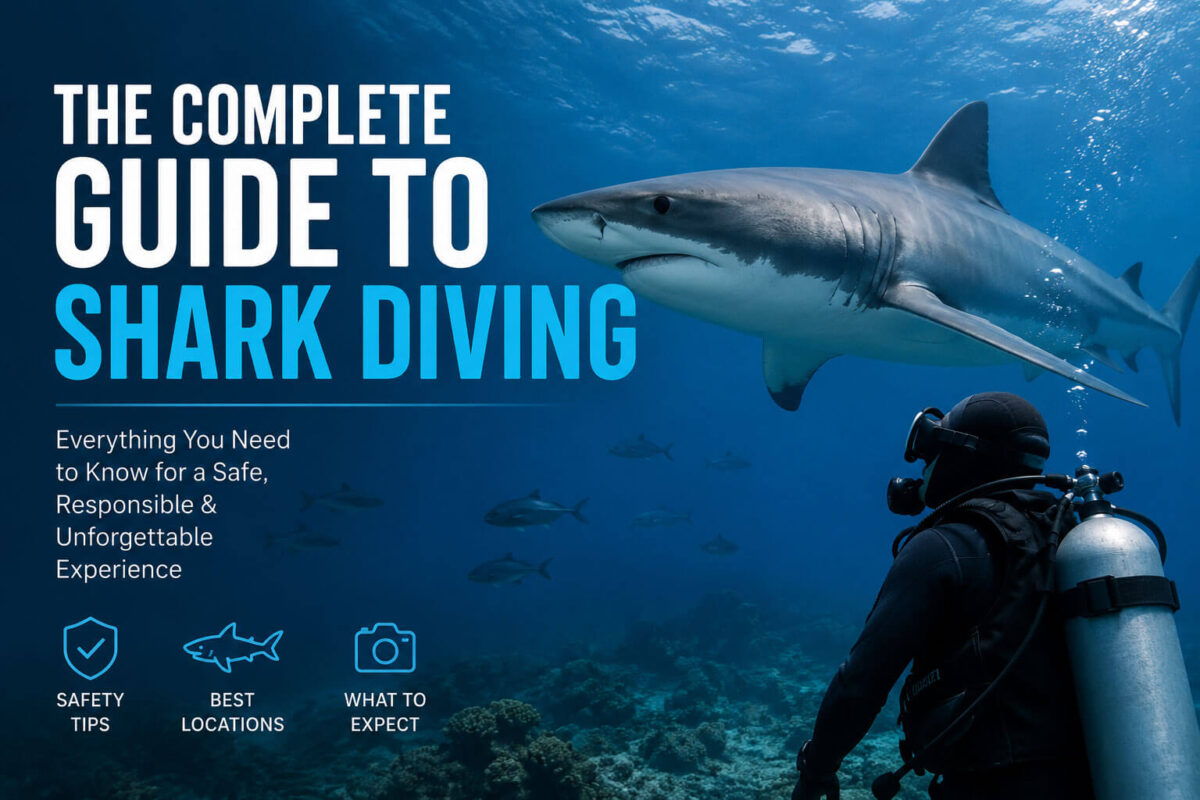
The Complete Guide to Shark Diving
From cage diving with great whites to drifting open ocean with oceanic whitetips — the definitive guide to diving with sharks safely, responsibly, and unforgettably.
Why dive with sharks?
There is a moment — brief, electric, and completely transformative — when a shark materialises out of the blue. Not the frenzied Hollywood predator, but something far more extraordinary: a creature of absolute hydrodynamic perfection, moving through water with an ease that makes every other animal look clumsy by comparison. That moment is why people travel to the ends of the Earth to dive with sharks.
Shark diving is one of the fastest-growing segments of adventure travel for good reason. It combines the raw thrill of encountering a powerful apex predator with the meditative calm of the deep ocean, set against some of the most spectacular marine environments on the planet. Divers who have completed a shark dive consistently describe it as one of the most profound wildlife experiences of their lives — a genuine recalibration of how they think about the ocean and its inhabitants.
“Sharks are beautiful animals, and if you’re lucky enough to see lots of them, that means that you’re in a healthy ocean.” — Sylvia Earle, Marine Biologist
Beyond the personal thrill, shark diving carries real ecological significance. Shark diving tourism generates over $314 million USD annually worldwide, providing a powerful economic argument for shark conservation at a time when a third of all shark species face extinction. When local communities profit from living sharks rather than dead ones, protection follows. Every diver who enters the water with these animals becomes, in a very direct sense, part of the solution.
You do not need to be an advanced diver to experience sharks. Cage diving requires no scuba certification at all. Reef shark encounters suit Open Water-certified divers. Truly advanced experiences — blue water open ocean dives, deep wall encounters — require more experience and preparation. There is a level of shark diving for almost everyone, and this guide covers all of them.
Key shark species to dive with
With over 500 known species, sharks occupy every corner of the ocean from shallow coral lagoons to abyssal trenches. For divers, a handful of species define the shark diving experience — each offering a fundamentally different encounter and requiring a different approach.
Great White Shark (Carcharodon carcharias)
The apex of the shark diving wish list. Great whites are typically encountered from the safety of a surface or submerged cage — most commonly off Guadalupe Island in Mexico, the Neptune Islands in Australia, and Gansbaai in South Africa. These encounters produce a visceral, unforgettable experience. Up close, great whites are simultaneously terrifying and astonishingly graceful — their sheer size (often 4–5 metres), dark eyes, and effortless movement leaving an impression that lasts a lifetime.
Bull Shark (Carcharhinus leucas)
Arguably the most thrilling open-water shark encounter available to recreational divers. Fiji’s Beqa Lagoon and Playa del Carmen in Mexico are world-famous for guided, cageless bull shark dives conducted by experienced operators. Bull sharks are stocky, powerful, and intensely curious — their proximity during these dives can be genuinely breathtaking. Encounters are carefully managed by divemasters with years of experience reading individual animals.
Tiger Shark (Galeocerdo cuvier)
Tiger sharks are the great inquisitors of the shark world — slow-moving, deliberate, and utterly unfazed by divers. The Bahamas, particularly Tiger Beach on Grand Bahama Island, offers perhaps the world’s finest tiger shark diving. Encounters often involve multiple large animals circling at close range in shallow, clear water — a scene of surreal and majestic calm that stays with you permanently.
Whale Shark (Rhincodon typus)
The world’s largest fish is a shark — and a profoundly gentle one. Whale shark encounters involve swimming and diving alongside filter-feeding giants that can exceed 12 metres in length. The experience at sites like the Maldives, Ningaloo Reef in Australia, Donsol Bay in the Philippines, and Holbox in Mexico is less about adrenaline and more about awe — a slow, dreamlike immersion into the true scale of the ocean.
Reef Sharks — Whitetip, Blacktip & Caribbean
For most divers, reef sharks will be their first shark encounter — and they are not to be underestimated as an experience. Schools of whitetip reef sharks resting on the seafloor at Cocos Island, blacktips cruising the outer reef edge in the Maldives, or Caribbean reef sharks patrolling the walls of the Bahamas — these encounters are abundant, accessible, and genuinely thrilling. Reef shark dives require only Open Water certification and are available at hundreds of sites globally.
Types of shark diving explained
Shark diving is not a single activity — it encompasses a wide spectrum of encounters, from cage-protected surface dives to remote blue water expeditions in the open ocean. Understanding the key formats helps you choose the right experience for your skill level, risk tolerance, and the species you most want to encounter.
| Type | Primary Species | Cert Required | Typical Depth | Level |
|---|---|---|---|---|
| Surface Cage Diving | Great White Shark | None required | 0–5m | All levels |
| Submerged Cage Diving | Great White Shark | Open Water | 5–12m | Beginner friendly |
| Reef Shark Diving | Blacktip, Whitetip, Caribbean Reef | Open Water | 10–25m | Beginner friendly |
| Baited / Provisioned Dives | Bull, Tiger, Lemon Sharks | Open Water+ | 10–30m | Intermediate |
| Blue Water / Open Ocean | Oceanic Whitetip, Silky, Mako | Advanced Open Water | 0–30m open water | Advanced |
Safety protocols & shark behaviour
Shark diving is statistically extremely safe when conducted with a professional operator and when divers follow established protocols for the encounter type. The overwhelming majority of shark bites globally occur not during organised dives, but during unstructured surface activities — surfing, spearfishing, and swimming at dawn or dusk. Understanding this context is the starting point for rational shark safety.
Understanding shark body language
Like all animals, sharks communicate through body posture. Learning to read these signals transforms you from a passenger in a shark encounter to an informed, aware participant. A relaxed shark moves in slow, fluid arcs. An agitated or threat-displaying shark may exhibit dropped pectoral fins, an arched back, exaggerated swimming motions, or short rapid turns. If you observe any of these signs, calmly signal your buddy, slow your movements, and exit the water slowly while facing the animal — never turn your back and bolt for the surface.
The core rules of shark diving safety
- Always dive with a qualified, experienced operator — never attempt a shark dive independently without expert supervision and local knowledge of the animals
- Follow your divemaster’s briefing without exception — positioning, movement protocols, and emergency procedures are non-negotiable
- Move slowly and deliberately — erratic, splashing movements at the surface are far more likely to attract unwanted attention than calm, controlled diving
- Keep your hands and arms close to your body — dangling limbs resemble injured prey; a tucked, streamlined profile is a safe, neutral profile
- Never wear high-contrast or reflective jewellery — flashy items may resemble baitfish scales in poor light conditions
- Avoid diving at dawn, dusk, or night in known shark areas without specific expert guidance — these are peak feeding periods for many species
- Do not touch sharks — beyond being potentially dangerous, touching removes the protective mucus layer that shields sharks from infection
- Maintain situational awareness at all times — watch your flanks and above you, not just the shark directly in front of you
Step-by-step: your shark dive
Every professional shark dive follows a structured sequence designed to maximise safety and the quality of your encounter. Here is exactly what to expect from the moment you board the dive vessel to the moment you surface.
Pre-dive briefing
Your divemaster conducts a thorough site briefing covering the target species, expected behaviour, positioning rules, permitted movement areas, hand signals specific to this dive, and emergency protocols. This briefing is the most important part of the entire experience — listen carefully, ask questions, and remember your assigned position in the water.
Gearing up & entry
For open-water shark dives, kit up as for any scuba dive — with particular attention to minimising loose, dangling equipment. Darker wetsuits are strongly recommended. Entry is typically a controlled giant stride or descent down a mooring line. Avoid splashing and enter as calmly as possible, then descend quickly and in a controlled manner rather than hovering at the vulnerable surface.
Positioning on the seafloor or wall
Once at depth, take up your assigned position — typically kneeling or holding a low, stable pose on the sand or against a reef wall. Staying low and stationary reduces your visual profile significantly and keeps you clear of bait distribution areas managed by the divemaster. Perfect buoyancy control is critical here: you must hover without flailing or rising unexpectedly into the encounter zone above you.
The encounter
Breathe slowly. Sharks will typically materialise gradually — first as shapes in the mid-water, then with increasing detail and proximity. Resist the urge to surge forward or reach out. Let the animals dictate the distance. Your divemaster will manage the encounter, and the most extraordinary moments often happen when you are most still. Some dives produce distant circling; others bring animals within arm’s reach. Both are magnificent.
Ascent & surface protocol
When the signal to ascend is given, rise slowly as a group and maintain formation during the ascent. Surface calmly at the descent line and exit the water efficiently — spend as little time at the surface as possible after a shark dive. A thorough post-dive debrief with your divemaster follows, where you can discuss what you observed, identify species, and ask any remaining questions about the encounter.
Specialist shark diving gear
Standard scuba gear gets you underwater, but shark diving has a handful of specific equipment considerations that meaningfully affect both your safety and your encounter quality. None of this is exotic or prohibitively expensive — but the differences matter.
Best shark diving destinations in the world
Sharks inhabit every ocean on Earth, but certain locations have achieved legendary status among shark divers for the reliability, diversity, and sheer magnitude of their encounters. These are the destinations that belong on every serious shark diver’s bucket list.
- Guadalupe Island, Mexico — The gold standard for great white shark cage diving. Gin-clear visibility often exceeding 30 metres, large resident great whites, and calm Pacific conditions make this the most visually spectacular great white encounter available anywhere on Earth. Season runs July to November.
- Tiger Beach, Grand Bahama, Bahamas — Shallow, crystal-clear water over a white sand bottom, consistently populated by large tiger sharks and lemon sharks. Considered the world’s finest tiger shark dive — close, calm, and conducted in extraordinary natural light and visibility year-round.
- Beqa Lagoon, Fiji — Home to the famous Shark Reef Marine Reserve bull shark dive. Up to eight species of shark circle experienced divemasters at 30 metres over a coral bommie. The most species-diverse shark dive on the planet, conducted by one of the world’s most experienced shark diving operations.
- Cocos Island, Costa Rica — A remote UNESCO World Heritage Site reached by a 36-hour liveaboard crossing. Offers schooling whitetip and hammerhead sharks in numbers that beggar belief — walls of hundreds of scalloped hammerheads in the blue is a common experience here. Advanced divers only.
- Gansbaai, South Africa (Shark Alley) — The most accessible great white cage diving destination in the world, just two hours from Cape Town. The channel between Dyer Island and Geyser Rock generates exceptional great white sightings, particularly during the seal pupping season from May to September.
- Ningaloo Reef, Western Australia — The world’s most reliable destination for snorkelling and diving with whale sharks. The season runs March to July, with encounters virtually guaranteed during peak weeks. One of the most awe-inspiring wildlife experiences available anywhere on Earth.
- Ras Mohammed, Red Sea, Egypt — World-class reef shark diving accessible from Sharm el-Sheikh. Oceanic whitetip sharks can be encountered in open water at sites like Elphinstone Reef, while grey reef sharks patrol every major dive site across the national park year-round.
Cage diving vs cageless open ocean diving
The choice between cage diving and cageless diving is the defining fork in the shark diving road. Both deliver extraordinary encounters — but they are profoundly different in character, skill requirements, and the nature of what you experience in the water.
Many divers use cage diving as the gateway into the shark diving world, gaining familiarity with the animals’ presence and movement before progressing to cageless encounters. There is no hierarchy here — a cage dive with a great white shark is one of the great wildlife spectacles on Earth, full stop. But if you have the certification and the temperament for it, a cageless encounter at depth changes your relationship with the ocean in ways that are genuinely difficult to describe to someone who hasn’t experienced it firsthand.
Sharks, conservation & the ethics of shark diving
Any honest guide to shark diving must address the complex ethical questions that surround it — particularly the use of bait and chum to attract sharks. These are legitimate questions, and the answers are more nuanced than either side of the debate often acknowledges.
Is chumming and baiting bad for sharks?
This is the most contested question in shark diving ethics. The concern is that provisioning — feeding or baiting sharks to attract them — conditions sharks to associate humans with food, potentially increasing bite risk in the broader area. Responsible operators counter that the weight of scientific evidence does not support a causal link between well-managed provisioning operations and increased bite incidents elsewhere, and that the conservation value of these operations far outweighs theoretical risks when conducted to a high standard.
The key word is responsibly. Operations that feed sharks directly, allow divers to touch or interact with feeding animals, or use excessive bait amounts are operating outside accepted best practice. Well-run operations use minimal, controlled bait to attract — not reward — sharks, conduct dives at established sites with protocols developed over years, and prioritise animal welfare over diver experience when the two conflict.
How to choose an ethical operator
- Look for PADI or SSI affiliation and membership in shark conservation organisations such as Shark Trust, Project AWARE, or the Shark Research Institute
- Ask about their no-touch policy — legitimate operators explicitly prohibit touching, riding, or harassing sharks under any circumstances whatsoever
- Check their bait protocol — responsible operators use bait to attract sharks to the area, not to lure them into direct contact with divers
- Read diver reviews carefully — accounts of sharks being harassed, or divemasters encouraging reckless proximity, are immediate red flags
- Support operators who contribute to shark research — many leading operations conduct photo-ID catalogues of individual animals and provide data to university research programmes
What you can do beyond the dive
The most impactful thing a shark diver can do beyond the water is to advocate loudly and consistently for shark conservation. Share your dive experiences and images — genuine, close encounters with living sharks are among the most powerful tools available for changing public perception of animals that centuries of cultural mythology have made into monsters. Support organisations like Shark Trust, Bite-Back, and Shark Allies. Refuse to purchase shark fin products. And always choose operators whose entire revenue model depends on living, healthy sharks in a living, healthy ocean.
Frequently asked questions
Dive deeper with SEASPORTEES
Worn by shark divers, ocean advocates, and marine wildlife obsessives worldwide. Explore our Shark & Ocean Wildlife collection — bold, ocean-inspired graphic tees built for people who live for encounters in the deep blue.
Shop the Shark & Ocean Wildlife Collection → Or explore our full ocean lifestyle range ↗Related articles
