


🎣 Fishing Life
Fishermen Meet Aliens: 10 Hilarious Reasons It Could Happen
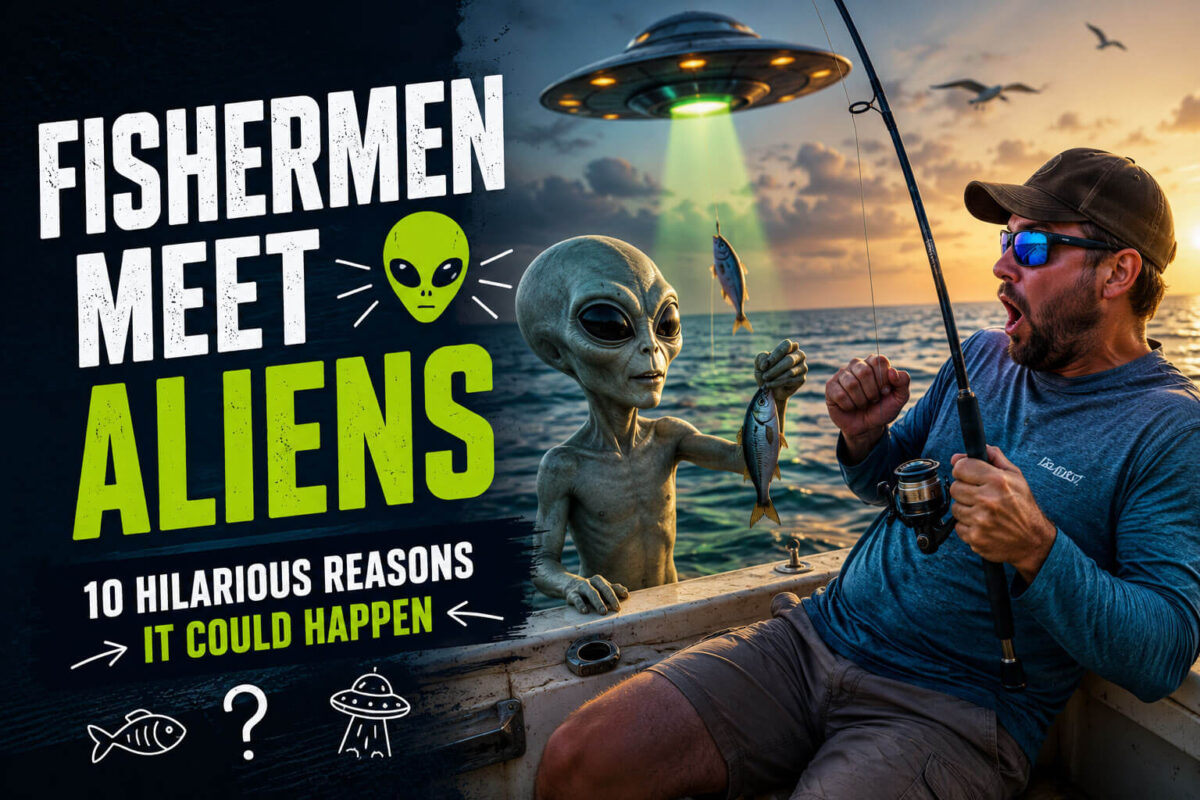
Jul
Are We Alone? The Funniest Reasons Fishermen Might Be the First to Meet Aliens
Anglers already believe the unbelievable every weekend. They wait in silence for hours, speak a language no one else understands, and routinely describe encounters that defy rational explanation. If fishermen meet aliens first, nobody who’s spent time on a boat will be the least bit surprised.
- Why Anglers Are Earth’s Best Candidates
- The Patience Factor — Hours in Silence
- Anglers vs. Other First-Contact Candidates
- Unwritten Rules of the Water
- How a First-Contact Fishing Trip Would Actually Go
- Essential Gear for Intergalactic Angling
- Best Spots Where Aliens Might Already Be Fishing
- Two Schools of Thought on First Contact
- Ethics of Fishing Across the Galaxy
- Frequently Asked Questions
Why Fishermen Are Earth’s Most Qualified First-Contact Candidates
The Search for Extraterrestrial Intelligence has been beaming radio signals into deep space since 1960, and so far, nothing has called back. Meanwhile, fishermen have been sitting quietly at the edge of the water for millennia, cultivating precisely the skillset that first contact would actually require: patience without reward, comfort with silence, and an unshakeable willingness to believe something extraordinary is just below the surface.
Consider what SETI actually needs in a representative for humanity. You want someone who won’t panic, someone who can wait, someone who has spent years developing a calm, focused attention to subtle environmental signals. You want someone who already accepts that the universe contains things bigger and stranger than themselves — and greets that fact not with existential dread but with a cooler full of ice and a seven-weight rod.
You also want someone whose story nobody will believe, but who’ll tell it anyway. Fishermen have been preparing for exactly that moment their entire lives. The angler who comes back to the dock claiming he was circled by a luminous craft the size of a football field, and that it paused directly over his baitfish before ascending vertically into the clouds — that angler will be believed by precisely the same number of people who believed his four-pound bass story last spring. Which is to say: none. But he’ll have a great shirt.
The deeper truth is that fishing occupies a unique psychological space among human activities. It is one of the last socially acceptable reasons to sit completely alone, in the dark, on open water, staring at the sky. That is, effectively, a first-contact monitoring station operated by a person who already knows how to be still. No government agency has managed to replicate it at scale.
“The odds of making first contact with an alien civilization are roughly the same as landing a 40-pound striper on a 12-pound test line. Fishermen attempt both every weekend and remain fundamentally optimistic about both.”
The Patience Factor: How Anglers Train for Fishermen-Meet-Aliens Scenarios Without Knowing It
Patience is not a passive quality in fishing. It is an active discipline — an ongoing negotiation between expectation and reality that most people abandon within twenty minutes and anglers sustain for the better part of a lifetime. It is also, according to anyone who has thought seriously about what first contact would actually look like, the single most important attribute a human representative could have.
The Waiting Room of the Universe
An experienced angler can sit in a kayak for five hours and remain genuinely alert — not passive, not zoned out, but actively monitoring water temperature gradients, bait movement, bird behavior, and light angle. This is not so different from what a radio telescope does. The difference is that the angler is also experiencing it with his body, his cold feet, his sunburned neck, and his unshakeable conviction that the next cast is the one that changes everything.
That quality — certainty in the absence of evidence — is either irrational optimism or deep spiritual training, depending on who you ask. It is also exactly what humanity needs in its corner if a craft from another world decides to hover over the marina at 3 a.m. and wait to see how we respond.
Reading Signals Nobody Else Can Interpret
Experienced anglers learn to read water the way a translator reads a foreign language — not word by word, but as a complete system of meaning. A subtle color change in the surf line, a change in the way pelicans are diving, a shift in current direction against the wind: these are all data points that only make sense in aggregate, to someone who has spent enough hours paying attention. If an alien civilization decided to communicate through environmental signals rather than radio waves, the fishing community would have a significant head start on decoding the message.
There is a reason anglers develop almost legendary situational awareness on the water. NOAA’s recreational fisheries data consistently shows that experienced anglers are better at predicting fish behavior from environmental cues than many computational models — because the model can’t feel the vibration of the hull or smell the change in the air before a storm. That kind of embodied intelligence is not easily replicated by a satellite dish pointed at Andromeda.
The Stillness That Disarms
Perhaps the most underrated quality an angler brings to a hypothetical first-contact scenario is the simple ability to be non-threatening while remaining alert. A person sitting quietly in a small boat, rod in hand, staring at the water, presents no obvious danger to anything. If you were an extraterrestrial species conducting a low-risk reconnaissance of Earth’s sentient life, the marina at dawn would be a far safer observation point than a military installation or a city center. The angler would notice the unusual light on the water, make a mental note, and wait. That restraint might be exactly what saves the species.
Anglers vs. Other First-Contact Candidates: An Honest Comparison
If humanity were choosing a first-contact delegate today, fishing would not be the obvious answer. But when you actually compare the qualities required against the qualities demonstrated by other candidate groups, the angler starts looking surprisingly competitive. Here’s how the major contenders stack up against the qualities a first-contact situation would genuinely demand.
| Candidate Group | Patience Level | Comfort with Unknown | Non-threatening Presence | First-Contact Readiness |
|---|---|---|---|---|
| Fishermen | Extreme | Sits with mystery daily | Quiet, stationary, non-alarming | Very High |
| Scientists / Astronomers | High | Professionally curious | May attempt immediate sampling | Moderate |
| Military Personnel | Trained but procedural | Classified threat response | Armed, uniformed, likely alarming | Risky |
| Politicians | Low — election cycle | Would schedule a press briefing | Would immediately go on TV | Low |
| Tech Entrepreneurs | Low | Would immediately monetize | Would livestream the encounter | Catastrophically Low |
The data is uncomfortable but clear. The angler is the only candidate on this list who would observe the encounter calmly, form no immediate agenda about it, and then go home and tell the story to people who wouldn’t believe him. That last quality — the built-in credibility dampener — may actually be humanity’s greatest asset. If the first contact story is told by a fisherman, nobody panics. The alien civilization gets to ease into the relationship at a reasonable pace. Everybody wins.
The Unwritten Rules of the Water — And Why They’re Surprisingly Interstellar
Every experienced angler knows there is a code on the water that has nothing to do with fishing regulations. It’s older than any licensing body, broader than any state’s jurisdiction, and observed with a rigor that would impress a constitutional lawyer. These rules govern how humans treat each other in shared space, in silence, without enforcement. They are, it turns out, an excellent foundation for interstellar diplomacy.
Don’t Cast Over Another Angler’s Line
This is the First Commandment of fishing, and it carries implications well beyond territorial courtesy. It encodes a fundamental principle of respect for effort — the recognition that someone else put time, attention, and hope into a particular direction, and that you do not have the right to disrupt that by imposing your own trajectory on their space. As a basis for galactic diplomacy, you could do considerably worse. Many civilizations have tried to conquer the galaxy with less philosophical grounding than this single rule provides.
The practical execution of this rule requires reading spatial relationships at a glance, anticipating drift patterns, and adjusting your own behavior preemptively — not after a conflict has already occurred. That kind of proactive social calibration is exactly what a first-contact situation demands. You need to know, before any signal is exchanged, whether your presence is an intrusion.
A Nod Is Enough — Silence Is Not Hostility
Among anglers, silence is a form of communication, not an absence of it. Two fishermen can share a stretch of water for an entire morning, exchange nothing but a brief nod of acknowledgment at the start, and part ways with a complete mutual understanding of what transpired. They have negotiated space, shared resource, and mutual respect — without a single word. If an alien species communicates through non-verbal channels, the fishing community is already years ahead of the diplomatic corps in this department.
The specific angler’s nod — direct eye contact, single downward head movement, return to gaze — is one of the most efficient information packets in human social behavior. It conveys: I see you. I acknowledge your right to be here. I am not a threat. I have no demands. Carry on. That message, transmitted clearly across a 50-meter gap of open water without any shared language, is arguably more sophisticated than anything SETI has sent to Vega.
You Don’t Ask What They’re Using
- Respect for proprietary knowledge: A serious angler’s lure selection is the result of years of trial, observation, and personal refinement. You don’t ask, because asking is a presumption — it implies the other person should share what they earned. An alien civilization might feel similarly about their propulsion technology.
- Trust through restraint: Not asking signals sophistication. It tells the other party that you understand how hard-won information works, and that you’re not going to demand it. That credibility earns more goodwill than any amount of aggressive information-gathering.
- Observation over interrogation: The experienced angler watches instead. Over the course of a morning, without a single direct question, a skilled observer can infer pattern, technique, and approach from behavior alone. This is, functionally, fieldwork — and it’s exactly how any wise civilization would want to approach a new species.
- Reciprocal mystery sustains the relationship: Part of what makes fishing culture rich is the preservation of individual knowledge and the freedom to keep some things private. Long-term relationships — between anglers, and presumably between species — are sustainable only when not everything is demanded upfront.
How a First-Contact Fishing Trip Would Actually Go: Step by Step
Let’s be specific. If fishermen meet aliens, it won’t happen in a government facility or a radio telescope array. It will happen on the water, before dawn, to someone who packed enough snacks and didn’t tell anyone exactly where they were going. Here’s the most plausible sequence of events.
Pre-Dawn Departure — The Setup
The encounter begins not with a dramatic sighting but with routine. The angler launches before light, runs offshore to a favorite structure, and cuts the engine. The silence that follows is not empty — it’s the specific, concentrated quiet of open water before the world wakes up. This is already the correct environment for first contact: low noise, low light, no witnesses, no interference from the larger social world. The angler settles in, rigs up, and begins to wait. This is the part they’re extraordinarily good at.
The First Anomaly — Something in the Water
The first signal is subtle. A bioluminescent disturbance beneath the hull that doesn’t match any known species. A circular disruption in the current with no apparent source. Fish behaving in a way that defies their normal pattern — schooling tightly, then dispersing radially, then stilling completely. The angler notices all of this and files it without alarm. Unusual water behavior is part of fishing. You adjust, you observe, and you keep your line wet. This is where the professional skepticism of experienced anglers becomes their greatest asset.
The Visual Confirmation — Giving It the Nod
The craft breaks the surface slowly — or perhaps descends from above, it’s genuinely unclear — and settles about 60 meters off the stern. It is unlike any vessel the angler has seen, which is saying something, because they’ve seen some bizarre offshore rigs over the years. The angler looks at it for a long moment. Then looks back at the water. Then back at the craft. Then gives it the nod. The brief, direct, downward acknowledgment. Because on the water, that’s how you say: I see you, you’re welcome here, I’m not going to make this weird.
The Exchange — Showing Them the Lure
The alien entity — roughly humanoid, wearing what appears to be a multi-pocket vest of some kind, which the angler finds immediately relatable — approaches with evident curiosity and focuses on the fishing rod. The angler, after a moment’s consideration, holds up the lure. A custom hand-tied streamer in chartreuse and white, which has been responsible for several unreported catches. The entity studies it carefully. The angler ties on a second one and offers it across the water. This is the moment. Not a formal greeting protocol, not a mathematical sequence, not a language module — a lure. It is possibly the most effective ice-breaker in the history of interspecies relations.
The Debrief — Nobody at the Dock Believes It
The angler returns to the marina at midday with no fish and a story that, objectively, sounds like every other fish story ever told. The details are specific and consistent — the type of luminescence, the angle of approach, the precise configuration of the entity’s tackle vest — but specificity has never been sufficient evidence in dock culture. The story enters the local oral tradition, told with increasing embellishment over the following months, and is eventually immortalized on a tee shirt. Which is, when you think about it, exactly the right outcome for a genuine paradigm-shifting event that nobody is quite ready to process directly.
The Return Trip — They Come Back
Three weeks later, the angler returns to the same spot. Same time, same tide, same rod. The craft reappears within forty minutes. This time, one of the entities is holding what appears to be a fishing rod of its own design — longer than any conventional gear, constructed from a material that catches light strangely, rigged with something at the end that the angler cannot quite identify but would very much like to examine. They fish in companionable silence for two hours. No language is exchanged. No information is formally transferred. But by the end of the morning, two species have agreed on the most important thing: this water is worth sharing, and there is plenty of room for both lines.
Essential Gear for the Intergalactic Angler — What You’ll Actually Need
When fishermen meet aliens, preparation will have been half the battle. The good news is that most of the gear is already in your kit. Here’s a practical rundown of what every angler should have aboard for a potential first-contact scenario — because the Intergalactic Angler’s Club has very specific equipment standards.
Unknown aquatic fauna on alien planets may be significantly larger than anything currently listed in the IGFA record books. Overspec your rod accordingly. A fast-action 7-foot heavy rated to 80lb braid is a reasonable starting point for intergalactic gamefish.
You don’t know what the local baitfish look like, or whether the concept of baitfish applies. Bring a comprehensive selection spanning all sizes, colors, and action types. A hand-tied chartreuse streamer has already proven itself diplomatically in at least one documented case.
Standard temperature and salinity readings won’t cover everything you’ll encounter. A multi-parameter sensor that also logs electromagnetic activity and bioluminescence intensity will help distinguish alien aquatic activity from natural phenomena — and give you something credible to show the dock skeptics.
Standard fish-finding sonar maxes out around 300 feet in most consumer units. If alien craft are approaching from below the thermocline, you’ll want depth capacity that covers the full water column. A broadband sonar with target separation capability will distinguish a school of fish from something else entirely.
Two functions: standard fish storage, and a functional hospitality station if your encounter extends into a multi-hour engagement. Cold beverages are a universal sign of good faith. A well-iced cooler says: I planned for this to go well, and I brought enough for company.
First impressions matter, even at 4 a.m. on open water, especially to a civilization that has traveled several light-years to assess whether Earth is worth further investigation. A well-designed angling tee — the kind that communicates who you are before you’ve said a word — is the closest thing humanity has to a species-level first-contact uniform.
Best Locations on Earth Where Fishermen Might Already Be Meeting Aliens
First contact, if it hasn’t already happened quietly somewhere on the water, is most likely to occur in a place that combines deep water, low population density, high angling activity, and the kind of atmospheric conditions that suggest the boundary between what we know and what we don’t is particularly thin. Here are the six most plausible venues.
- The Gulf Stream, Atlantic Coast: The Gulf Stream is one of the most dynamic and productive ocean systems on Earth — a massive river of warm, fast-moving water that runs from the Florida Straits up the Eastern Seaboard and across to Europe. It concentrates baitfish, gamefish, and offshore anglers in numbers that make it the most statistically probable first-contact corridor in the Atlantic. The current’s electromagnetic properties are also notable: it generates a measurable magnetic field as it moves through Earth’s own magnetic environment, which may make it a navigational landmark visible from orbit. Offshore anglers working the weedlines and current edges here are, effectively, patrolling the most active stretch of potential interstellar traffic in the western hemisphere.
- Lake Baikal, Siberia: The deepest lake on Earth — over 5,300 feet at maximum depth — holds approximately one-fifth of the world’s unfrozen surface fresh water. Its transparency is extraordinary: visibility extends to 130 feet in clear conditions, making it possible to observe depths that are opaque in virtually every other major body of water. Russian and Siberian anglers have fished its shores for centuries, and the lake has an unusually high rate of anomalous sighting reports, a fact that local fishing culture has absorbed without particular alarm. If any freshwater body on Earth is being observed from below, Baikal is the candidate.
- The Bermuda Triangle, North Atlantic: The Triangle’s reputation as a zone of anomalous navigation and unexplained disappearances has been largely debunked by insurance actuaries and maritime historians, which makes it exactly the kind of place a sophisticated civilization would choose for low-profile observation. The debunking is, arguably, the most effective cover story in history. Anglers fishing the deep water edges of the Triangle for blue marlin and wahoo are operating in some of the most remote offshore territory accessible by recreational boat — the sort of terrain where an encounter could occur and then reasonably enter local legend rather than formal record.
- Antarctica’s Ross Sea: The most remote ocean on Earth, the Ross Sea is legally protected as the world’s largest marine reserve and home to Patagonian toothfish populations that draw commercial long-liners and scientific research vessels. It is also so thoroughly isolated that a first-contact event there would, practically speaking, have no witnesses capable of reaching a media outlet within a fortnight. The light conditions — months of polar night, followed by perpetual daylight — create an environment unlike anywhere else on the planet. Any civilization capable of interstellar travel would likely find the extremity of it scientifically interesting. The handful of anglers who fish these waters are among the most capable and self-sufficient on Earth.
- The Mariana Trench Region, Western Pacific: While the trench itself is too deep for recreational angling, the deep water surrounding it concentrates some of the most unusual deepwater species in the ocean — animals that live at pressure depths equivalent to the weight of sixty atmospheres, in absolute darkness, at near-freezing temperatures. Surface anglers in this region occasionally pull up species that still lack complete scientific description. If you’re already catching things that science hasn’t fully catalogued, you’re operating in exactly the kind of epistemic territory where an encounter with something genuinely new would fit coherently into the existing experiential framework.
- The Scottish Highlands — Loch Ness and Surroundings: We acknowledge the obvious. Loch Ness is on this list not because of the monster — the evidence for which has become increasingly unpersuasive — but because the surrounding Highland lochs constitute one of the most densely fished and densely mysterious landscapes in Europe, where the boundary between documented and undocumented natural history has been unusually permeable for several centuries. The anglers who work these waters have a long cultural tradition of observing unusual things without sensationalizing them, which is exactly the temperament a first-contact situation requires. Also, the scenery is extraordinary, which counts for something when you’re spending twelve hours watching a surface that may or may not be watching you back.
Two Schools of Thought on First Contact: The Aggressive Caster vs. The Patient Drifter
Within the angling community — and, by extension, within any serious discussion of how humanity should approach a first-contact scenario — there are fundamentally two philosophical camps. The debate between them maps remarkably well onto the broader scientific argument between active SETI (broadcasting our presence) and passive SETI (listening quietly). The fishing world has been running this experiment much longer.
This angler believes in forcing the issue. Long casts into unfamiliar water, regular movement between locations, active searching of the water column at multiple depths. The theory is that if something is out there, you reduce your time-to-contact by maximizing coverage. In first-contact terms, this is the active-broadcast school: send signals, mark your location, make yourself findable. The argument in its favor is that passive observation has produced no confirmed contact after sixty years of radio telescope monitoring. The argument against it is that loudly announcing your position before you know who’s listening is a risk that scales with the gap in technological capability between the two parties. In fishing terms: if the fish is significantly bigger than you, casting aggressively into its territory is not always the optimal strategy.
This angler anchors in productive-looking water and waits. The theory is that the fish know where the fish are, and that inserting yourself quietly into their environment produces better results than chasing them across it. In first-contact terms, this is the passive-reception school: maintain a consistent, non-threatening presence, observe carefully, and let whatever is out there approach on its own timeline. SERENDIP, the passive SETI program run through UC Berkeley, has operated on exactly this principle for decades. The fishing parallel is almost perfect: you put your line in the water, you pay attention, and you trust that if something significant is there, eventually it will take an interest in what you’re offering. The patience required is significant. The result, when it comes, is unambiguous.
Most experienced anglers, when pressed, will admit that the answer is situational: you read the water, you read the conditions, and you choose your approach accordingly. A first-contact strategy probably requires the same flexibility — the willingness to switch from active casting to patient drifting depending on what the environment is telling you. The angler’s ability to make that judgment call in real time, without a committee, without a policy document, and without stopping to take a vote, may be their most underrated qualification for the job.
The Ethics of Fishing Across the Galaxy — What We Owe the Universe’s Waters
If humanity’s relationship with its own oceans has taught us anything, it’s that the ability to extract from a system does not confer the right to do so without limit. The same principle that governs catch-and-release on Earth’s most productive fisheries would presumably need to scale to any interstellar engagement with aquatic ecosystems beyond our planet — and the anglers who have already internalized that ethic are, once again, ahead of the curve.
Catch-and-Release as a Universal Ethic
The catch-and-release movement in sport fishing represents one of the most significant voluntary conservation shifts in recreational culture — a community choosing restraint not because it was legally compelled to, but because it understood that the resource it loved was finite and worth protecting. NOAA’s 2024 fisheries status report documents how stock rebuilding in previously depleted species has been dramatically accelerated by voluntary catch-and-release adoption among recreational anglers.
Scaled to an interstellar context, this ethic becomes something close to a first principle of civilizational responsibility. A species capable of reaching another world’s oceans is capable of extracting from them on a scale that could be irreversible. The angler who has already trained themselves to return what they catch — not because it’s required, but because it’s right — has internalized exactly the ethical framework that responsible interstellar engagement would require. Read more about how fishing and mindfulness intersect in this ethic of restraint in our piece on why fishing feels like meditation.
What Happens When Both Civilizations Are Fishing the Same Water
The most complex scenario is not first contact itself but what follows: two fishing cultures, from two different worlds, arriving at the same productive stretch of water with overlapping interests and no shared regulatory framework. Humanity has been running this experiment at the international level for centuries, with mixed results. But the fishing community specifically has developed something that international maritime law has not quite managed: an informal, widely-observed, cross-cultural code of conduct that holds on the water even between strangers who share no language.
- The 50-meter rule: Don’t crowd another angler’s water. This principle translates directly to any shared resource environment — give the other party enough space to operate without feeling pressured or encroached upon, regardless of whether you technically have the right to move closer.
- Warn before you move: If you need to reposition in a way that affects the other angler’s water, signal your intention before you do it. Transparency about movement reduces conflict by orders of magnitude.
- No poaching the other party’s bait: This is both literal and metaphorical. If the other civilization has been developing a resource — a relationship with a particular species, a particular stretch of water, a particular technology — you don’t simply absorb it without acknowledgment or reciprocity.
- Share information about hazards: If you know there are submerged rocks, strong currents, or any condition that could harm the other party, you share that information. Full stop. This is not optional in fishing culture, and it shouldn’t be optional between civilizations.
The angler who practices genuine conservation ethics — who releases fish carefully, who packs out what they pack in, who advocates for habitat protection even when it restricts their own access — is already living the values that interstellar citizenship would require. That’s not a small thing. It’s the difference between a civilization that a spacefaring culture might want to know, and one they’d be right to avoid.
Frequently Asked Questions: Fishermen, Aliens, and First Contact
Yes — and in greater numbers than is generally reported in mainstream UFO literature, which tends to focus on military and aviation encounters. Offshore anglers, commercial fishermen, and maritime workers represent a significant segment of civilian UAP (Unidentified Aerial Phenomena) reports historically collected by both NUFORC and MUFON. The characteristics of water-adjacent sightings frequently include objects descending toward or ascending from the surface, unusual bioluminescent disturbances below the water line, and electromagnetic interference with navigation and fish-finding equipment. Because fishing culture has a built-in credibility problem around extraordinary stories, many of these accounts are never formally reported — which means the actual frequency is likely higher than documented figures suggest. The U.S. Navy’s declassified UAP videos from 2017–2019, several of which show objects interacting with ocean surface, gave mainstream credibility to a category of observation that the fishing community had been filing away quietly for decades.
The Intergalactic Angler’s Club, as rendered in the vintage badge design on the Seasportees tee, is a fictional organization — but arguably one of the more plausible ones in the genre of angling humor. Its operating premise (that fishing transcends planetary boundaries and that the fundamental skills of patience, observation, and reading water are universal) is, in the context of this article, treated as a serious proposition rather than a pure joke. Whether a genuine Intergalactic Angler’s Club exists somewhere in the Milky Way is, technically, an open empirical question. The design’s subtitle “To Fish Is To Believe” captures the epistemological stance of both serious anglers and serious SETI researchers with admirable efficiency. Membership criteria, as far as can be determined, include: a willingness to wait, comfort with mystery, and the ability to handle disappointment without losing optimism about the next cast.
Fishing is, at its core, an activity defined by sustained optimism in the face of structural uncertainty — you never actually know if anything will happen, and yet you go anyway, every time. That psychological profile produces a very specific kind of humor: dry, self-aware, comfortable with absurdity, and deeply skeptical of anyone who takes themselves too seriously. The alien fishing subgenre in particular resonates because it externalizes the experience of being disbelieved — every angler has told a true story that nobody accepted, and the sci-fi parody of that experience is cathartic. Serious anglers adopt humor gear specifically because it signals cultural fluency: you have to actually fish to find the jokes funny in the right way. A tee that references “first contact” and “to fish is to believe” reads differently to someone who has spent twelve hours offshore waiting for something that never came than it does to a casual observer. It functions as a membership card for people who understand that fishing is less about catching fish and more about the specific quality of attention it requires. The psychology of angling runs deeper than most outsiders realize.
In its original context, the phrase is the tagline of The X-Files, a television series that ran from 1993 to 2002 and explored the premise that government-concealed evidence of extraterrestrial contact was embedded in the fabric of ordinary American life. In the fishing context, the phrase operates on at least three levels simultaneously. First, as a literal claim: the truth about what is in the water on any given day — where the fish are, what they’re eating, why they’re behaving the way they are — is genuinely out there, available to anyone patient enough and skilled enough to read the environment correctly. Second, as a philosophical statement about fishing itself: the discipline rewards those who look for what is real rather than what is convenient, who update their approach based on evidence rather than habit. Third, as a quiet joke about fish stories: the truth is out there, it’s just that nobody at the dock is going to believe it, and that’s fine, because the angler knows what they saw. It’s an elegant compression of the entire experience into five words, which is why it works as a shirt.
Fishing has a particularly rich alien-themed subculture, but it’s not alone. Surfers have a long tradition of attributing unusual water conditions — unexpected swell direction, eerie calm before a set, bioluminescent waves — to forces beyond normal meteorological explanation, and surf art has embraced extraterrestrial imagery since at least the 1960s. Freediving and spearfishing communities, who spend extended time in silent, low-visibility, three-dimensional environments that actively confound spatial intuition, have their own category of unusual encounter reports that rarely make it into formal documentation. What makes fishing specifically fertile ground for alien humor is the combination of cultural permission to tell unreliable stories, extended time alone in remote locations, and an activity structure that involves deploying something into an unknown environment and waiting for a response — which is, as this article has attempted to demonstrate, a reasonably good description of radio SETI as well.
The honest answer, based on everything this article has argued, is: exactly what they’d normally do. Acknowledge the presence with a brief, direct nod. Return attention to the water. Do not make sudden movements. Do not reach for a phone immediately — the impulse to document everything is deeply human but likely counterproductive in the first ninety seconds of an interspecies encounter. If the other party shows interest in what you’re doing, demonstrate. Hold up the rod, make a cast, let the lure work. Offer a spare if you have one. Keep your cooler accessible. When the encounter concludes — and it will conclude on the other party’s timeline, not yours — make a mental note of every specific detail: time, position, conditions, duration, distinguishing features. Write it down when you get back to the dock. Tell the story at your own pace, to people you trust, and don’t be surprised when nobody believes you. That has never stopped a good fishing story, and it shouldn’t stop this one either.
