


🤿 Scuba & Free Diving
The Ultimate Beginner’s Guide to Scuba Diving ⭐⭐⭐⭐⭐
Jun
🤿 Scuba Diving Guide
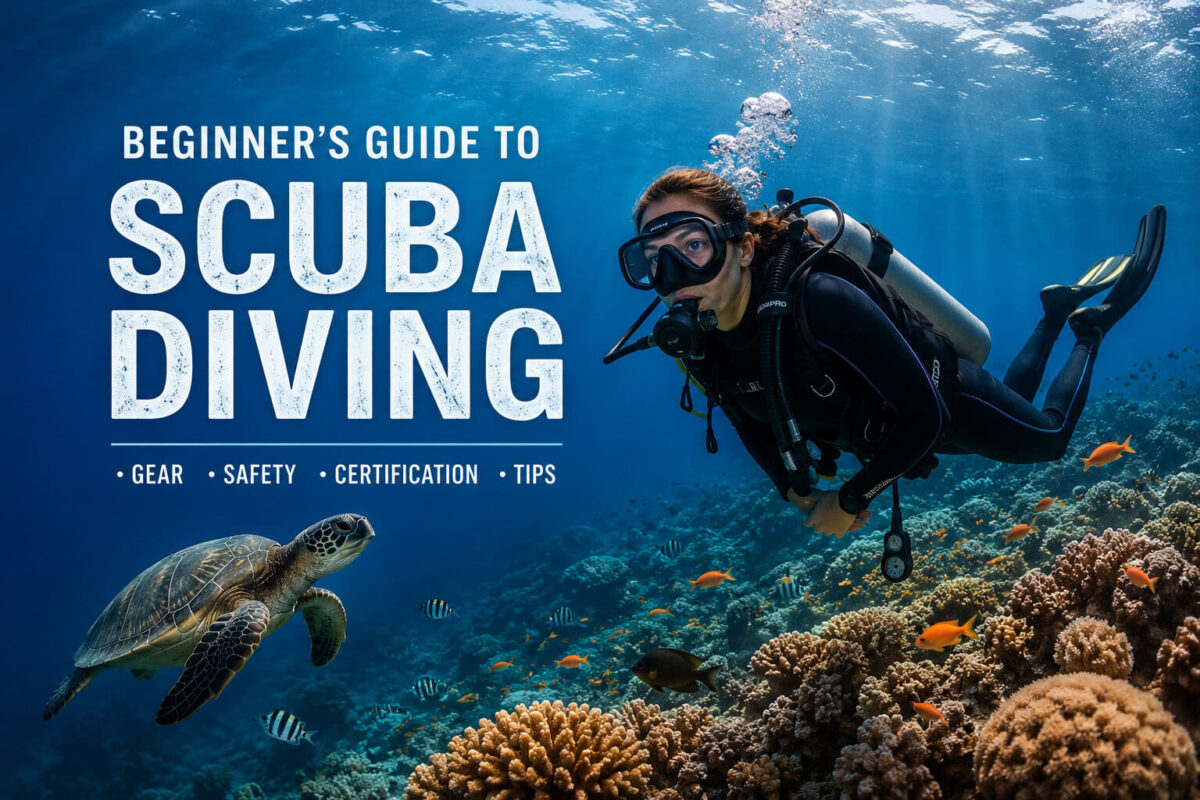
The Ultimate Beginner’s Guide to Scuba Diving
Everything you need to know before you take the plunge — from your first breath underwater to choosing your certification, gear, and dream dive destination.
What is scuba diving?
Scuba stands for Self-Contained Underwater Breathing Apparatus. It’s the sport — and art — of exploring the underwater world using a tank of compressed air strapped to your back, breathing through a regulator as you descend into a realm most people never see.
Unlike snorkelling, where you stay at the surface, scuba diving takes you down to coral reefs, shipwrecks, underwater caves, and open ocean environments teeming with marine life. It’s the closest most humans will ever get to flying — weightless, silent, and utterly alive.
“The sea, once it casts its spell, holds one in its net of wonder forever.” — Jacques Cousteau
Scuba diving is suitable for almost everyone. Children as young as 10 can begin with junior programmes, and there’s no upper age limit as long as you’re in reasonable health. You don’t need to be an elite swimmer — you just need to be comfortable in the water.
How does scuba diving work?
At its core, scuba diving works by delivering breathable air from a high-pressure cylinder to your lungs on demand. Your cylinder holds compressed air at around 200–300 bar. A regulator reduces this to ambient pressure so you can breathe comfortably at depth. As you descend, water pressure increases — roughly 1 atmosphere for every 10 metres — and your regulator adapts automatically.
Buoyancy: the skill that defines great diving
The most important skill in scuba diving is buoyancy control — the ability to hover effortlessly at any depth. This is managed through your BCD (Buoyancy Control Device), a jacket you inflate or deflate to fine-tune your position in the water column.
Your breathing also influences buoyancy: inhale slowly and you gently rise; exhale and you sink slightly. Mastering this is what separates a clumsy beginner who kicks up sand from a fluid diver who glides alongside sea turtles without disturbing a single grain of the seafloor.
Is scuba diving safe?
Scuba diving is statistically very safe when practised with proper training and within your certification limits. The most common issues — ear equalisation problems, mild seasickness, or unfamiliarity with equipment — are easily managed with good preparation.
The golden rules of safe diving
- Never dive alone — always use the buddy system
- Never hold your breath — always breathe continuously
- Ascend slowly and perform a safety stop at 5 metres for 3 minutes
- Never exceed your certification depth or experience level
- Equalise your ears early and often — never push through ear pain
- Check your equipment before every single dive, without exception
Getting certified: PADI, SSI & NAUI explained
Before you can dive independently, you need an Open Water certification. Three major agencies dominate the recreational diving world, and your C-card from any of them is recognised at dive centres globally — for life.
| Agency | Best known for | Duration | Level |
|---|---|---|---|
| PADI | Global reach, most dive centres worldwide | 3–4 days | Beginner friendly |
| SSI | Digital learning, flexible self-paced study | 3–5 days | Beginner friendly |
| NAUI | Rigorous training, technical focus | 4–6 days | More demanding |
What does an Open Water course involve?
Online / classroom learning
Cover dive theory: physics, physiology, equipment, and safety protocols. Usually done at home via an app before your in-water days begin.
Confined water sessions
Practice core skills in a swimming pool or shallow water — mask clearing, regulator recovery, buoyancy control, and emergency ascent procedures.
Open water dives
Four dives in the sea or a lake, demonstrating your skills in a real underwater environment. Maximum depth is 18 metres during training.
Certification
Pass your knowledge reviews and skills assessment, and you’ll receive a C-card recognised at dive centres around the world — valid for life.
Essential scuba gear explained
You don’t need to own all your gear as a beginner — most dive centres rent everything. But understanding what each piece does makes you a more confident diver from day one.
Your first open water dive: what to expect
Nerves before your first real ocean dive are completely normal. Here’s exactly what will happen, step by step, so you arrive ready and confident.
Briefing on the boat
Your instructor describes the site: max depth, entry and exit, hand signals, marine life to watch for, and the dive plan. Pay close attention.
Kitting up
Assemble and check your equipment using the BWRAF checklist: BCD, Weights, Releases, Air, Final check. Always run through this with your buddy.
Entry
Giant stride from a boat, or wade in from a beach. Take a breath, signal OK, and let yourself sink slowly while equalising your ears from the very first metre.
The dive itself
Follow your buddy and instructor. Breathe slowly and steadily. Look, hover, and explore. It will feel surreal — in the very best possible way.
Ascent & safety stop
Ascend at no more than 9 metres per minute. Stop at 5 metres for 3 minutes to off-gas nitrogen — standard practice on every dive.
Best beginner dive destinations in the world
Some dive sites are genuinely tailored to beginners: warm, calm, crystal-clear water with gentle currents and extraordinary marine life. These are the world’s finest starting points.
- Red Sea, Egypt — Warm, calm, and extraordinarily rich with reef life. Hurghada and Sharm el-Sheikh offer some of the most accessible coral reef diving on the planet, with visibility often exceeding 30 metres.
- Koh Tao, Thailand — One of the most popular places in the world to get certified. Warm, shallow reefs and a huge community of dive schools.
- The Maldives — Gin-clear visibility, warm water year-round, and manta rays that treat divers as welcome neighbours.
- Great Barrier Reef, Australia — The world’s largest coral reef system. Cairns is the main gateway, with dozens of beginner-friendly sites.
- Cozumel, Mexico — Drift diving over spectacular wall reefs in the Caribbean’s clearest water.
- Bali, Indonesia — Diverse sites from mola mola encounters to serene coral gardens, suitable for every certification level.
Scuba diving vs freediving: which is right for you?
Both disciplines open the underwater world to you — but they offer fundamentally different experiences of it.
Many ocean lovers end up doing both. The two disciplines complement each other beautifully.
Common beginner mistakes — and how to avoid them
- Overusing your arms instead of gliding — slow down, breathe steadily, and let your fins provide all the propulsion.
- Ascending too quickly — always ascend at a maximum of 9 metres per minute. Your dive computer will alarm if you exceed this.
- Not equalising early enough — equalise every metre on the way down, before you feel any pressure. Never push through ear pain.
- Being overweighted — too much weight makes buoyancy control exhausting. Get properly weighted in a pool first.
- Touching or standing on the reef — corals are living animals that take decades to grow. Never touch, kick, or kneel on them.
- Panicking at depth — if you feel overwhelmed, stop, breathe very slowly, and signal your buddy. Never bolt to the surface.
Frequently asked questions
Dive deeper with SEASPORTEES
Worn by divers, freedivers, and ocean obsessives worldwide. Explore our Scuba & Free Diving collection — ocean-inspired graphic tees built for people who live for the underwater world.
Shop the Scuba & Freediving Collection → Or explore our full ocean lifestyle range ↗Related articles
