


🤿 Scuba & Free Diving, 🐋 Ocean & Marine Life
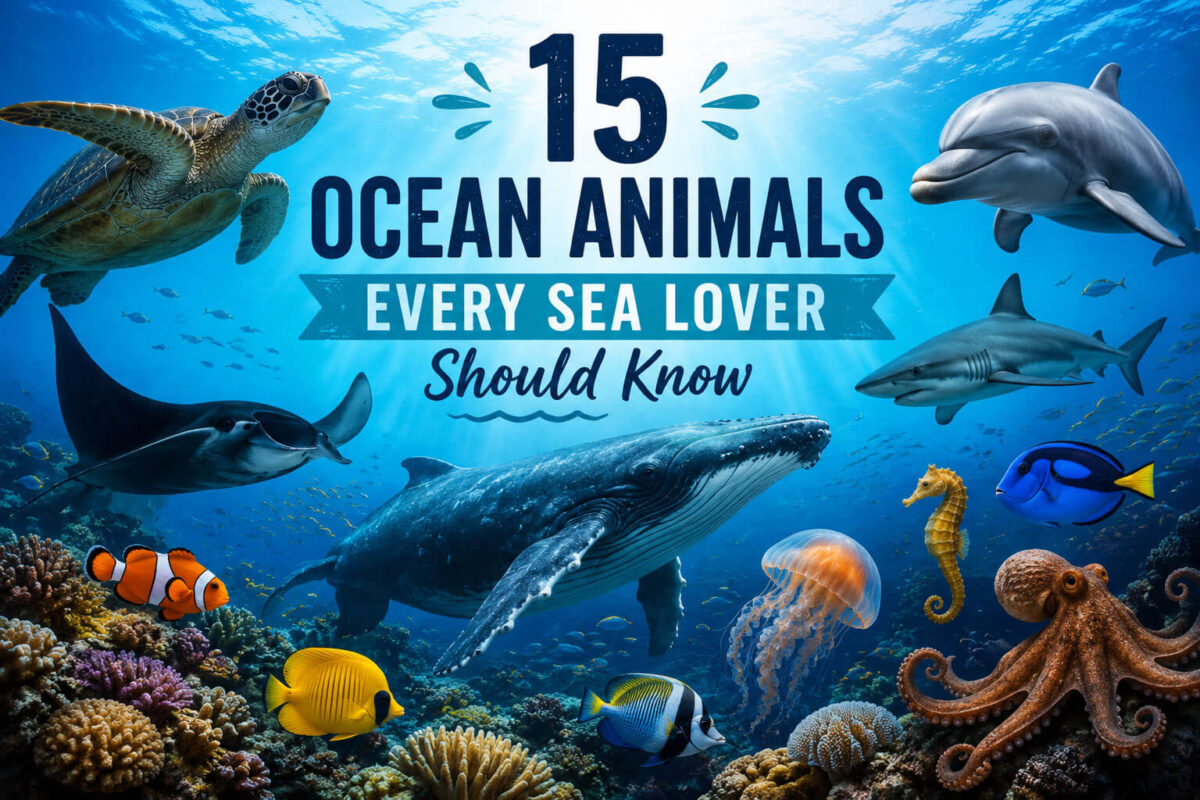
15 Ocean Animals Every Sea Lover Should Know
Jun
🌊 Ocean Wildlife Guide
Ocean Animals Every Sea Lover Should Know
From the smallest bioluminescent plankton to the largest animal ever to have lived on Earth — the essential guide to the ocean’s most extraordinary creatures and the roles they play in keeping our seas alive.
Why every sea lover should know their ocean animals
The ocean is not a backdrop. It is not the blue space between the continents that makes Earth look beautiful from space. It is the engine of all life on this planet — producing more than half the oxygen we breathe, regulating global temperature, driving weather systems, and supporting a web of living organisms so intricate and so vast that marine scientists have barely begun to map its edges. At the heart of all of this are the animals — from microscopic copepods to filter-feeding whale sharks — whose interactions, migrations, predations, and decompositions keep the entire system running.
Knowing these animals by name, by behaviour, and by ecological role transforms every encounter with the ocean. A snorkelling trip over a coral reef becomes something entirely different when you can identify the parrotfish grinding coral with its beak-like teeth into the white sand beaches below, or recognise the cleaning station where a small wrasse picks parasites from the gills of a much larger grouper in a relationship of absolute mutual benefit. Knowledge converts observation into understanding, and understanding converts a pleasant holiday swim into something that genuinely changes the way you see the world.
“No water, no life. No blue, no green. The ocean is the cornerstone of earth’s life support system, it shapes climate and weather, and it holds most of life on earth.” — Sylvia Earle
For divers, freedivers, and ocean swimmers, species knowledge also carries a direct practical dimension. Knowing that a pufferfish inflates as a defence mechanism — not an invitation to touch — keeps both you and the animal safe. Recognising the threat display of a moray eel (wide-open mouth, not aggression but breathing) prevents unnecessary alarm. Understanding that manta rays feed on plankton and have no stinging barb makes a close encounter something to savour rather than fear. In the ocean, knowledge is both enrichment and safety equipment.
This guide introduces you to the ocean’s most important and fascinating animal groups — the ones you are most likely to encounter, most likely to see in documentaries, and most important to understand from a conservation perspective. By the end of it, you will look at the ocean differently. And if you already love the sea, you will love it more completely, more intelligently, and more protectively than you did before.
Apex predators: the ocean’s keystone animals
Apex predators sit at the top of the ocean food web — animals with no natural predators of their own, whose presence (or absence) shapes the behaviour and population of every species below them. Their importance to ocean health is difficult to overstate. When apex predators disappear from a marine ecosystem, the cascading effects — called trophic cascades — can destabilise entire reef systems, seagrass beds, and open-ocean food webs within years.
Sharks — 450 million years of evolutionary perfection
Sharks predate the dinosaurs, the trees, and even many of the continents in their current configuration. Over 500 species fill every ecological niche from shallow tropical reefs (blacktip reef sharks) to the open abyss (the Greenland shark, which may live over 400 years). As apex predators, sharks regulate prey populations, removing sick and weak individuals and preventing any single species from overrunning its ecosystem. Reef systems with healthy shark populations consistently show greater biodiversity, more robust coral growth, and more stable fish populations than equivalent reefs from which sharks have been removed. Despite this, a third of all shark species are now threatened with extinction — primarily through commercial fishing, finning, and bycatch.
Orcas (Killer Whales) — the ocean’s apex of apexes
Orcas are the only marine predator that preys upon other apex predators — great white sharks, sperm whales, and even blue whales when hunting in cooperative pods. Unlike sharks, which are solitary hunters guided by instinct and sensory input, orcas are highly social, cognitively complex animals that hunt cooperatively using techniques passed between generations — a form of cultural transmission found in very few non-human species. Different orca populations (“ecotypes”) specialise in entirely different prey: some eat only fish, others target marine mammals exclusively, and some have developed extraordinary techniques for beaching themselves temporarily to snatch seals from the shoreline. Their intelligence, social bonds, and behavioural diversity make orcas among the most scientifically fascinating animals on Earth.
Sperm Whales — ocean engineers of the deep
The sperm whale holds an extraordinary collection of superlatives: the largest toothed predator ever to have existed, possessing the largest brain of any animal in Earth’s history, capable of diving to over 2,000 metres and holding its breath for up to 90 minutes. Sperm whales hunt giant squid in absolute darkness at crushing pressures using echolocation clicks that are the loudest biological sounds produced by any animal. But their ecological importance extends beyond predation — sperm whale defecation at the surface releases iron-rich nutrients that fertilise phytoplankton blooms. Those blooms absorb carbon dioxide and produce oxygen. A single sperm whale, over its lifetime, contributes to the sequestration of tonnes of carbon from the atmosphere — making large whale populations one of nature’s most effective climate regulation mechanisms.
Major ocean animal groups at a glance
The ocean’s animal kingdom is organised into broad groups that share fundamental body plans, evolutionary histories, and ecological roles. Understanding these groups gives you a framework for making sense of the extraordinary diversity you encounter underwater — whether you are diving a coral reef in the Coral Triangle or rock-pooling on a temperate coastline.
| Animal Group | Key Examples | Where Found | Ecological Role | Encounter Ease |
|---|---|---|---|---|
| Elasmobranchs | Sharks, rays, skates | All oceans, all depths | Apex & mesopredator regulation | Common on reefs |
| Cetaceans | Whales, dolphins, porpoises | Open ocean, coastal waters | Nutrient cycling, prey regulation | Seasonal / offshore |
| Cephalopods | Octopus, squid, cuttlefish | Reef, open ocean, deep sea | Predator & prey, intelligence research | Common when sought |
| Marine Reptiles | Sea turtles, sea snakes, marine iguanas | Tropical & subtropical seas | Seagrass grazing, jellyfish control | Accessible at many sites |
| Echinoderms | Sea stars, urchins, sea cucumbers | All depths, especially reefs | Reef cleaning, nutrient cycling | Easily overlooked |
How to spot and identify ocean animals
Most first-time snorkellers and divers are surprised by how much they miss on their early dives — not because there is nothing to see, but because they do not yet know where or how to look. Ocean animal identification is a learnable skill that improves dramatically with practice, patience, and a basic understanding of animal behaviour and habitat preference. The ocean rewards slow, attentive observers far more generously than fast, excitable ones.
Slow down and let your eyes adjust
The single most effective technique for finding ocean animals is to stop moving entirely and simply wait. Most reef fish have what biologists call a “flight distance” — the distance at which they will move away from a perceived threat. When you first arrive at a site and begin moving through the water, fish scatter. But if you hover motionless for 60–90 seconds, they resume their normal behaviour within arm’s reach. The same applies to octopuses, which freeze and camouflage when threatened but resume active foraging when the perceived danger passes. Stillness is the diver’s most underrated tool.
Learn to look in three dimensions
New divers habitually look forward and slightly down — the same visual field they use on land. Experienced underwater observers scan a full three-dimensional space: looking up at the underside of coral overhangs (where lobsters, moray eels, and resting nurse sharks shelter), into crevices and holes (octopuses, scorpionfish, and cleaning shrimp), and out into the blue water beyond the reef edge (where pelagic fish, sharks, and rays cruise). Train yourself to regularly rotate and look above you — many of the ocean’s most spectacular animals, from eagle rays to whale sharks, pass overhead without ever approaching the reef itself.
Use habitat as your search guide
Every ocean animal has a preferred habitat — a microenvironment within the broader reef where it feeds, shelters, or reproduces. Knowing these preferences transforms a random search into a targeted one. Pygmy seahorses are found exclusively on specific species of sea fan coral (Muricella and Annella genera). Frogfish favour sponges that match their body colour and pattern. Nudibranchs graze on the specific bryozoans, sponges, or hydroids that constitute their diet — find the food source, find the animal. Cleaning stations — recognisable by the queue of larger fish waiting patiently for small cleaner wrasse or cleaner shrimp to remove their parasites — are excellent places to observe close interspecies interactions at almost every tropical reef site.
- Look for sand puffs — a small cloud of disturbed sand often indicates a flounder, stingray, or flatfish lifting off the bottom directly beneath you
- Watch the baitfish — a sudden, coordinated change in direction from a school of small fish indicates a predator nearby; look immediately in the direction they turned away from
- Check coral rubble zones — the sandy rubble at the base of the reef is prime habitat for mantis shrimps, garden eels, jawfish, and gobies with symbiotic shrimp
- Follow the current — filter feeders (mantas, whale sharks, whale sharks) concentrate where currents deliver plankton; current-exposed reef points and channel mouths are key locations
- Dive at dawn and dusk — crepuscular periods when day-active and night-active species overlap produce the greatest diversity of observable behaviour, including predation events and courtship displays
- Night dive for invertebrates — octopuses, squid, Spanish dancers, and basket stars emerge exclusively at night; a single well-timed night dive on a familiar reef reveals an entirely different community of animals
Step-by-step: making the most of your first wildlife encounter
A wild ocean animal encounter is not something you can force — but it is absolutely something you can prepare for, position yourself for, and respond to in a way that maximises both the quality of the experience and the wellbeing of the animal. Here is how to approach your first significant wildlife encounter, from preparation to the moment you surface.
Research your target species before the dive
Know the animal before you enter the water. Understand its typical behaviour, flight distance, feeding patterns, and any known threat displays. A manta ray feeding in a plankton bloom is preoccupied and approachable with patience; a manta ray being chased by multiple snorkellers is stressed and likely to leave the area. Knowing the difference — and knowing to position yourself in the animal’s path rather than chasing it — defines the quality of every wildlife encounter you will ever have in the ocean.
Achieve neutral buoyancy before you reach the animal
Nothing disturbs a wildlife encounter faster than a diver who cannot control their depth and begins finning frantically to avoid sinking into coral or rising out of range. Before you reach your target animal, take a moment to fine-tune your buoyancy — exhale slowly to drop slightly, inhale to rise — until you can hover without any fin movement at all. From this position of complete stillness, approach the animal slowly and horizontally, never from above (which mimics a predator’s attack angle) and never by swimming directly toward it head-on.
Approach from the side and maintain a respectful distance
The internationally recommended minimum approach distance for most large marine animals — sea turtles, dolphins, manta rays, whale sharks — is 3 metres. For cetaceans in most jurisdictions it is a legal minimum, not merely a guideline. Approaching from the side rather than head-on is less confrontational and allows the animal to track you with one eye while continuing its natural behaviour. If the animal turns to face you or changes direction sharply, stop moving immediately and hold your position — let the animal decide whether to approach further on its own terms.
Observe actively — read behaviour, not just appearance
Once you are within observation distance, shift your attention from simply registering the animal’s presence to actively reading its behaviour. Is it feeding, resting, patrolling, or displaying? Does it appear relaxed — smooth, unhurried movements — or agitated — rapid direction changes, erratic swimming, raised fins or bristled spines? Behavioural observation is what transforms a wildlife sighting into genuine natural history knowledge. Keep a dive slate or waterproof notebook to record behaviours you want to research after the dive — this habit, practised consistently, builds an understanding of ocean animal behaviour that no book can replicate.
Exit without disruption and debrief thoroughly
When the encounter concludes — either because the animal moves on or because your air supply or bottom time requires you to ascend — withdraw slowly and calmly in the direction you came from, maintaining visual contact until the animal is at a comfortable distance. After the dive, debrief your encounter: record the species, time, depth, behaviour observed, and any unusual details. Submit significant sightings to citizen science platforms such as iNaturalist, Project AWARE’s Fish Count, or the Manta Trust’s MantaMatcher database — your observation contributes directly to global marine science.
Tools for ocean wildlife observation & photography
The right equipment transforms your ability to observe, document, and share ocean wildlife encounters. None of these tools require professional-grade investment — but choosing the right option for your primary activity (snorkelling, scuba diving, freediving, or shore-based observation) makes a meaningful difference to the quality of what you capture and learn.
Best places in the world to see ocean animals in the wild
Wildlife encounters of genuine quality — close, natural, and in healthy ecosystems — are not evenly distributed across the ocean. Certain locations, by virtue of their geography, currents, and the marine protection they receive, consistently deliver encounters that rank among the finest wildlife experiences available anywhere on Earth. These are the places serious ocean lovers put at the top of their lists.
- Raja Ampat, West Papua, Indonesia — The most biodiverse marine environment ever documented on Earth. Raja Ampat’s 4.6 million hectares of ocean contain 75% of all known coral species and over 1,700 species of reef fish. Wobbegong sharks rest on the reef floor, walking sharks (epaulette sharks) stroll between tide pools on their pectoral fins, manta rays cruise plankton-rich channels, and schools of fish so dense they block the sunlight are a daily occurrence. This is the pinnacle of tropical marine wildlife encounters, and no other destination on Earth competes with it for sheer biodiversity.
- Galápagos Islands, Ecuador — The Galápagos offers a quality of marine wildlife encounter found nowhere else on the planet — animals with no fear of humans, evolved over millennia in the absence of terrestrial predators. Marine iguanas (the world’s only ocean-going lizard) feed on algae alongside snorkellers. Galápagos sea lions play directly with divers. Hammerhead sharks school in their hundreds at cleaning stations. Whale sharks cruise the nutrient-rich waters off Darwin and Wolf islands. Above all, the animals here behave with a natural, undisturbed confidence that makes every encounter feel like a genuine privilege rather than a managed tourist experience.
- Komodo National Park, Indonesia — Beyond its famous terrestrial dragons, Komodo’s marine park protects a spectacular underwater wilderness. Manta rays aggregate in Manta Alley year-round, approaching divers with remarkable ease. Pygmy seahorses inhabit the sea fans. Schools of bumphead parrotfish — a species becoming increasingly rare across much of its range — graze the healthy reef systems in numbers seldom seen elsewhere. Strong currents at many sites mean this is better suited to intermediate and advanced divers, but the rewards are extraordinary.
- Ningaloo Reef, Western Australia — The world’s most reliable whale shark destination hosts an annual congregation of these gentle giants from March to July, with encounters virtually guaranteed during peak weeks. The same waters support manta rays, humpback whales (August to October), tiger sharks, dugongs in the seagrass beds, and some of the healthiest coral reef systems in the Indian Ocean — all accessible from a pristine beach with minimal tourist infrastructure. Ningaloo is, by any measure, one of the great wildlife destinations on Earth.
- Socorro Islands (Revillagigedo Archipelago), Mexico — A UNESCO World Heritage site accessible only by liveaboard from Cabo San Lucas, Socorro delivers encounters with giant Pacific manta rays — the largest manta species on Earth — that actively seek out and interact with divers in a behaviour completely unlike anything seen elsewhere. Hammerhead sharks, silky sharks, Galápagos sharks, humpback whales, and dolphins complete an extraordinary open-ocean wildlife cast. Advanced divers and underwater photographers consider Socorro one of the handful of truly unmissable diving destinations in the world.
- Azores, Portugal — The mid-Atlantic volcanic archipelago is the world’s finest destination for encounters with sperm whales — the deep-diving giants that feed on giant squid in the abyssal waters surrounding these islands. Blue whales, fin whales, and sei whales pass through on seasonal migrations. Mobula rays aggregate in large schools during summer. And the Azores’ position at the intersection of Atlantic current systems makes it a hotspot for pelagic species — blue sharks, mako sharks, and common dolphins — of a quality found nowhere else in European waters.
Snorkelling vs scuba diving for ocean wildlife encounters
Both snorkelling and scuba diving provide access to extraordinary ocean wildlife encounters — but they access different parts of the ocean, suit different physical conditions, and create fundamentally different relationships between the observer and the animal. Understanding the genuine trade-offs helps you choose the right approach for each wildlife encounter and destination.
The most experienced ocean wildlife enthusiasts use both approaches strategically — snorkelling for large pelagic animals in open water (whale sharks, mantas, humpback whales) where their quieter profile and surface position is an advantage, and scuba diving for reef exploration, cryptic species, and any encounter that requires sustained time at depth. Freediving — breath-hold diving without scuba equipment — is a third, increasingly popular approach that combines the silence of snorkelling with meaningful depth access, and produces some of the most intimate and photographically extraordinary ocean wildlife encounters of any discipline.
Ocean animal conservation & your direct role
The ocean’s animals are in crisis. Decades of industrial fishing, habitat destruction, plastic pollution, ocean warming, and acidification have reduced marine vertebrate populations by an average of 49% since 1970, according to WWF’s Living Planet Report. Of the over 17,000 marine species assessed by the IUCN Red List, more than a quarter face some level of extinction risk. The scale of the challenge is genuinely daunting — but the direct actions available to individual ocean lovers, multiplied across a global community of divers, snorkellers, and ocean advocates, are genuinely significant.
The most impactful things you can do right now
- Reduce single-use plastic consumption — an estimated 8 million tonnes of plastic enters the ocean annually; sea turtles mistake plastic bags for jellyfish, seabirds feed plastic fragments to their chicks, and microplastics now contaminate the tissues of marine animals at every trophic level from zooplankton to sperm whales
- Choose sustainable seafood — the Marine Stewardship Council (MSC) and the Monterey Bay Aquarium’s Seafood Watch programme publish regularly updated guides to which seafood species are sustainably sourced; your purchasing decisions directly influence commercial fishing pressure on vulnerable ocean animal populations
- Support marine protected areas financially and politically — MPAs, when properly enforced, demonstrably rebuild fish populations, restore habitat, and increase wildlife encounter quality at dive sites within their boundaries; advocate for their expansion and adequate funding at every opportunity
- Submit wildlife sightings to citizen science databases — iNaturalist, eBird (for seabirds), Happywhale (for cetaceans), and the Manta Trust’s MantaMatcher all use diver and snorkeller sightings to track population trends, migration routes, and individual animal life histories that would be impossible to gather through professional research alone
- Never purchase products derived from endangered marine species — shark fin, sea turtle products, coral jewellery, dried seahorses, and certain traditional medicines are derived from marine animals whose populations cannot sustain commercial exploitation; consumer demand drives the trade
- Share your encounters responsibly and powerfully — photographs and video of living, wild ocean animals in healthy ecosystems are among the most effective conservation tools available; share your encounters with accurate species identification and conservation context to build the public connection to ocean wildlife that drives political will for protection
Choosing wildlife tourism that gives back
Not all ocean wildlife tourism is created equal. At its best, wildlife tourism generates the economic incentive for local communities to protect marine animals rather than exploit them — a living manta ray in the Maldives generates an estimated $1 million USD over its lifetime in dive tourism revenue, compared to $40–$500 as a fishing commodity. At its worst, irresponsible wildlife tourism stresses animals, disrupts feeding and breeding behaviour, and contributes to the very degradation it claims to celebrate. Choose operators who follow published wildlife encounter guidelines, contribute a portion of revenue to local conservation initiatives, employ local guides with genuine ecological knowledge, and limit group sizes at wildlife encounters to numbers that do not overwhelm the animal’s tolerance. The quality of your encounter will be better, and the animal will benefit rather than suffer from your visit.
Frequently asked questions
Related articles
