


🐋 Ocean & Marine Life
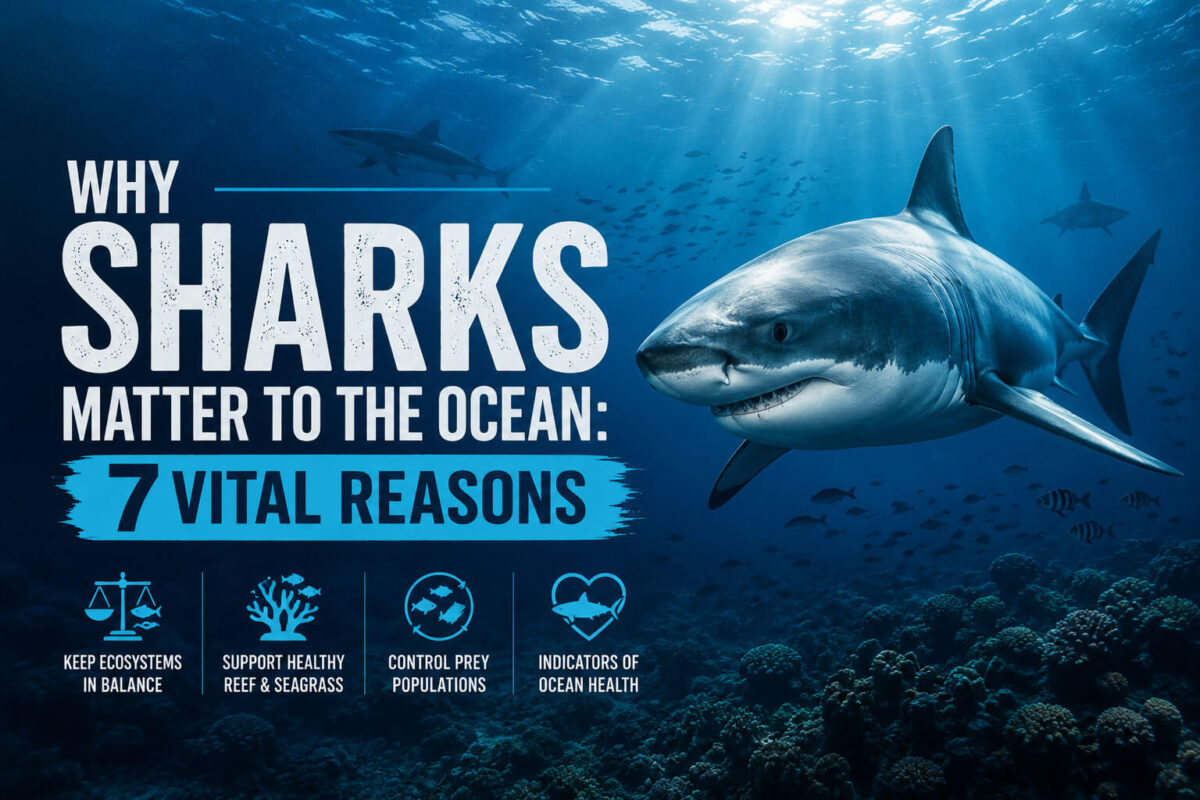
Why Sharks Matter to the Ocean: 7 Vital Reasons
Jul
Why Sharks Matter to the Ocean: 7 Vital Reasons
Sharks have patrolled Earth’s oceans for over 450 million years — and without them, marine ecosystems would collapse. Here’s the powerful science behind why sharks are irreplaceable.
Why Sharks Matter to the Ocean — The Big Picture
Understanding why sharks matter to the ocean requires stepping back from Hollywood mythology and looking at cold, hard ecology. Sharks are not mindless killing machines — they are one of the most sophisticated and ecologically critical species to ever evolve on this planet. As apex and mesopredators, they sit at or near the very top of marine food webs, and their influence trickles down through every layer of ocean life in ways that scientists are still working to fully understand.
The ocean covers 71% of Earth’s surface and produces more than half of the world’s oxygen through phytoplankton photosynthesis. Sharks are one of the key reasons those phytoplankton populations stay healthy. By regulating fish populations that graze on seagrass and control herbivore numbers, sharks indirectly protect the foundation of marine primary productivity. Remove sharks, and the entire food chain begins to unravel from the top down — a cascading process ecologists call a trophic cascade.
Sharks have survived five mass extinction events, including the one that wiped out the dinosaurs. They have been refining their ecological role for 450 million years, which is 200 million years before trees first appeared on land. That evolutionary longevity is not an accident — it reflects how deeply embedded sharks are in the architecture of marine life. Every ocean ecosystem that has evolved over millions of years has done so in the presence of sharks. Their removal creates a void that no other species can fill.
The economic argument for shark conservation is equally compelling. Healthy shark populations support thriving reef systems, which support billions of dollars in fisheries, tourism, and coastal protection. A single reef shark generates an estimated $250,000 in ecotourism revenue over its lifetime — compared to roughly $50 as a catch. Yet despite this calculus, we continue to lose approximately 100 million sharks every year to fishing, finning, and bycatch. Understanding why sharks matter to the ocean is the first step toward reversing that trend.
“Sharks are the immune system of the ocean — they remove the sick and the weak, keeping prey populations genetically robust and ecosystems in balance.”
Apex Predator Dynamics: How Sharks Keep the Ocean in Balance
The Trophic Cascade Effect
When sharks decline, the species they prey upon explode in population — a phenomenon called a trophic cascade. A landmark study published in the journal Science documented exactly this in the Northwest Atlantic: as large shark populations collapsed due to overfishing, their cownose ray prey increased 40-fold. Those rays then decimated bay scallop populations, destroying a century-old commercial scallop fishery in North Carolina. One predator removed, an entire industry lost. This is not a hypothetical — it happened within decades.
Trophic cascades triggered by shark removal don’t stop at the first prey level. They ripple downward through four, five, and six levels of the food web, destabilizing communities of fish, invertebrates, and even seagrasses and corals. The ocean’s food web is not a simple ladder — it’s a web of interdependencies, and sharks hold many of those threads in tension.
Regulating Prey Behavior, Not Just Numbers
Sharks don’t only influence ecosystems by eating prey — they change how prey species behave. This is known as the “ecology of fear,” and it may be just as important as predation itself. When sharks are present, sea turtles avoid overgrazing seagrass meadows in any single area. Green turtles, for example, will graze the tops of seagrass blades rather than the roots when tiger sharks patrol, allowing grass beds to regenerate. Remove the threat, and turtles concentrate in one place and strip entire meadows bare.
Fish behavior changes dramatically in the presence of sharks, too. Prey species school tighter, move more cautiously, and avoid certain areas — all of which has effects on where nutrients are deposited on the seafloor and how coral reef fish communities organize themselves spatially. Sharks function as architects of behavior across entire ecosystems, not just population controllers.
Genetic Health and Disease Control
Sharks selectively prey on the sick, injured, and genetically weaker individuals in a population. This is not sentiment — it’s mechanics. A weakened fish swims with an irregular gait, is slower to respond, and is easier for a shark to detect and catch. By continually removing these individuals, sharks improve the genetic fitness of fish populations over time. Without this pressure, diseases spread more rapidly through populations, weakening entire species. Sharks are, in the most literal ecological sense, the ocean’s immune system.
🔬 Research Insight: A 2021 study in Nature found that reef systems with healthy shark populations had fish communities 15–20% more resilient to bleaching events than reefs where sharks had been removed — demonstrating how predator presence strengthens entire ecosystems.
Types of Sharks and Their Ecological Roles
Not all sharks play the same ecological role. The ocean’s roughly 500 species of sharks occupy different niches — from open-ocean apex predators to bottom-dwelling scavengers — each contributing to marine health in distinct ways. Understanding this diversity is essential to grasping the full scope of why sharks matter to the ocean.
| Shark Species | Primary Habitat | Ecological Role | Diet | Conservation Status |
|---|---|---|---|---|
| Great White Shark | Coastal & open ocean | Apex predator; controls marine mammal populations | Seals, tuna, rays, cetaceans | Vulnerable |
| Tiger Shark | Tropical coastal waters | Generalist scavenger; seagrass ecosystem regulation | Turtles, seabirds, fish, carrion | Near Threatened |
| Whale Shark | Open ocean, tropics | Nutrient cycling via filter feeding on plankton | Plankton, small fish, fish eggs | Endangered |
| Hammerhead Shark | Coastal & reef systems | Stingray population control; reef health maintenance | Stingrays, octopus, squid, fish | Critically Endangered |
| Caribbean Reef Shark | Coral reef ecosystems | Reef fish behavior regulation; structural reef health | Reef fish, octopus, rays | Near Threatened |
This diversity of form and function means that shark conservation is not a one-size-fits-all challenge. Protecting an open-ocean apex predator like the great white requires different strategies than protecting a reef-dependent species like the Caribbean reef shark. Policymakers, researchers, and ocean advocates must understand the specific roles each species plays in order to craft effective conservation plans.
🦈 Did You Know: Hammerhead sharks were once so numerous in reef systems that their populations kept stingray numbers in check. As hammerheads have declined by over 80% in some regions, stingray populations have surged — with direct consequences for shellfish and bottom-dwelling communities.
Threats Sharks Face: What’s Driving Their Decline
Sharks face an unprecedented convergence of threats in the 21st century. Unlike most marine species discussions, which focus on a single stressor, sharks are being hit simultaneously from multiple directions — and their slow reproductive rates mean populations take decades to recover from even modest pressures. To protect these animals, we need to clearly understand what is killing them and at what scale.
Overfishing and Targeted Shark Fisheries
Sharks are targeted directly in fisheries around the world, primarily for their fins, liver oil (used in cosmetics and supplements), meat, and cartilage. The shark fin trade is the most notorious driver: fins are sliced off and the body dumped overboard — often still alive — to save freezer space on fishing vessels. An estimated 73 million sharks are killed for their fins each year, supplying a global trade worth hundreds of millions of dollars. Despite international bans and trade regulations in many countries, enforcement at sea remains inconsistent and difficult.
Bycatch: The Silent Killer
Millions of additional sharks die as bycatch — unintentional capture in longlines, trawls, and gillnets set for tuna, swordfish, and other commercial species. Longlines can stretch for 100 kilometers and carry tens of thousands of hooks, and sharks are attracted to the same bait. The FAO estimates that bycatch accounts for between 50 and 80 million shark deaths per year, on top of targeted catches. Many of these deaths go unrecorded, making it nearly impossible to accurately measure total shark mortality.
Habitat Destruction and Climate Change
Coral reef degradation, mangrove destruction, and coastal development eliminate critical nursery habitats where juvenile sharks grow and feed before moving into adult territories. Climate change compounds this by warming and acidifying ocean waters, shifting prey distributions, disrupting migration patterns, and bleaching coral reefs that reef sharks depend on. For sharks with slow reproductive cycles — some species only produce one or two pups after a gestation period longer than a human pregnancy — habitat loss at the nursery stage can devastate entire regional populations.
- Shark finning: Fins removed at sea, body discarded; banned in over 100 countries but enforcement is weak in international waters.
- Longline bycatch: Up to 4.5 sharks caught as bycatch for every shark targeted, across global commercial fleets.
- Gill nets: Stationary nets that entangle sharks indiscriminately; responsible for millions of deaths in coastal artisanal fisheries.
- Beach drumlines: Baited hooks deployed near popular swimming beaches in Australia and South Africa kill thousands of non-target sharks annually.
- Aquarium and trophy trade: Live capture for aquariums and jaws/teeth for trophy markets adds additional mortality pressure on local populations.
- Pollution and microplastics: Chemical pollution and microplastic ingestion impair shark immune systems and reproductive success. Learn more about how microplastic pollution affects the marine food chain.
⚠️ Critical Stat: Sharks reproduce slowly — many species take 10–15 years to reach sexual maturity and produce fewer than 10 pups per litter. At current fishing rates, most commercially exploited species cannot recover within human timescales without immediate, dramatic intervention.
How Sharks Regulate Ocean Ecosystems: Step by Step
Sharks Hunt and Cull Weak Prey
At the base of the process, sharks locate and pursue prey species — fish, rays, marine mammals, and invertebrates — targeting individuals that display signs of weakness, disease, or injury. This selective predation removes genetic vulnerabilities from the gene pool, strengthening the prey population as a whole. Healthy prey populations are better able to withstand environmental stressors like disease outbreaks and temperature fluctuations.
Prey Populations Are Kept in Check
By consuming prey, sharks prevent any single species from becoming overly dominant. Unchecked herbivore populations — like certain fish that feed on coral and seagrass — will overgraze their food source to the point of collapse. Sharks regulate these populations, ensuring enough plant and algae growth persists to support the entire lower tier of the food web, including the zooplankton and small fish that everything else depends on.
Fear Changes Prey Behavior Across the Ecosystem
The mere presence of sharks alters how and where prey species feed, move, and congregate. This “landscape of fear” distributes grazing pressure more evenly across habitats, preventing localized overgrazing. Seagrass meadows stay intact, coral polyps have space to grow, and benthic communities maintain structural integrity — all because prey animals alter their behavior to avoid shark-patrolled zones.
Nutrient Cycling Through Predation and Defecation
When sharks feed and digest, they excrete nutrient-rich waste that fertilizes the water column and seafloor. This is especially significant in oligotrophic (nutrient-poor) open-ocean environments, where shark-derived nutrients can be a meaningful input to primary productivity. Whale sharks, which filter enormous volumes of plankton-rich water, also redistribute nutrients horizontally as they migrate across ocean basins, connecting distant ecosystems.
Dead Sharks Fuel Deep-Sea Communities
When a large shark dies, its carcass — called a “shark fall” — sinks to the seafloor and provides a massive pulse of nutrients to deep-sea communities. A single whale shark carcass can sustain deep-sea scavengers and microorganisms for months or even years. These events enrich the deepest, most nutrient-starved parts of the ocean, supporting species that would otherwise have far fewer energy inputs. Sharks nourish the ocean even in death.
Healthy Sharks Sustain Healthy Oceans for Humans
The cascading benefits of shark presence ultimately return to human populations. Healthy fisheries, thriving coral reefs, productive seagrass meadows, and a stable global climate all depend in part on functional shark populations. Coastal communities that depend on reef tourism, artisanal fishing, or coastal protection from storm surge are all downstream beneficiaries of healthy shark ecosystems. Protecting sharks is an investment in ocean-dependent human livelihoods around the world.
Tools of Shark Research: How Scientists Study These Apex Predators
Studying sharks in the wild is one of the most logistically challenging tasks in marine biology. These animals move vast distances, dive to extraordinary depths, and are rarely encountered predictably. Scientists have developed an impressive toolkit to track, observe, and understand sharks without disturbing natural behaviors or causing harm to the animals they are trying to protect.
Attached to the dorsal fin, SPOT tags transmit GPS location data whenever the fin breaks the surface. They have revealed jaw-dropping migration distances — great whites travelling 20,000 km in a single year — and exposed previously unknown aggregation sites critical to conservation planning.
Implanted transmitters ping underwater receivers anchored at known locations, building detailed maps of habitat use, depth preferences, and seasonal movement. Networks of thousands of receivers across ocean basins now allow collaborative multi-species tracking at a global scale.
Scientists filter water samples and analyze trace genetic material shed by sharks — skin cells, mucus, waste — to detect presence without ever seeing the animal. eDNA surveys can reveal whether a species inhabits an area and estimate relative abundance from a simple water bottle.
Cameras mounted on weighted frames with bait attractors are deployed on the seafloor to record passing shark species. BRUVs provide standardized survey data for population estimates and are used globally to compare reef shark abundance across marine protected areas and fished zones.
Individual sharks can be identified by natural markings — spot patterns on whale sharks, fin notches on great whites, and scar patterns. Platforms like Wildbook for Whale Sharks use AI image-matching to build global population databases from citizen science photo submissions.
Drones equipped with HD cameras allow researchers to observe sharks from above without any in-water interaction, capturing behavior, body condition, pregnancy status (visible in gravid females), and social interactions across aggregation sites in remote locations impossible to study any other way.
💡 Pro Tip for Ocean Advocates: You can contribute to shark science without a research vessel. Apps like Shark Guardian and citizen science platforms allow divers and snorkelers to submit shark sightings and photos that feed directly into population databases used by conservation scientists worldwide.
Best Shark Ecosystems Worldwide: Where Sharks Still Thrive
Despite global declines, there are places in the ocean where shark populations remain relatively healthy and where their ecological roles are still intact. These locations offer a window into what functional ocean ecosystems look like — and provide crucial data for restoration science. If you love the ocean, these are the places worth protecting, visiting, and advocating for. You might also enjoy reading about the complete guide to shark diving to experience these ecosystems firsthand.
- Cocos Island, Costa Rica: A remote UNESCO World Heritage Site in the Eastern Pacific, Cocos Island hosts some of the world’s densest aggregations of scalloped hammerhead sharks, whale sharks, and whitetip reef sharks. With no permanent human habitation and strict no-fishing protection, it represents a rare example of a nearly intact pelagic shark ecosystem — and is a benchmark against which degraded systems are measured.
- The Bahamas: Long a pioneer in shark protection (the Bahamas established the world’s first shark sanctuary in 2011), these shallow tropical waters host healthy populations of Caribbean reef sharks, great hammerheads, and tiger sharks. Nassau’s Stuart Cove and Tiger Beach off Grand Bahama Island are globally recognized sites where shark diving tourism generates millions in annual revenue, demonstrating the economic power of living sharks.
- Palau, Micronesia: Palau declared its entire 600,000 square kilometer exclusive economic zone a shark sanctuary in 2009. The country’s commitment to shark protection has paid dividends: reef shark biomass in Palau is among the highest ever recorded, and the economy benefits enormously from a dive tourism industry built around these animals. It stands as a global model for shark-centered marine protection.
- Guadalupe Island, Mexico: The cold, clear waters around this remote Pacific island are the world’s premier site for observing great white sharks. Biannual aggregations of up to 200 individuals have been documented, attracting cage diving operators who have built a sustainable industry that funds local conservation and research simultaneously. The island is a federally protected biosphere reserve.
- Aliwal Shoal, South Africa: This submerged rocky reef off KwaZulu-Natal attracts oceanic blacktip sharks, ragged-tooth sharks (sand tigers), and tiger sharks in large numbers year-round. It is one of Africa’s most biodiverse dive sites and has been central to South Africa’s efforts to establish marine protected zones that cover critical shark habitat.
- Raja Ampat, Indonesia: The coral triangle epicenter of global marine biodiversity, Raja Ampat hosts an extraordinary density of reef-associated shark species including wobbegongs, bamboo sharks, and reef whitetips. Indonesia declared a national shark sanctuary in 2013, and Raja Ampat’s local governments have been among the most progressive in enforcing no-take zones for elasmobranchs.
🌟 Top Recommendation: Cocos Island, Costa Rica remains the gold standard for experiencing sharks in a fully intact ecosystem. Its remoteness keeps fishing pressure low and its protected status has held for decades — making it the closest thing on Earth to what the ancient ocean looked like when sharks ruled unchallenged.
Sharks vs. No Sharks: Two Very Different Oceans
Coral reefs are structurally complex, with diverse fish communities and abundant invertebrates. Seagrass meadows are intact and productive, supporting dugongs, turtles, and juvenile fish. Prey fish populations are genetically robust and disease rates are low. Marine mammal populations are kept in check, preventing localized depletion of prey fish. Nutrient cycling is active throughout the water column. Fisheries are productive and sustainable. Ecotourism flourishes, generating economic returns that dwarf extractive fishing. The ecosystem has resilience and can recover from disturbance events like storms or bleaching.
Mesopredator populations explode, leading to overharvesting of lower trophic levels. Seagrass meadows are grazed to bare sand by unchecked turtle and dugong populations, eliminating nursery habitat for countless species. Coral reefs become algae-dominated wastelands as herbivorous fish populations spiral out of control. Disease spreads rapidly through weakened, genetically homogenous prey populations. Fisheries collapse within one to three generations of shark removal. Coastal ecosystems lose structural integrity and storm protection capacity. The ocean becomes an unstable, low-diversity system increasingly dominated by jellyfish — an indicator of deep ecological dysfunction.
The contrast between these two states is not theoretical — scientists have documented the transition from healthy-shark to no-shark ocean conditions in real time in the Northwest Atlantic, the Mediterranean, and large sections of the Indo-Pacific. In every documented case, the removal of sharks triggers measurable deterioration within years. Recovery, when protection is reinstated, takes decades — if the ecological conditions for recovery still exist at all. The urgency of shark conservation cannot be overstated: every year of continued decline makes recovery harder and more expensive.
Ethics, Conservation, and What You Can Do to Protect Sharks
The Ethical Case for Shark Protection
Beyond ecology and economics, there is a straightforward ethical argument for shark conservation. Sharks are sentient beings capable of learning, problem-solving, and potentially experiencing stress. Finning — slicing off fins and discarding a live animal to drown — is an act of extraordinary cruelty that most people would find abhorrent if they witnessed it directly. The distance between consumer and consequence (a bowl of shark fin soup in a restaurant and a dying shark on a distant ocean) makes it psychologically easier to ignore, but the suffering is real and the ecological harm is compounding.
Indigenous and coastal communities around the world have coexisted with sharks for millennia, many viewing them as spiritual ancestors and ecological partners rather than threats to be eliminated. Western-dominated fisheries science is increasingly recognizing the value of traditional ecological knowledge in shark management — understanding that communities who have lived alongside sharks for generations often have sophisticated, if informal, knowledge of shark behavior and ecology that complements scientific data.
What Effective Shark Conservation Looks Like
The most effective conservation interventions combine policy, enforcement, economic incentives, and public education. Marine Protected Areas that are large enough to cover shark home ranges and adequately enforced are the gold standard — but they must be paired with sustainable livelihood alternatives for fishing communities that currently depend on shark catches. Consumer-facing campaigns that reduce demand for shark fin, shark liver oil, and shark meat can have dramatic market-level effects, as demonstrated by campaigns in China that reduced shark fin consumption by an estimated 50–70% between 2012 and 2020.
- Support shark sanctuaries: More than 15 countries have declared shark sanctuaries banning all commercial shark fishing — advocate for more and for the enforcement funding to make them effective.
- Refuse shark products: Shark fin soup, shark steaks, squalene supplements, and shark cartilage products all drive demand that kills millions of sharks annually. Choosing alternatives matters at scale.
- Choose ethical ocean tourism: Support dive operators who practice responsible shark diving — no feeding, no touching, no flash photography — and who donate a portion of revenue to research and conservation.
- Advocate for bycatch reduction: Support organizations pushing for circle hook mandates on longlines, time-area closures during shark aggregation seasons, and mandatory bycatch reporting across global fisheries.
- Educate and challenge the narrative: Media continues to portray sharks as threats to humans. The reality: sharks kill fewer than 10 people per year worldwide. We kill 100 million of them. Sharing accurate information shifts public sentiment toward protection. Learn more at Oceana’s shark conservation page.
📊 Key Statistic: According to the IUCN Red List, 37% of shark and ray species are now threatened with extinction — up from 24% just a decade ago. This accelerating trajectory means the window for effective intervention is narrowing rapidly, and the decisions made in the next decade will determine whether sharks survive as a functional ecological force.
Understanding why sharks matter to the ocean is ultimately about understanding what kind of world we want to inhabit. A world without sharks is not just a world with fewer predators — it’s a world with a fundamentally broken ocean, reduced oxygen production, collapsed fisheries, and diminished resilience in the face of climate change. The choice to protect sharks is the choice to protect the ocean itself, and through it, the stability of life on this planet. That is not an exaggeration — it is the conclusion that decades of ecological science demands.
Frequently Asked Questions About Why Sharks Matter to the Ocean
If all sharks disappeared, ocean ecosystems would experience dramatic and destructive trophic cascades. Mesopredator fish and rays would multiply unchecked, devastating populations of smaller fish, shellfish, and invertebrates. Seagrass meadows would be overgrazed by unconstrained herbivore populations. Coral reefs would become algae-dominated wastelands without the fish community structure that sharks help maintain. Primary productivity — and therefore oxygen production — would decline as phytoplankton ecosystems destabilized. The ocean would become far less diverse, less productive, and far less capable of sustaining the fisheries that billions of people depend on for food and income.
Yes, though indirectly. Sharks help maintain the health of ocean ecosystems that support phytoplankton, which produce over 50% of the world’s oxygen through photosynthesis. By regulating the food web, sharks prevent the collapse of the lower trophic levels that phytoplankton depend on. Whale sharks also directly interact with plankton-rich waters through filter feeding, and their movement patterns influence nutrient distribution across ocean basins. Healthy shark populations are thus a component — albeit indirect — of the planetary oxygen cycle.
Conservative scientific estimates place annual shark mortality due to human activity at between 63 and 100 million individuals per year. This figure includes sharks killed in directed fisheries for fins, meat, and liver oil, as well as the massive number killed as bycatch in commercial longline, trawl, and gillnet operations targeting other species. The true number may be higher, as bycatch in small-scale artisanal fisheries is largely unrecorded. By comparison, sharks kill fewer than 10 humans per year on average globally — making sharks one of the most disproportionately persecuted animals on Earth.
Apex predators like great white sharks, tiger sharks, and hammerheads are keystone species — their influence on the ecosystem is disproportionately large relative to their biomass. By sitting at the top of the food web, they regulate the populations and behaviors of every level below them. Their removal triggers trophic cascades that can collapse entire ecosystem compartments within years. They also contribute to genetic fitness of prey populations through selective predation, and they drive behavioral change in prey species that has far-reaching consequences for habitat structure and nutrient distribution. No other group of marine animals performs this combination of ecological functions.
Recovery is possible but slow and dependent on effective, sustained protection. Sharks’ slow reproductive rates — many species take a decade or more to reach sexual maturity and produce small litters — mean populations cannot bounce back quickly the way fast-reproducing fish can. Studies of no-take marine reserves show measurable increases in reef shark abundance within 5–10 years of protection, but full ecosystem recovery to pre-depletion baselines typically requires 20–50 years of strict management. Success stories exist: Caribbean reef shark populations in protected Bahamian waters have increased significantly since 2011’s shark sanctuary declaration. But recovery requires not just stopping killing, also protecting habitat and prey.
There are meaningful actions at every level of engagement. At the consumer level: avoid shark fin products, check cosmetics for squalene (shark liver oil), and choose seafood certified by bodies that monitor shark bycatch. As an ocean enthusiast: choose responsible dive operators that practice ethical shark encounters, contribute to citizen science platforms with shark sighting data, and share accurate information about sharks on social media to counter fear-based narratives. At the advocacy level: support organizations like the Shark Conservation Fund, Oceana, and the Marine Conservation Society that lobby for better fisheries legislation, larger marine protected areas, and stronger bycatch regulations. Every action, however small, adds to the collective pressure needed to turn the tide for sharks. Wearing your passion for ocean life is also a form of advocacy — and brands like Seasportees make that statement easy and stylish.
