


🤿 Scuba & Free Diving
Why Divers Joke About the Deep (And What It Really Means)
Sep
Why Divers Joke About the Deep (And What It Really Means)
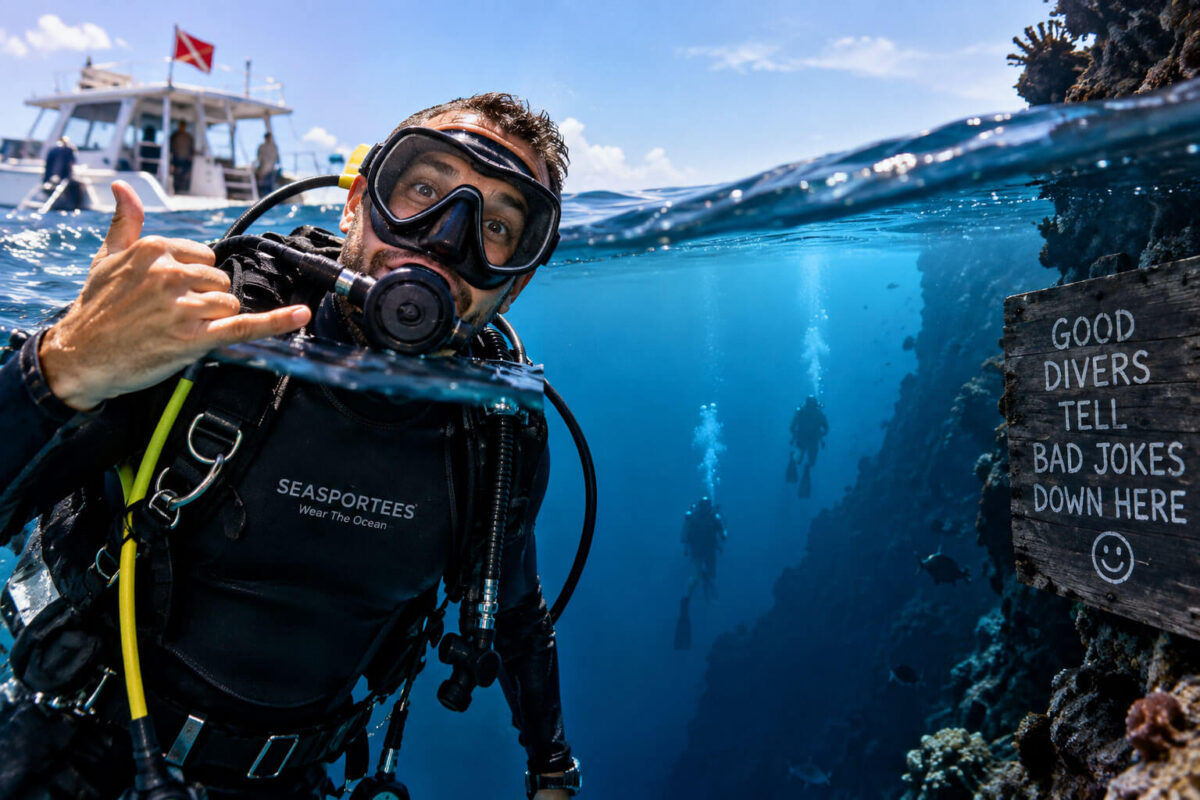
Dark humor, skull imagery, and gallows wit aren’t random in dive culture — they’re the language of people who’ve faced real depth and come back laughing. Here’s why divers joke about the deep, and what it actually reveals about the community.
- Why Divers Joke About the Deep
- The Psychology Behind Dive Humor
- Types of Dive Humor: A Breakdown
- When the Jokes Are Actually Safety Briefings
- How Dive Humor Becomes a Ritual
- The Gear That Earns a Joke
- Where Dive Humor Is Born
- Dark Humor vs. Dive Machismo
- Humor, Ethics, and Respect Underwater
- Frequently Asked Questions
Why Divers Joke About the Deep — And Why It’s Never Just a Joke
There’s a particular kind of humor that only makes sense once you’ve descended past twenty meters, felt your ears equalize in the dark, and returned to the surface realizing you’ve just done something genuinely wild. It’s the kind of humor that produces T-shirts with grinning skulls in dive masks, one-liners about nitrogen bubbles, and entire group chats dedicated to the phrase “it’s fine, we’re diving tomorrow.” Understanding why divers joke about the deep means understanding what kind of activity diving actually is — not a sport for the anxious, but not reckless either. It exists in a specific psychological space between careful preparation and accepted uncertainty, and humor is how people inhabit that space without losing their minds.
Dive humor has its roots in something much older than scuba. Sailors, mountaineers, firefighters, and surgeons all share a similarly dark, self-deprecating comedic register. Researchers in occupational stress have long noted that gallows humor is one of the most reliable coping mechanisms in high-stakes professions, helping individuals process fear, build group cohesion, and signal competence without bragging. Divers didn’t invent this — they just applied it to a world where the environment genuinely can kill you if you surface too fast, and where the person most likely to save your life is the buddy cracking jokes before the briefing.
The fact that dive humor is often death-adjacent — skulls, nitrogen narcosis, the bends, running low on air — is not coincidence. It’s precision. Jokes about the deep acknowledge the stakes while simultaneously signaling that the teller is experienced enough to treat those stakes with composure rather than panic. A new open-water student doesn’t crack nitrogen jokes because nitrogen isn’t funny yet — it’s just terrifying. The diver with 500 logged dives has absorbed enough experience to hold the danger at a comfortable ironic distance. The joke is proof of the journey.
This is why dive humor travels so naturally onto apparel, stickers, and gear bags. The joke doesn’t just communicate a sense of humor — it communicates a résumé. When someone reads “Deep Dives & Dead Vibes” on a shirt, they’re reading a claim about who that person is: someone who has been down there, knows what it costs, and came back with a grin. That’s a more efficient form of identity communication than any certification card tucked in a wallet.
“The best dive briefing I ever got was from a divemaster who opened with, ‘The good news is we’ve never lost anyone at this site. The bad news is we’ve never actually checked.’ Forty dives later, I still think about that briefing every time I kit up — and I’ve never been more alert underwater.”
The Real Psychology Behind Why Divers Joke About the Deep
Psychologists who study humor under stress consistently find that the ability to joke about a threatening situation correlates with perceived control. People who feel they understand a risk — and have developed genuine competence in managing it — are far more likely to find it funny than those who feel helpless. This maps almost exactly onto the diver’s experience curve. Early diving is marked by anxiety, careful rule-following, and a healthy respect for everything that can go wrong. Advanced diving is marked by the same respect — but also by the ease that comes from thousands of repetitions.
Humor as Cognitive Reappraisal
Cognitive reappraisal is a psychological strategy in which a person reframes a stressful situation to change its emotional impact. Humor is one of the most elegant forms of reappraisal available to humans. When a diver jokes that they’re “already dead” before entering cold water, they’re performing a micro-reappraisal of the stress response — acknowledging the discomfort, stripping it of its power to produce panic, and replacing that power with laughter. It’s not denial. It’s a practiced, sophisticated emotional maneuver that most recreational athletes never need to develop. According to research published in Personality and Social Psychology journals, humor-based coping is associated with lower physiological stress responses and faster return to baseline after threat exposure.
Group Identity and the In-Joke Barrier
Dive humor functions as a membership signal. You either get the nitrogen narcosis joke or you don’t, and the getting of it is itself proof that you belong at the table. This kind of in-group signaling through shared humor is well-documented in communities built around shared risk — military units, surgical teams, wildfire crews. The dive community is no different. A joke about skipping a safety stop isn’t funny to a non-diver, marginally funny to an open-water graduate who has never wanted to skip a safety stop, and hilarious to a divemaster who has watched a hundred tourists treat the stop like optional homework. The specificity of the joke is what makes it powerful.
Releasing the Pressure Valve
Diving demands a particular kind of emotional regulation: you must be calm enough to make good decisions underwater, but alert enough to respond instantly to changing conditions. That combination — controlled alertness — requires significant mental energy. Humor is one of the most efficient pressure-valve mechanisms available between dives. The joke cracked on the surface interval isn’t just entertainment; it’s active emotional maintenance, bleeding off accumulated tension so that the next dive starts with a clean slate. Experienced dive guides intuitively understand this, which is why the best ones tend to have a sharp, dry sense of humor and deploy it strategically before difficult dives rather than after easy ones.
📌 Research note: A 2019 study from the University of Zurich found that individuals who used humor to cope with daily stress showed measurably lower cortisol levels than those who used avoidance strategies. Dive culture figured this out empirically, decades before the research confirmed it.
Types of Dive Humor — A Breakdown of Why Divers Joke About the Deep
Not all dive jokes are created equal. The community has developed a remarkably consistent taxonomy of humor styles, each serving a slightly different psychological or social function. Below is a breakdown of the most common categories, roughly ordered from most benign to most philosophically interesting — and why each one persists.
| Humor Type | Example | Function | Common Context | Intensity |
|---|---|---|---|---|
| Gear Nerd Wit | “My BCD costs more than my car. The car is fine.” | Community bonding through shared financial pain | Dive shop, online forums | Mild |
| Nitrogen Narcosis Jokes | “Narced at 35m and tried to hand my reg to a fish.” | Normalizing altered states, signaling depth experience | Post-dive surface interval | Mild |
| Dark Competence Humor | “Deep dives and dead vibes — see you on the other side.” | Reappraisal of risk, identity signaling | Liveaboard, dive boat kitting up | Medium |
| Buddy System Mockery | “My buddy’s job is to witness the incident.” | Processing genuine dependency with irony | Between trusted dive partners | Medium |
| Existential Deep Humor | “Forty meters down, nothing matters. It’s actually great.” | Philosophical reframing of the underwater state | Late-night liveaboard, post-night dive | Medium |
Each type maps onto a slightly different moment in the dive experience and serves a different social function. Gear humor is entry-level — anyone who’s checked a price tag can participate. Existential deep humor is reserved for people who have spent genuine time at depth in conditions that strip away distraction, and who have returned with something they can only describe obliquely, through a joke. The pressures that build better divers are also the pressures that produce the best jokes.
📌 Worth noting: The humor types that persist longest in dive culture — dark competence humor and existential deep humor — are also the ones that require the most actual diving experience to produce. They can’t be faked. You either have the depth to support the joke, or you don’t, and experienced divers can tell the difference immediately.
When the Jokes Are Actually Safety Briefings in Disguise
One of the most underappreciated functions of dive humor is its role as an informal safety communication channel. The official pre-dive briefing covers emergency procedures, signals, and turn-around pressure. The jokes that follow — the ones that seem purely social — often reinforce those same points in a form the brain is far more likely to retain. This is not accidental. Experienced divemasters and instructors frequently use humor deliberately as a pedagogical tool, because information delivered alongside an emotional response (laughter, in this case) is encoded more durably than information delivered in a monotone recitation.
The Briefing Embedded in the Punchline
Consider the classic dive boat line: “Your buddy is there so when you get into trouble, someone can describe exactly what happened.” The joke is dark. The underlying message is serious: your buddy needs to be watching you, not the reef. The humor format makes the message land without sounding like a lecture, which means the diver who laughed is more likely to actually watch their buddy than the diver who sat through a straight recitation of buddy-system rules and promptly forgot them.
Humor as Hazard Reinforcement
Repeated exposure to the same jokes builds a shared mental library of known hazards. When every diver on a boat laughs at the same nitrogen narcosis story, they’re collectively rehearsing the signs of impairment without formally rehearsing anything. The joke about the diver who tried to give their regulator to a grouper at 35 meters reinforces — through repetition and laughter — that narcosis is real, that it affects judgment before the diver knows it’s happening, and that depth requires active cognitive monitoring. The formal dive manual covers all of this. The joke makes it memorable.
Why New Divers Should Listen to the Jokes
- Humor carries field knowledge: Most dive jokes reference real incidents or near-misses, stripped of identifying details and repackaged as comedy. The joke is the incident report that people actually read.
- Dark jokes signal high-stakes realities: If experienced divers joke about a specific hazard, that hazard deserves serious attention. The joke is often a calibration tool for what actually goes wrong.
- Laughter lowers defensive resistance: Information delivered humorously bypasses the defensiveness that can arise from formal warnings, especially in divers who consider themselves already experienced.
- Shared humor builds the trust required for genuine safety: The buddy pair that laughs together is more likely to maintain honest communication underwater, including the uncomfortable kind (“I’m not feeling right — let’s ascend”).
📌 Instructor insight: PADI and SSI research on retention rates consistently show that scenarios — including humorous ones — produce far higher retention of safety-critical information than declarative instruction alone. The best dive instructors have known this for years. The jokes aren’t the break from the lesson. They are the lesson.
How Dive Humor Becomes a Ritual — Step by Step
Dive humor doesn’t arrive fully formed. It develops through a predictable sequence of experiences that every diver moves through, at their own pace, on their way from nervous beginner to someone who can joke about running low on air without it being a cry for help. Understanding this sequence helps explain why divers joke about the deep in the specific ways they do — and why the humor changes as experience accumulates.
The First Open-Water Dive — No Jokes Yet
The first time a student diver descends to ten meters, humor is not available. The cognitive load of buoyancy control, regulator breathing, mask clearing, and spatial orientation consumes every available mental resource. This is the phase where diving feels genuinely dangerous and any attempt at dive humor from instructors lands flat. Respect for the environment is being installed at the operating-system level.
The First Twenty Dives — Humor Borrowed, Not Owned
After basic competence develops, newer divers begin absorbing the humor of the divers around them — laughing at jokes they don’t fully understand yet, repeating lines that sound right even if the experience behind them hasn’t fully arrived. This is the apprentice phase of dive culture, and it’s valuable: the jokes are being stored for later, when they’ll finally make complete sense.
The First Real Incident — Humor as Processing Tool
Every diver has a moment — a missed safety stop, an unplanned rapid ascent, a genuine air-sharing situation, an encounter with a current that felt genuinely dangerous — that produces the raw material for their first real dive joke. The joke typically emerges days or weeks later, after the adrenaline has fully metabolized. It’s not denial. It’s the moment the experience gets converted from something that happened to something the diver owns and can carry forward.
The Regular Dive Community — Humor as Membership
Once a diver has enough experience to contribute original material — their own stories, their own punchlines, their own variations on shared themes — they become a full participant in the dive humor ecosystem. This is where dive apparel, stickers, and inside jokes take on their full social function: they’re membership cards for a community that doesn’t have a formal clubhouse, just a shared language of dark, affectionate, experience-based comedy.
The Advanced Diver — Humor as Craft
The most experienced divers — cave divers, technical divers, dive professionals with thousands of logged hours — develop a form of dive humor that is almost meditative in its calm. The jokes are dryer, more precise, and reference conditions and situations that most recreational divers will never encounter. This is the apex of dive humor: fully earned, structurally elegant, and completely incomprehensible to anyone who hasn’t been there. It’s also the phase where “Deep Dives & Dead Vibes” stops being edgy and starts being accurate.
The Gear That Earns a Joke — Six Pieces of Equipment with a Sense of Humor
Dive gear has its own comedic subculture, built around the combination of extreme expense, radical importance, and frequent malfunction. Every piece of equipment a diver owns has generated at least one category of joke, and the jokes tend to be more reliable than the equipment itself. Here are the six pieces of gear that have produced the most enduring humor in the dive community — and why each one deserves it.
The buoyancy compensator device costs enough to require a financing plan, fits like a second-hand sofa, and somehow always develops a slow leak at 18 meters. Every diver has a BCD story. None of them end well at the surface.
Masks fog when you need visibility most, flood when you’ve forgotten how to clear them, and cost three times as much as your first car if you want one that does neither. The fit test at the shop is never as reliable as the test at ten meters.
A precision instrument that delivers life-critical gas and requires annual servicing by a specialist who charges by the hour. The regulator joke category centers on the gap between what a reg costs and the fact that it’s a tube you breathe through.
A wrist-mounted device more expensive than most laptops, whose primary function is to flash warnings you will partially ignore while telling yourself you’re being conservative. The no-decompression limit joke is a genre unto itself.
The one piece of gear divers become genuinely evangelical about, despite the fact that most of the time they’re just there to help you accidentally kick the reef you were definitely not going to kick. Fin brand loyalty is approximately as rational as football team loyalty.
A 5mm rubber garment that requires twenty minutes and a talc bomb to put on, another twenty minutes to remove, and smells like a marine mammal by week three of a liveaboard. The wetsuit on the dive boat rail is the universal signal that someone is already having a morning.
📌 Pro tip: The diver who jokes the most about their gear is almost always the diver who maintains it most carefully. In dive culture, humor about equipment is a form of respect — you only joke about the things you take seriously enough to understand intimately.
Where Dive Humor Is Born — The Locations That Produce the Best Stories
Dive humor is not evenly distributed across the world’s oceans. It concentrates in specific environments where conditions are challenging enough to generate genuine stories, and where dive communities are dense enough that those stories get told, retold, and eventually distilled into jokes. Here are the locations most reliably associated with the highest quality dive humor — and the specific conditions that produce it.
- Liveaboard boats, anywhere: The liveaboard is the university of dive humor. Six to ten days with the same group of people, four dives per day, communal meals, and no cellular service produces a comedic pressure cooker. Inside jokes that would take years to develop on land arrive fully formed by day three. The surface interval on a liveaboard at night, somewhere in the Coral Sea or the Red Sea, is responsible for more enduring dive jokes than any other context.
- The Red Sea, Egypt: Consistently cold early mornings, visibility that makes other dive destinations look foggy, and a local dive industry that has been perfecting the deadpan delivery of safety information since the 1970s. Egyptian dive guides have a specific form of dry humor that travels home in every diver’s luggage.
- The Great Barrier Reef, Australia: Australian dive culture runs on self-deprecation and competitive understatement. The reef provides enough genuine drama — currents, sharks, visibility variables — to generate excellent raw material, and Australian divers are constitutionally incapable of describing anything dramatic without making it sound boring.
- Komodo, Indonesia: The dragons onshore are a reliable conversation starter, but it’s the current diving — drift dives through channels that feel more like being shot out of a cannon — that produces the humor. Every diver who has done Komodo has a current story. Every current story ends with “and then I just stopped fighting it.”
- The Cayman Islands: The dive industry here is so well-organized and professionally delivered that the humor arrives through contrast — the gap between the immaculate briefing and the absolute chaos of what actually happens underwater. Stingray City alone has produced enough comedy to fill several podcast seasons.
- Cenotes, Mexico: Cave and cavern diving humor is its own subspecialty, operating at a level of philosophical calm that can unsettle people who don’t dive. The cenote diver’s joke is always delivered in a tone that suggests they’re not entirely sure they’re still in the same dimension as everyone else. They may not be.
📌 Top recommendation: If you want to understand why divers joke about the deep at its most refined, spend a week on a liveaboard in a genuinely challenging destination — Komodo, the Maldives, or the Red Sea. The jokes you bring home will last longer than the tan.
Dark Humor vs. Dive Machismo — They Are Not the Same Thing
One of the most important distinctions in dive culture is the difference between genuine dark humor — which acknowledges risk with calm, earned confidence — and dive machismo, which minimizes risk through denial and social performance. They can look similar from the outside, but they function entirely differently and produce very different outcomes underwater. Understanding the difference matters not just philosophically, but practically, because the two attitudes respond to emergencies in completely opposite ways.
Earned through real experience. Acknowledges the actual risks of diving with specificity and precision. The joke-teller understands exactly what they’re joking about, has protocols in place for the scenario they’re describing, and would be the first person to abort a dive that doesn’t feel right. Dark humor is confidence with its eyes open. The diver who jokes about running low on air is the same diver who checks their SPG obsessively and never actually runs low on air.
Performed for social effect rather than earned through experience. Minimizes risk not because it’s genuinely well-managed, but because acknowledging it would feel like weakness. The machismo diver skips safety stops to look casual, ignores dive computers to seem experienced, and jokes about depth limits they don’t actually understand. Unlike dark humor — which is a sign of competence — machismo is a warning sign. It correlates with avoidable incidents, not with impressive dive logs.
The key diagnostic question is simple: does the person joking about the deep genuinely respect it? Real dark humor is downstream of genuine respect. You can’t authentically joke about nitrogen narcosis if you don’t actually understand what narcosis does to decision-making at depth. You can’t credibly wear “Deep Dives & Dead Vibes” if your deepest dive is the pool session during your open-water course. The community knows the difference, and it calibrates accordingly. Real respect for the ocean environment is always the foundation under the joke.
Humor, Ethics, and the Lines That Don’t Get Crossed Underwater
Dive humor operates within a clear ethical framework, even if that framework is never formally stated. The community has developed strong implicit rules about what kinds of jokes are acceptable and what crosses into territory that undermines the actual safety culture that makes humor possible in the first place. These rules aren’t written down, but violating them produces swift and consistent social consequences — usually a silence that is considerably more eloquent than any correction.
What Dive Humor Protects
The highest function of dive humor is to make the safety culture more durable, not less. A community that laughs together about the realities of diving maintains honest communication about those realities far more reliably than a community that treats every risk as too serious to acknowledge lightly. The ethics of dive humor are therefore fundamentally aligned with its practical function: the jokes that reinforce awareness and competence are good jokes; the jokes that undermine either are simply not funny, and the community’s silence tells you so.
Conservation and the Limit of the Joke
There is one domain where dive humor stops almost entirely: marine conservation. Divers are, as a community, deeply committed to the health of the environments they dive in, and jokes that minimize damage to reefs, species, or ecosystems land with a particular flatness that functions as a hard cultural boundary. Coral reef health is not a punchline in any functional dive community, and the absence of reef-damage humor in an otherwise humor-saturated culture is itself a form of communication about what the community considers sacred. For a definitive look at ethical shark diving, that same standard applies: the ocean’s apex predators are a source of awe, not material.
- Peer pressure jokes are not acceptable: Humor that pressures divers to exceed their training, ignore their computer, or skip safety procedures crosses from comedy into hazard. The community recognizes this quickly.
- Real incidents are off-limits until processed: Jokes about actual dive fatalities or serious incidents are never made in real time. The community observes a clear distinction between earned dark humor and opportunistic insensitivity.
- Equipment failure humor has a timeliness rule: Joking about a gear malfunction is fine six months later. It’s not fine while the malfunction is happening or immediately afterward, when the emotional processing isn’t complete.
- New diver anxiety deserves respect, not comedy: The experienced diver who makes nervous students feel foolish is violating the fundamental ethic that the humor is supposed to build community, not establish hierarchy at the expense of the vulnerable.
📌 Key statistic: According to Divers Alert Network (DAN), the majority of dive incidents involve a combination of task loading, poor communication, and compromised decision-making under stress — all of which are precisely what a healthy dive humor culture actively counters. The jokes are not incidental to safety. They are infrastructure.
The ethics of dive humor ultimately mirror the ethics of diving itself: preparation, awareness, honesty, and a genuine commitment to bringing everyone back to the surface in the same condition they went down in. The joke is permitted because the underlying seriousness is unimpeachable. Remove the seriousness, and the joke becomes something else entirely — something the ocean doesn’t reward.
Frequently Asked Questions: Why Divers Joke About the Deep
Why do divers use dark humor and skull imagery so often?
Dark humor and skull imagery in dive culture are shorthand for the same thing: I have been somewhere genuinely dangerous, I understand the stakes, and I came back. Skulls are a cross-cultural symbol for mortality, and divers who operate at depth are one of the few recreational communities that genuinely engage with the concept of mortality as a practical consideration rather than an abstract one. Using skull imagery on apparel or gear isn’t morbidity for its own sake — it’s a compressed identity signal that communicates experience, composure, and belonging in a community where those qualities matter. The skull in dive gear (mask, snorkel, compass emblem) is a specific visual language that experienced divers read correctly immediately.
Is dive humor actually linked to better safety outcomes?
The evidence suggests yes, though the link is indirect. Dive communities with strong humor cultures tend to also have strong open-communication cultures — and open communication is one of the most reliable predictors of safe diving. Groups where divers feel psychologically comfortable admitting uncertainty, anxiety, or equipment concerns are groups where problems get surfaced (literally and figuratively) before they become emergencies. Humor reduces the social cost of vulnerability, which makes it easier for divers to say “I don’t feel right about this dive” without losing face. That kind of communication saves lives, and humor is one of the mechanisms that makes it possible.
What does “dead vibes” mean in dive culture?
“Dead vibes” in dive culture is a deliberately ironic phrase that plays on the combination of stillness, silence, and sensory strangeness that experienced divers encounter at depth — particularly on deep or night dives, or in environments like blue-water diving where there’s no visible reef or bottom. It doesn’t communicate danger or recklessness; it communicates familiarity with a specific quality of the underwater experience that is genuinely difficult to describe any other way. The phrase “Deep Dives & Dead Vibes” pairs the depth with that particular emotional register — calm, slightly otherworldly, earned. It’s a joke that requires you to have been there to fully get it.
Why do dive instructors make jokes during safety briefings?
Because humor dramatically improves retention of safety-critical information. Instructors and divemasters who have been delivering the same briefing hundreds of times understand intuitively what behavioral research confirms: information delivered alongside an emotional response — laughter, surprise, mild discomfort — is encoded more durably than information delivered in a flat, procedural tone. The joke about the buddy system is funnier than the formal explanation of the buddy system, and it’s also more likely to be remembered at thirty meters when remembering it actually matters. The best instructors use humor deliberately as a teaching tool, not as a distraction from teaching.
Is dark dive humor appropriate for beginner divers?
Context and delivery matter enormously here. Dark humor delivered by an experienced instructor or divemaster in a context where it’s clearly playful — and where the underlying safety message is visible — is appropriate and valuable for beginners. Dark humor that minimizes genuine risk, pressures nervous students, or uses the joke as a substitute for actual safety communication is not appropriate at any level. The distinction is whether the humor serves the student’s learning and comfort, or serves the instructor’s social performance. Good instructors know the difference instinctively. The litmus test: does the joke make the student more aware of the hazard, or less? If more, it’s good pedagogy. If less, it’s not humor — it’s a hazard.
How can non-divers understand dive humor?
The honest answer is that full understanding requires some time in the water, because the jokes reference specific sensory and psychological experiences that are genuinely difficult to convey in language. That said, non-divers can appreciate the architecture of dive humor by understanding its function: it’s the humor of people who have done something that requires real preparation, real trust in a partner, and genuine acceptance of a specific set of risks. The same structural logic applies to the humor of surgeons, mountaineers, wildfire crews, and military units. If you’ve ever been in any context where the stakes were real and the group dealt with them by laughing, you understand the emotional geography of dive humor, even if you don’t know which end of a regulator to breathe from. Curious to go deeper? The best gifts for scuba divers are a good place to start understanding the culture from the outside in.
