


☀️ Beach & Summer Vibes
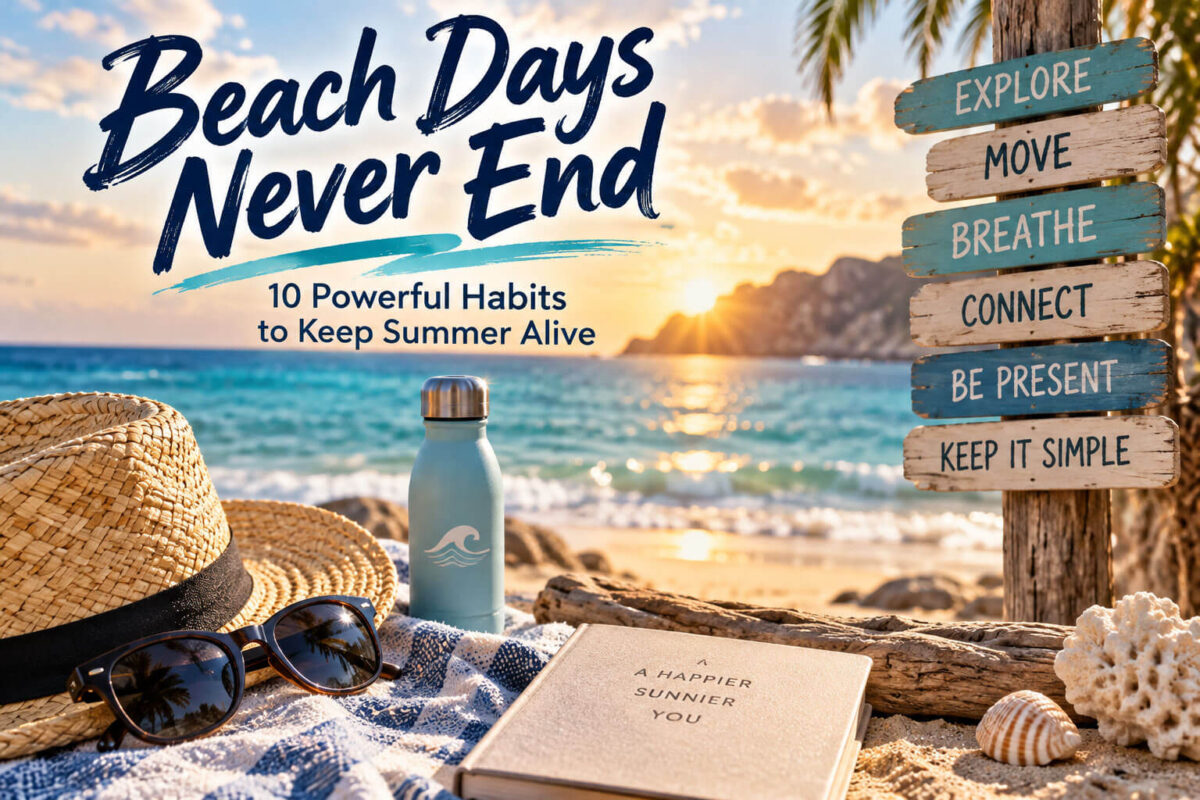
Beach Days Never End: 10 Powerful Habits to Keep Summer Alive
Sep
Beach Days Never End: 10 Powerful Habits to Keep Summer Alive All Year
The calendar insists on moving forward, but your beach days never end when you carry the right habits through every season. Here’s how to keep the warm-weather mindset burning bright in January.
Why Beach Days Never End for the Right People
For most people, summer is a calendar event. It starts when school lets out and ends when the wind turns cold. But for a specific tribe — the early-morning surfers, the year-round swimmers, the sailors who keep their boats in the water through November — beach days never end. They’ve built a relationship with the coast that doesn’t depend on a thermometer reading or a sunny forecast.
The distinction isn’t about geography. You don’t need to live in the Caribbean to carry a beach mindset through winter. It’s a deliberate set of habits, rituals, and perspectives that people with a deep ocean connection develop almost unconsciously. They eat breakfast with salt air on the windowsill. They schedule weekend drives to the water even when the sky is gunmetal grey. They wear the colors and imagery of summer on their bodies as a private reminder that the coast is always within reach.
Research supports what beach lovers already know intuitively. Studies from the University of Exeter’s Blue Space research program consistently show that proximity to water — even the sight and sound of it — triggers measurable reductions in cortisol levels and activates the parasympathetic nervous system. The beach isn’t simply a pleasant place. It’s a neurological reset button, and the habits that keep you connected to it are, in a very real sense, mental health practices.
This guide is built for people who refuse to let a season dictate their state of mind. Whether you’re a competitive freediver who trains through December, an angler who fishes in a January drizzle, or simply someone who dreams of the coast from a landlocked office, these ten habits will help you prove — to yourself and to everyone watching — that for the right person, beach days truly never end. You might also want to read about the daily benefits of beach exposure to understand exactly what you’re protecting when you commit to this mindset year-round.
“The sea does not reward those who are too anxious, too greedy, or too impatient. One should lie empty, open, choiceless as a beach — waiting for a gift from the sea.” — Anne Morrow Lindbergh
The Science Behind Coastal Calm and the Beach Days Never End Mentality
Blue Mind Theory: What Water Does to the Brain
Marine biologist Wallace J. Nichols coined the term “Blue Mind” to describe the mildly meditative state the human brain enters when near, in, on, or under water. His research, detailed in the landmark book of the same name, draws on neuroscience, psychology, and evolutionary biology to explain why the ocean has such a profound effect on human wellbeing. The brain shifts into a default mode network state — the same state associated with creativity, rest, and reduced anxiety — when stimulated by the sight and sound of moving water.
This isn’t metaphor. fMRI studies show measurably different brain activity when subjects view coastal environments compared to urban ones. The implications for people who want to maintain a summer mindset are significant: even visual exposure to ocean imagery — photographs, artwork, clothing with coastal motifs — can activate some of the same neural pathways as physical proximity to the water. This is partly why wearing beach-themed apparel year-round isn’t just aesthetics; it’s a subtle environmental cue that nudges the brain back toward its coastal baseline.
Cold Water Exposure and Winter Resilience
Cold water swimming has surged in scientific credibility over the past decade. Research published in the British Medical Journal and supported by studies from Scandinavia — where cold water bathing is a cultural institution — shows that regular cold water exposure raises the body’s baseline levels of norepinephrine by up to 300%, significantly improving mood, alertness, and cold tolerance. For people who want to keep beach days alive through winter, this is a cheat code. The water is cold. Go in anyway. Your nervous system will thank you.
Beyond the biochemistry, there’s a psychological dimension to cold water entry that can’t be overstated. Every time you walk into cold surf in November, you’re demonstrating to yourself that the ocean is not seasonal. You’re building identity evidence — proof that you are someone for whom beach days never end, not just someone who likes warm sand. That identity evidence compounds over time into genuine resilience.
Seasonal Affective Disorder and the Coastal Antidote
Seasonal Affective Disorder affects an estimated 10 million Americans each year, with a further 10–20% experiencing a milder form of winter-linked low mood. Coastal-connected habits offer a meaningful buffer. Light exposure at dawn near open water, physical exertion in cold air, and the sensory richness of a winter beach — wind, spray, the smell of brine — all stimulate neurological pathways that counteract the light-deprivation and sedentary patterns that drive seasonal depression.
The beach in winter is not a consolation prize for missing summer. For those who learn to read it correctly, it’s a wilder, more honest version of the same landscape — and a genuinely powerful tool for mental and physical health. Explore more about ocean therapy and its benefits for beach lovers to understand the full evidence base behind these habits.
Key insight: The neurological benefits of coastal exposure — reduced cortisol, increased norepinephrine, Blue Mind activation — are partially available through visual and sensory cues, not just physical presence. Building your home, wardrobe, and daily routine around ocean imagery and saltwater habits keeps those pathways primed year-round.
Summer Habits Compared Across Seasons: What Survives the Calendar
Not every beach habit translates cleanly across seasons. Some require adaptation; others turn out to be more powerful in winter than they ever were in July. The table below maps the most common summer coastal habits against each season’s realistic conditions, helping you identify which ones to double down on and which to evolve rather than abandon.
| Beach Habit | Summer | Autumn | Winter | Year-Round Viability |
|---|---|---|---|---|
| Early morning ocean swim | Easy — warm water, long days | Achievable with wetsuit | Challenging — high reward, cold exposure benefits | High |
| Sunrise beach walk | Effortless daily habit | Beautiful golden light, fewer crowds | Raw and genuinely moving experience | High |
| Outdoor surfing or paddleboarding | Peak conditions | Often better swells, thinner crowds | Requires 5mm wetsuit minimum | High |
| Beachside dining and socialising | Natural and easy | Transitional — fire pits help | Requires deliberate effort and planning | Moderate |
| Wearing coastal lifestyle apparel daily | Effortless expression | Layers over coastal tees naturally | A conscious identity signal — powerful for mindset | High |
The table reveals something important: the habits that survive all four seasons are the ones anchored to identity rather than comfort. Comfort-dependent habits — outdoor dining, barefoot walks, midday sunbathing — are genuinely seasonal. Identity habits — the morning swim, the coastal walk, the way you dress and decorate your space — are not. They survive precisely because they’ve moved beyond preference into self-definition.
Pattern to note: Every habit rated “High” for year-round viability has one thing in common — it requires you to show up and engage with the coast on its own terms, not yours. The ocean doesn’t adjust for your comfort. The people for whom beach days truly never end have learned to adjust for the ocean’s instead.
Daily Rituals That Anchor the Beach Mindset Through Every Season
Habits live and die on daily repetition. Grand seasonal intentions — “I’ll swim every week all winter” — collapse without micro-rituals that keep the mindset alive on the days when the ocean itself is inaccessible. These small, repeatable practices are the infrastructure that ensures beach days never end, even when you’re nowhere near the water.
Morning Salt Air Ritual
The simplest possible anchor: open a window facing any direction and breathe slowly for two minutes before looking at your phone. If you’re within driving distance of the coast, do this at the shoreline once a week at minimum. The sensory act of smelling salt air or fresh morning air, taken deliberately and with attention, primes the brain’s coastal association network and sets the tone for a beach-connected day regardless of what follows.
Ocean Soundscape Practice
High-quality ocean soundscapes — not tinny phone speakers, but a proper speaker in the room where you wake up or work — are neurologically meaningful. A study from the Frontiers in Psychology journal found that natural soundscapes, particularly moving water, reduced heart rate and improved cognitive performance on attention tasks. This is a legitimate tool, not a wellness gimmick. Use it on the mornings when the actual ocean is three hundred miles away.
Visual Environment Design
Your environment sends constant signals to your brain about what mood is appropriate right now. A desk covered in corporate grey, a wardrobe of earth tones, and walls decorated with nothing coastal all signal “this is not a beach person’s life.” Deliberately countering those signals — coastal photography, ocean colour palettes, apparel that declares your identity — is not superficial. It’s environmental psychology in practice. The way you decorate your space and dress your body are daily votes for the person you’re choosing to remain.
- Saltwater journal: Record one ocean-related memory, intention, or observation each morning — takes under two minutes and consistently reinforces the coastal identity that keeps the mindset alive year-round.
- Cold shower contrast: End every shower with 60 seconds of cold water. It’s a controlled dose of the same neurochemistry that makes cold ocean swimming so addictive — norepinephrine, endorphins, and a sense of genuine accomplishment before 8am.
- Coastal playlist activation: Build a curated playlist of sound — not lyrics — that evokes your personal version of a perfect beach day. Play it during commutes, workouts, or cooking. Auditory environment is as shapeable as visual environment.
- Weekly tidal check: Know the tide times for your nearest beach each week, even if you don’t go. Staying calibrated to tidal rhythms keeps you psychologically synchronized with the ocean’s schedule rather than only the city’s.
- Ocean-connected clothing as daily signal: Wear something with a coastal connection every day — not as costume, but as identity infrastructure. See our guide to styling a coastal graphic tee year-round for practical approaches to making this effortless in any season.
Ritual truth: The difference between a summer person and someone for whom beach days never end is not access to better beaches — it’s the density of small daily practices that keep the coastal identity active and self-reinforcing. Start with one ritual. It compounds quickly.
10 Steps to a Year-Round Beach Days Never End Mindset
These aren’t vague suggestions. Each step is a discrete, actionable practice that ocean-connected people have used to maintain their coastal relationship through every season. Work through them sequentially to build the full system, or identify the two or three that feel most immediately achievable and start there.
Commit to One Coastal Visit Per Month, Minimum
No exceptions, no weather excuses. A winter beach at low tide in a howling onshore wind is not a lesser experience than a July afternoon — it’s a different, often more profound one. Book the drive the way you’d book a dentist appointment: into the calendar, non-negotiable. Physical presence at the water, even once monthly, is the single most powerful anchor for maintaining the belief that beach days never end.
Build a Cold Water Practice Before Winter Arrives
Begin cold water exposure in September, before it becomes uncomfortable. Swim or wade into the sea weekly through autumn, letting your body acclimate gradually. By December, water that would have felt shocking in August feels bracing and invigorating. Cold water adaptation is physiological — it takes four to six weeks of consistent exposure, not willpower. Start early and the winter ocean becomes an ally rather than an obstacle.
Redesign Your Indoor Environment Around Coastal Identity
Audit your living space for how many visual cues reinforce your ocean identity versus how many work against it. Replace at least three non-coastal elements with ocean-relevant alternatives: photography, art, objects collected from the sea, or colour choices pulled from the marine palette. Your home should make you feel like a beach person on a Tuesday in February, not just someone who occasionally visits the coast in summer.
Join or Build a Year-Round Ocean Community
Habits survive in community; they atrophy in isolation. Find the people in your area who surf in December, swim on New Year’s Day, or run open-water training sessions year-round. If that community doesn’t exist locally, build it — a WhatsApp group of like-minded beach regulars, a monthly cold water swimming meetup, a shared plan to visit a new coastal location each month. Social reinforcement is the most reliable system for maintaining habits through seasons when motivation is low.
Invest in Season-Appropriate Coastal Gear
The single most common reason beach habits die in winter is inadequate equipment. A 3mm wetsuit that was perfectly comfortable in September becomes genuinely miserable in January. Invest once in the right gear for your local winter conditions — a 5mm or 6mm suit, booties, gloves, and a thick-lined changing robe — and the physical barrier to getting in the water virtually disappears. Gear is the practical foundation under every winter ocean habit.
Anchor Beach Identity in Your Wardrobe
Identity signals compound over time. Wearing coastal apparel daily — not just at the beach, but at work, at the grocery store, during the school run — sends a constant private message to your own subconscious: this is who I am. Ocean lifestyle brands like Seasportees design precisely for this intersection: apparel that reads as premium casual anywhere but broadcasts a specific coastal identity to everyone who knows the territory. Discover why ocean lovers wear marine graphic tees as a year-round identity practice.
Plan a Winter Coastal Trip as an Annual Ritual
If your local coast becomes genuinely inaccessible through deep winter, designate one warm-coast destination as your annual reset point. A five-day trip to a surf town in the Canary Islands, the Algarve, or Central America in January or February does more for the year-round beach mindset than any number of indoor rituals. It’s proof-of-identity evidence — you didn’t just think about the ocean all winter, you went to it.
Consume Ocean-Connected Media Intentionally
Documentaries, photography books, podcasts from surfers and divers and sailors, marine biology content, ocean conservation journalism — curate your media diet to include a meaningful proportion of ocean-related content year-round. This isn’t escapism; it’s deliberate environment design at the level of information. The way you think about the ocean is shaped by what you read, watch, and listen to, and that thinking is the substrate from which all your beach habits grow.
Track the Seasons Through the Ocean’s Lens
Instead of marking seasons by temperature and daylight — the dominant cultural frame — learn to track them through the ocean’s rhythms. Autumn brings the best Atlantic swells of the year. Winter thins the crowds and sharpens the light. Spring pushes sea temperatures up and brings migrating species back. Summer is alive and warm but rarely the ocean’s most interesting season for those paying attention. Reframing seasons through a marine lens converts them from obstacles into chapters of an ongoing story.
Celebrate the Seasonal Transitions, Not Just the Peaks
The beach in late October, when the last tourists have gone and a low autumn sun is cutting sideways across empty sand, is one of the most beautiful places on earth. The same beach in early March, when the first warmth of the year arrives and the sea is still cold enough to be bracing — that’s a different gift. People for whom beach days never end have learned to find the specific beauty in every transitional moment rather than tolerating the off-season as dead time between summers. That shift in perception is the final and most important habit of all.
Gear That Keeps Beach Days Never End Habits Alive in Any Season
Equipment is the unsexy foundation of sustainable beach habits. Every winter ocean swimmer who makes it look effortless is backed by the right gear for the conditions. Every coastal lifestyle that survives the off-season is supported by the right everyday objects. Here are six categories worth investing in properly.
Pro tip: Don’t buy gear reactively — after the first cold swim convinces you to quit. Buy it in September, before the season turns. The moment you own a changing robe and a winter wetsuit, the psychological barrier to getting in the water drops to nearly zero. Gear purchased in advance is a commitment device, not just equipment.
Best Coastal Destinations for When Beach Days Never End Needs a Boost
Sometimes the local coast goes flat, grey, and genuinely uninspiring for weeks at a stretch. That’s when a targeted escape to a destination with year-round coastal energy recharges the entire system. These six locations deliver genuine ocean culture in the depths of winter — not just warm beaches, but real coastal communities that live and breathe salt water twelve months a year.
- Ericeira, Portugal: Europe’s second World Surfing Reserve and the continent’s most reliable winter swell destination. Water temperatures hover around 14–16°C through December and January — manageable in a 4mm suit — and the point breaks at Ribeira d’Ilhas fire consistently when Atlantic storms produce the season’s best surf. The town’s fishermen-turned-surf-culture identity gives it an authenticity that purpose-built resort beaches can’t replicate.
- Playa del Carmen, Mexico: The Caribbean side of the Yucatan delivers 27°C water and 25°C air in January while most of the Northern Hemisphere is shivering. Cenote diving, reef snorkelling, and a genuinely international beach lifestyle community make this a full-immersion reset. Stay south of the tourist corridor for the version of the town that actually lives by the water.
- Byron Bay, Australia: January in Byron Bay is midsummer by local standards — warm, busy, and pulsing with surf culture. But the reason to come in the Northern Hemisphere’s winter (Australia’s summer) is the quality of the lifestyle infrastructure: coastal markets, world-class waves at The Pass, dolphins in the bay at dawn, and a beach town that has managed to preserve its identity despite enormous tourist pressure.
- Lofoten Islands, Norway: For those who want their beach days to come with genuine drama, the Lofoten archipelago in winter is extraordinary. Fishing from beaches flanked by snow-covered peaks, the possibility of Northern Lights over open water, and a culture of coastal living so deeply embedded it makes you recalibrate what “beach days” means entirely. Come prepared for cold — temperatures below zero are normal — but the experience is irreplaceable.
- Taghazout, Morocco: Two hours north of Agadir, this former fishing village has become West Africa’s quiet surf capital. December through February brings the season’s most consistent Atlantic groundswells, water temperatures of around 19°C, and a local culture that blends Berber tradition with an international surf community in a way that feels entirely genuine. Budget-friendly, deeply warm-hearted, and genuinely off the beaten track for most of the winter.
- Noosa, Queensland, Australia: Noosa’s north-facing breaks and national park-backed foreshore make it Australia’s most civilised surf town. The Noosa Festival of Surfing in March draws longboarders and alternative craft riders from around the world, but the town’s genuine appeal is year-round: consistent small waves, clear warm water, and a coastal lifestyle culture anchored in the idea that the beach is where you live, not where you visit.
Top recommendation: For the most complete year-round beach days experience within a single trip, Ericeira in Portugal delivers the full package — world-class surf, Atlantic wildness, genuine local culture, and proximity to Lisbon for those who want to mix coastal and urban. The fact that it functions beautifully in January, when most European beach towns are shuttered, makes it the definitive destination for proving your beach days never end thesis to yourself.
Indoor vs Outdoor Beach Habits: Building a Resilient Year-Round System
A sustainable year-round beach mindset requires two categories of habit: outdoor practices that engage the actual ocean, and indoor practices that maintain the coastal neurological state when outdoor access is genuinely impossible. The mistake most people make is relying entirely on outdoor habits and collapsing when the season makes them difficult. The goal is a system where both categories reinforce each other.
The most resilient year-round beach practitioners are the ones who have built both columns without rating one as superior. A December day when a storm makes swimming genuinely dangerous is not a failed beach day — it’s an indoor coastal day. A perfect June morning when work prevents you from getting to the water is not wasted — it’s an indoor coastal morning with an outdoor one pending. The system treats ocean access as a spectrum, not a binary, and finds the appropriate practice for every point on that spectrum without declaring any of them a compromise.
Environmental Mindset: Why Beach Days Never End Comes With Responsibility
If the ocean is genuinely central to your identity and your mental health — if beach days never end is a lived practice and not just an aspirational slogan — then ocean stewardship is not optional. The coast that you’re committed to returning to year after year, the cold water that resets your nervous system, the tidal rhythms that organize your internal clock — these are not inexhaustible. They require active protection, and the people most positioned to provide that protection are the ones who use the ocean most.
The Plastic Problem and the Regular Beach User’s Responsibility
Over 8 million tonnes of plastic enters the ocean each year, according to data from the Ocean Conservancy. The people who visit the beach year-round — not the seasonal tourists who come once in summer — are both the most impacted and the most capable of making a sustained difference. A simple commitment to a two-minute beach clean at the start of every coastal visit removes plastic before it reaches the water. Over a year of weekly visits, that’s over an hour of active plastic removal per person — not negligible at all.
Beyond the individual act, regular beach users are positioned to normalize the practice within their community. When the cold water swimming group does a collective clean at every session, when the surfing crew picks up on the way back to the car, when the pier fishermen take a bag out every time — the cumulative effect is significant, and the social modeling accelerates adoption beyond the immediate group.
Choosing Ocean-Literate Brands and Products
Every purchase made by an ocean-connected consumer is a vote for the kind of coast that exists in ten years. Reef-safe sunscreen, responsibly sourced seafood, and apparel brands that use eco-friendly printing processes — such as water-based DTG inks that avoid the chemical waste associated with traditional screen printing — all represent material choices that align consumer identity with ecological values. The brands worth wearing are the ones that understand this alignment and design for it.
- Reef-safe sunscreen: Chemical UV filters — oxybenzone and octinoxate — are demonstrably harmful to coral reef development. Mineral sunscreens (zinc oxide, titanium dioxide) provide equivalent UV protection without the ecological cost. Switch once and never switch back.
- Two-minute beach clean habit: Two minutes at the start of every coastal visit. A small bag. Whatever you find in that radius. It requires no organisation, no special equipment, and no scheduled event — just a consistent practice from every individual who visits regularly.
- Ocean conservation support: Surfrider Foundation, Oceana, and local marine conservation charities translate individual concern into coordinated policy and cleanup action at a scale impossible through individual effort alone. A modest annual membership is a meaningful contribution from people who benefit directly from the work.
- Responsible fishing and foraging: Bag limits, size limits, and seasonal restrictions exist for biological reasons. Year-round coastal practitioners who fish or forage have an obligation to understand and respect those limits — not as legal compliance but as genuine ecological literacy.
- Wildlife disturbance awareness: Nesting seasons, seal pupping periods, and bird colony protection zones are posted at most managed beaches. Year-round coastal users are more likely than seasonal visitors to encounter these conditions — and more capable of modelling respectful behaviour for others.
Important note: According to IUCN data, over 33% of shark and ray species are now threatened with extinction due to overfishing, habitat degradation, and climate-driven range shifts. The ocean you return to every month is not a static resource — it’s a living system under active stress. The people best positioned to advocate for it are the ones who know it year-round, not just in season.
The beach days never end mindset carries an embedded responsibility. To love something year-round — to rely on it for mental health, identity, and community — is to accept some stewardship of it. The good news is that the habits of an environmentally responsible coastal practitioner are not difficult impositions on an ocean-connected life. They’re the natural extension of genuine love for the thing you keep coming back to, season after season, regardless of what the calendar says.
Frequently Asked Questions: Beach Days Never End
