


🎣 Fishing Life
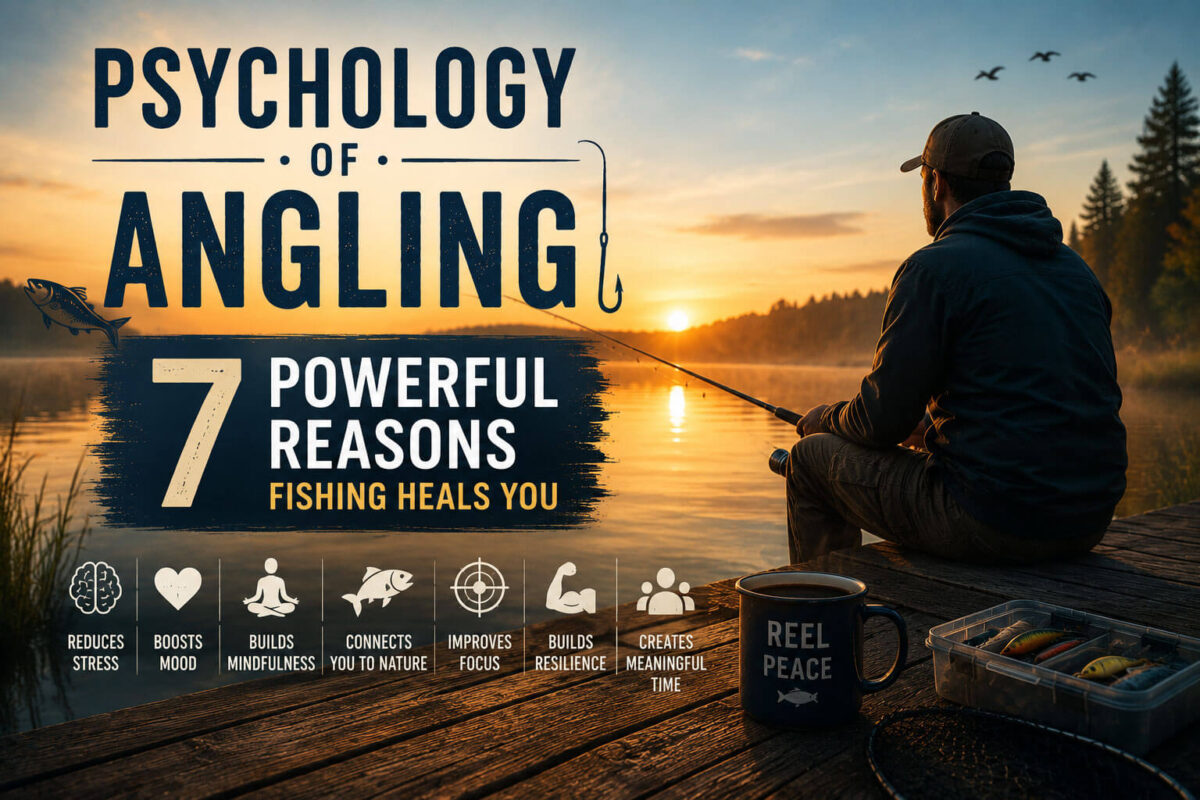
Psychology of Angling: 7 Powerful Reasons Fishing Heals You
Jul
Chasing the Horizon: The Psychology of Angling
Why does casting a line into open water quiet the noise of modern life? The psychology of angling runs far deeper than the catch — it’s about patience, presence, and the ancient human drive to connect with nature.
- Why Angling Captivates the Human Mind
- Fishing & Mental Health Benefits
- Types of Anglers & Their Mindsets
- Flow State, Patience & Focus
- The Ritual Process of Fishing
- Gear & the Psychology of Preparation
- Best Fishing Environments for the Mind
- Solo vs. Social Angling
- Angling Ethics & Conservation Mindset
- Frequently Asked Questions
Why the Psychology of Angling Captivates the Human Mind
There is something primordial about standing at the edge of water, rod in hand, waiting. The psychology of angling is rooted in evolutionary biology, cognitive science, and a deep cultural mythology that stretches back tens of thousands of years. Before agriculture, before cities, humans were hunter-gatherers — and fishing was not a hobby but a survival skill woven into our DNA. That ancient circuitry doesn’t disappear because we now buy our salmon shrink-wrapped at the supermarket. It lies dormant, waiting for the tug of a line to wake it.
Modern psychology has begun to take fishing seriously as a therapeutic tool and a window into human behavior. Researchers studying attention restoration theory (ART) — developed by Rachel and Stephen Kaplan at the University of Michigan — identify natural water environments as uniquely restorative to the fatigued human brain. The “soft fascination” of moving water, the play of light on a surface, the ambiguity of what lies beneath — these elements hold our attention effortlessly, without demanding the directed concentration that exhausts us in daily life. Anglers have known this instinctively for centuries. Science is only now catching up.
The focus keyword here is not just relaxation. The psychology of angling encompasses anticipation, risk tolerance, pattern recognition, emotional regulation, and even spiritual experience. Fishing teaches us to sit with uncertainty — something most humans find profoundly difficult. Every cast is a small act of hope placed into an indifferent universe, and every patient hour of waiting is a masterclass in delayed gratification, a cognitive skill that predicts wellbeing across nearly every domain of life studied by psychologists.
What makes angling particularly fascinating as a psychological subject is its paradox: it is simultaneously a pursuit of control and a surrender to chaos. An angler studies water temperature, tide tables, seasonal feeding behavior, and fly patterns — and then casts into a world that operates by its own rules entirely. This tension between mastery and mystery is the engine that keeps millions of people returning to the water, season after season, for their entire lives. It is one of the few human activities where “losing” — going home empty-handed — can still feel like a profound victory.
“The charm of fishing is that it is the pursuit of what is elusive but attainable, a perpetual series of occasions for hope.” — John Buchan
The Psychology of Angling and Mental Health: What the Science Says
The therapeutic power of fishing is no longer anecdotal. Organizations like Project Healing Waters Fly Fishing have documented measurable improvements in PTSD symptoms, depression, and anxiety among veterans who participate in guided fly fishing programs. The combination of focused attention, physical sensation, natural environment, and community creates a uniquely potent recipe for psychological recovery. Understanding why requires a look at three core mechanisms through which the psychology of angling operates on the brain.
Cortisol Reduction and the Water Effect
Numerous studies have confirmed that proximity to natural water environments significantly lowers cortisol — the body’s primary stress hormone. The sound of flowing water activates the parasympathetic nervous system, shifting the body from its alert “fight-or-flight” mode into a calmer “rest-and-digest” state. For anglers, this effect is amplified by the physical rhythm of casting, the tactile sensation of line running through fingers, and the olfactory richness of a riverbank or shoreline. The cumulative sensory experience is a full-body reset that no app can replicate.
Dopamine, Anticipation, and the Reward Loop
Fishing is a variable-ratio reinforcement schedule — the same neurological pattern that makes slot machines compelling. You don’t know when the next bite will come, which keeps dopamine (the neurotransmitter of anticipation) flowing continuously. Unlike gambling, however, angling’s reward loop is embedded in a healthy context: fresh air, physical activity, and genuine skill development. Each catch releases a burst of dopamine that is deeply satisfying precisely because it was earned through effort, patience, and accumulated knowledge. The brain codes this as a meaningful achievement, not mere luck.
Mindfulness Without Meditation
Many anglers describe a state of consciousness on the water that psychologists would recognize as mindfulness — a non-judgmental, present-moment awareness. Fly fishing in particular demands this: reading the water, watching the drift, detecting the subtle strike. There is simply no cognitive bandwidth left for rumination about the past or anxiety about the future. Research published in the Frontiers in Psychology journal supports the idea that nature-based activities like fishing can induce mindfulness states equivalent to formal meditation practice, with lasting benefits for emotional regulation and cognitive flexibility.
Types of Anglers and the Psychology Behind Each Style
Not all anglers are the same, and understanding the psychology of angling means understanding that different people fish for fundamentally different psychological reasons. The motivational landscape of fishing is remarkably diverse, ranging from highly competitive tournament anglers to solitary contemplatives who haven’t weighed a fish in years. Recognizing your own angling archetype can deepen your self-understanding and help you choose the approach that best serves your mental and emotional needs.
| Angler Type | Primary Motivation | Psychological Trait | Preferred Environment | Engagement Level |
|---|---|---|---|---|
| The Contemplative | Peace, solitude, nature immersion | Introversion, mindfulness | Remote streams, quiet lakes | Reflective |
| The Competitor | Performance, trophies, rankings | Achievement orientation, competitiveness | Tournament circuits, bass lakes | Highly Driven |
| The Naturalist | Ecosystem knowledge, species ID | Curiosity, scientific mindset | Diverse habitats, tidal zones | Observational |
| The Traditionalist | Heritage, ritual, connection to roots | Nostalgia, loyalty, cultural identity | Family fishing holes, ancestral waters | Ritual-Focused |
| The Social Angler | Bonding, shared experience, storytelling | Extraversion, relationship-orientation | Group charters, pier fishing | Community-Driven |
Flow State, Patience, and the Rules of Focused Attention
Psychologist Mihaly Csikszentmihalyi’s concept of “flow” — the mental state of complete absorption in a challenging, rewarding activity — is nowhere more naturally achieved than on the water. The psychology of angling is fundamentally compatible with flow theory because fishing sits at the precise intersection of skill and challenge that flow requires. Too easy, and the mind wanders; too hard, and anxiety takes over. Fishing, especially in technical disciplines like fly fishing or surf casting, offers an almost infinite ladder of difficulty that keeps the angler perpetually at their growing edge.
Patience in fishing is not passive endurance — it is an active psychological discipline. Elite anglers develop what sports psychologists call “constructive waiting”: using downtime between bites to refine strategy, observe environmental cues, and maintain alert readiness without tipping into restless frustration. This capacity for constructive waiting transfers powerfully to everyday life, building tolerance for delayed gratification and improving performance in careers that require sustained attention.
Reading the Water: Pattern Recognition and Cognitive Skill
Experienced anglers develop a sophisticated visual literacy for water. They read current seams, identify feeding lanes, interpret cloud cover and light penetration, and decode the surface behavior of fish. This is genuine expert-level pattern recognition — the same cognitive skill that underlies expertise in chess, medicine, and science. The psychology of angling thus encompasses real intellectual development, not just meditative rest.
Emotional Regulation Under Pressure
Hooking a large fish tests emotional regulation in real-time. The surge of adrenaline, the trembling hands, the need to stay calm and apply technical skill while excitement overwhelms — this is emotional self-management under authentic pressure. Anglers who train this skill on the water frequently report improvements in how they handle high-stakes situations in professional and personal life.
The Ethics of Patience: When to Let Go
One of fishing’s most psychologically sophisticated lessons is knowing when to change tactics entirely — when patience becomes stubbornness. Experienced anglers develop a meta-awareness of their own decision-making, regularly asking: “Am I staying because the conditions are right, or because I’m afraid to admit this isn’t working?” This distinction between adaptive persistence and ego-driven stubbornness is a lesson many highly successful people cite as transformative.
The Ritual Process of Fishing: A Step-by-Step Psychological Journey
Fishing is not a single event — it is a ritual sequence with distinct psychological phases. Understanding each phase helps anglers maximize the mental benefits of every outing, and helps non-anglers understand why those who fish describe it as almost sacred in its structure.
Anticipation and Planning
Days or weeks before a trip, anglers enter a state of anticipatory pleasure — researching conditions, selecting tackle, studying maps. Neuroscience shows that the anticipation of a rewarding experience activates the brain’s reward circuits almost as powerfully as the experience itself. This phase extends the psychological benefit of fishing far beyond the time actually spent on the water, making angling a gift that keeps giving.
The Journey to Water
The drive, walk, or paddle to a fishing spot is a psychological transition zone — a liminal space between the demands of ordinary life and the altered state of the fishing mind. Many anglers describe this journey as itself therapeutic. The gradual shift from urban noise to natural soundscape, from artificial light to natural sky, represents a genuine neurological recalibration that prepares the brain for deep presence.
Setup and Preparation
Rigging a line, selecting a fly, tying a knot — these small, precise, tactile tasks serve as a mindfulness entry protocol. The fine motor focus required to tie a blood knot or thread a lure draws attention fully into the present moment. This is why experienced anglers often describe the pre-fishing setup as one of their favorite parts of the experience — not merely instrumental, but intrinsically satisfying and centering.
Active Fishing and Flow
The fishing session itself is where flow state, emotional regulation, and the full psychology of angling converge. Time distorts — hours pass like minutes. Awareness expands to include environmental details invisible to the distracted mind: the direction of wind, the behavior of birds, the subtle changes in water color. This expanded situational awareness is the hallmark of the deeply absorbed angler, and it constitutes a genuinely altered state of consciousness — healthy, voluntary, and repeatable.
Reflection and Return
The journey home from fishing is a unique psychological space: the mind is calm, often pleasantly tired, and naturally inclined toward reflection. Many anglers report their best creative thinking, clearest emotional processing, and most insightful problem-solving happening in this post-fishing state. It is as if the water has cleaned the lens of the mind, allowing a sharper focus on whatever truly matters. This reflection phase completes the ritual and seals its psychological benefits into long-term memory.
Gear and the Psychology of Preparation in Angling
The tackle box is a psychological artifact. Every piece of gear an angler carries represents a decision, a hope, an investment in competence. The psychology of angling is inseparable from the ritual of gear selection — a process that builds confidence, expresses personal identity, and serves as a form of pre-performance mental preparation. Understanding why certain tools matter to anglers reveals important truths about how humans prepare for uncertain, high-stakes endeavors.
An extension of the angler’s arm and intention, the rod transmits sensitivity and power. The right rod feels like a conversation between angler and fish — building confidence and enabling precise technical performance.
Line selection encodes an angler’s understanding of their quarry’s environment. Choosing the right weight, material, and visibility level is a cognitive exercise that reinforces mastery and connects equipment to ecological awareness.
The lure box is a psychological landscape of hope and theory. Each lure represents a hypothesis about fish behavior. Selecting and switching lures keeps the angler mentally engaged, scientific, and creatively problem-solving throughout the session.
Organization of gear reflects the angler’s mental preparedness. A well-organized fishing vest reduces decision fatigue on the water, allowing full cognitive bandwidth to be devoted to reading conditions and responding to opportunity.
Proper clothing is not vanity — it is the physical armor of the angler’s commitment. Waders allow deeper water access, polarized sunglasses reveal subsurface structure, and UV protection enables longer sessions. Comfort directly supports sustained mental focus.
The most psychologically powerful piece of gear in any serious angler’s kit. Recording conditions, techniques, and results transforms individual outings into a longitudinal learning system — building self-awareness, pattern recognition, and a deeply personal relationship with water over time.
Best Fishing Environments for Mental Restoration and the Soul
Where you fish shapes the psychological experience as profoundly as how you fish. The best environments for the mind are those that combine natural complexity, sensory richness, and a degree of challenge that keeps the angler genuinely engaged. These six environments each offer a distinct psychological profile — and each draws a different type of angler to its banks for reasons that go far beyond the fish.
- Mountain Trout Streams: The archetypal healing environment of the psychology of angling. Fast, clear, cold water running through mountain landscapes activates every element of attention restoration theory simultaneously. The visual complexity of riffles and pools, the physical challenge of wading, the technical demands of dry-fly presentation — these combine into an experience that is simultaneously activating and deeply calming, leaving the angler refreshed in body and mind.
- Coastal Surf and Beaches: Surf fishing combines the psychological power of the ocean — one of nature’s most potent awe-inducing environments — with the physical rhythm of casting into breaking waves. The vastness of the ocean horizon produces a documented state of “awe” that psychologists at UC Berkeley have linked to reduced self-focused thinking, greater social connectedness, and increased feelings of meaning and purpose. Just as ocean lovers connect deeply with marine life through lifestyle choices, surf anglers find identity and belonging through their relationship with the sea.
- Stillwater Lakes at Dawn: The early-morning lake represents fishing’s most meditative environment. Mirror-flat water, mist rising, the first light of dawn breaking — these conditions invite deep contemplative stillness. Bass and pike fishing on still water encourages slow, methodical presentation and patient waiting, making it ideal for anglers seeking mental decompression rather than athletic challenge.
- Saltwater Flats and Mangroves: Sight-fishing on tropical flats — hunting bonefish or permit in gin-clear shallows — represents the most visually demanding and psychologically intense form of angling. The need to spot, track, and present to individual fish at distance demands surgical focus. Success on the flats produces some of the most intense flow states in all of angling, making it the discipline of choice for anglers who use fishing to train elite levels of concentration.
- Ice Fishing on Frozen Lakes: Counterintuitively, ice fishing produces profound psychological benefits through radical environmental simplicity. The reduction of visual stimulation, the enforced stillness, the community gathered around a shared fire — these create conditions for deep conversation, genuine rest, and a meditation on patience that warmer-season fishing cannot replicate. Ice anglers often describe their most meaningful memories of the sport as emerging from these stripped-back, elemental experiences.
- Urban Rivers and Canal Systems: Not all healing water is remote. Urban fishing environments — canals, city park ponds, tidal urban rivers — provide accessible psychological restoration for the millions of anglers who cannot easily reach wilderness. Research consistently shows that even brief nature exposure in urban settings significantly improves mood, attention, and stress levels. The urban angler who stands on a canal bank at dusk, line in water, has access to the same fundamental psychology of angling as the wilderness fly fisherman, simply in a different setting.
The Ethics and Conservation Mindset Within the Psychology of Angling
A complete understanding of the psychology of angling must grapple with its ethical dimension. The question of what anglers owe to the fish, the water, and future generations is not a peripheral concern — it sits at the heart of what it means to fish with integrity. The most psychologically mature anglers are invariably also the most conservation-conscious, because a genuine relationship with water and fish inevitably generates reverence, and reverence generates responsibility.
Catch and Release: Ethics Meets Psychology
The rise of catch-and-release fishing reflects a profound psychological shift in angling culture — from extraction to relationship. Releasing a fish is an act of restraint that can feel deeply counter-intuitive to the evolved hunter in every angler, which is precisely why it is psychologically significant. The decision to release is a declaration that the experience — the connection, the challenge, the moment of encounter — was the true catch all along. This philosophical reframing transforms fishing from a consumptive activity into a practice of mindful stewardship.
Proper catch-and-release technique also demands knowledge: wet hands before handling, minimizing air exposure, proper hook removal, supporting the fish horizontally during release. Developing this competence builds an angler’s sense of themselves as a responsible steward — a deeply satisfying identity that strengthens commitment to conservation over time. Understanding the broader ocean ecosystem, including the role of species diversity and habitat health, is as important to the thoughtful angler as reading water. Exploring resources like essential ocean animals every sea lover should know deepens this ecological literacy.
The Angler as Environmental Advocate
Anglers are, historically, among the most effective environmental advocates in the world. Because their ability to pursue their passion depends directly on clean water and healthy fish populations, they have powerful personal incentives to support conservation policy. Organizations like Trout Unlimited in the U.S. represent millions of anglers who have translated their love of fishing into legislative action, habitat restoration, and public education. This advocacy role gives fishing a social and civic dimension that elevates it far beyond recreation.
- Practice proper catch-and-release technique: Always wet your hands before handling fish, use barbless hooks when possible, and minimize time out of the water to reduce stress and increase survival rates.
- Know your local regulations: Size limits, bag limits, and seasonal closures exist to protect breeding populations. Compliance is the minimum bar; advocacy for stronger protections is the ideal.
- Remove all trace of your presence: Pack out everything you pack in. Monofilament line left behind is lethal to birds, mammals, and fish. Leave every water you visit cleaner than you found it.
- Support habitat restoration: Donate to or volunteer with organizations that restore riparian buffers, remove obsolete dams, and rehabilitate degraded spawning grounds. The fish you pursue tomorrow depend on the habitat investments made today.
- Educate new anglers: Share ethical practices with beginners. The culture of a sport is reproduced through mentorship. Every ethical angler who guides a newcomer is investing in the long-term health of both the fishery and the sport.
The psychology of angling at its most evolved is inseparable from the ethic of care — for the water, for the fish, for the communities that depend on healthy aquatic ecosystems, and for the generations of anglers who have not yet been born. When fishing becomes a practice of stewardship rather than mere extraction, it achieves its full psychological and spiritual depth. The horizon we are chasing, ultimately, is not just the fish on the other end of the line — it is a relationship with the natural world that is honest, humble, and life-giving.
Frequently Asked Questions About the Psychology of Angling
Psychology explains fishing’s relaxing effect through multiple mechanisms. First, natural water environments activate the parasympathetic nervous system, lowering cortisol and heart rate. Second, the variable-reward structure of fishing keeps dopamine flowing at a pleasant, sustained level without the spikes and crashes of digital stimulation. Third, fishing induces mindfulness states — present-moment awareness — that interrupt rumination and worry cycles. The combination of physical presence in nature, focused sensory engagement, and the gentle rhythm of casting and waiting produces a genuinely altered neurological state that most people experience as profound relaxation. Research from the University of Exeter confirms that time spent near water is among the most powerful non-clinical interventions for stress and anxiety available.
Yes — and this is increasingly well-supported by evidence. Programs like Project Healing Waters, which uses fly fishing as a therapeutic tool for veterans with PTSD, depression, and traumatic brain injury, have documented clinically significant improvements in participants. The mechanisms include increased physical activity, social connection (for group fishing programs), exposure to natural environments, development of mastery and self-efficacy through skill building, and the mindfulness-inducing qualities of the activity itself. While fishing is not a substitute for professional mental health treatment in serious cases, it is a genuinely effective complementary strategy with an essentially zero risk profile. Many therapists now recommend regular time fishing as part of broader wellbeing plans for clients dealing with anxiety and mild to moderate depression.
Research in the psychology of angling suggests that certain personality traits do correlate with deep engagement in fishing. These include high openness to experience, a capacity for patience and delayed gratification, comfort with uncertainty, and a strong connection to natural environments. Sensation-seeking traits also correlate with some angling styles — particularly offshore and big-game fishing. However, “born fisherman” is misleading because nearly all dedicated anglers point to a specific formative experience — usually with a parent or grandparent — as the origin of their passion. Culture, early exposure, and meaningful relational memories are more predictive of deep angling engagement than any innate personality profile. In other words, great fishermen are mostly made, not born.
The “fish that got away” phenomenon is a genuinely interesting psychological curiosity. Memory for emotionally charged events — and catching (or losing) a big fish is emotionally charged — is subject to consistent inflation over time. The brain encodes peak emotional experiences with high vividness but poor metric precision; it remembers the excitement better than the inches. Additionally, angling is a culture rich in oral storytelling tradition, where the performance of the narrative — dramatic, vivid, emotionally compelling — is valued alongside factual accuracy. Slight exaggeration in fishing stories also serves a social bonding function: shared hyperbole signals in-group membership and lubricates the storytelling ritual that has been central to fishing culture for thousands of years. It’s less about dishonesty and more about how memory and social performance interact in a culture built on memorable experiences.
Fishing is one of the most effective teachers of patience because it makes the reward for waiting genuinely uncertain and genuinely worth waiting for. Unlike artificial patience exercises, which are often perceived as arbitrary, the wait in fishing has clear ecological logic — fish bite when conditions are right, not on demand. Learning to accept this and remain productively engaged during the wait — adjusting bait, reading water, staying observant — builds what psychologists call “active patience” or “tolerant waiting.” For children especially, the occasional reward of a real fish provides powerful reinforcement that patience genuinely pays off, building neural pathways that support delayed gratification in academic, social, and later professional contexts. The psychology of angling makes patience something earned through experience rather than taught through instruction.
Fishing shares significant functional overlap with formal meditation practices, though the two are not identical. Both cultivate present-moment awareness, reduce rumination, lower physiological stress markers, and improve emotional regulation. The key difference is that fishing achieves these effects through engagement with an external, dynamic environment rather than through inward focus. For many people — particularly those who find formal sitting meditation difficult or culturally alien — fishing provides a more accessible and sustainable route to equivalent benefits. Research published in Frontiers in Psychology supports the classification of nature-based activities like fishing as “effortless attention” practices, distinct from but complementary to directed meditation. Some practitioners combine both, meditating before or after fishing to deepen both practices. The ocean environment itself carries profound meditative power; understanding why it captivates us connects to everything from marine conservation to lifestyle identity.
