


🐋 Ocean & Marine Life
Lionfish Identification: Complete Venomous Species Dive Guide
Sep
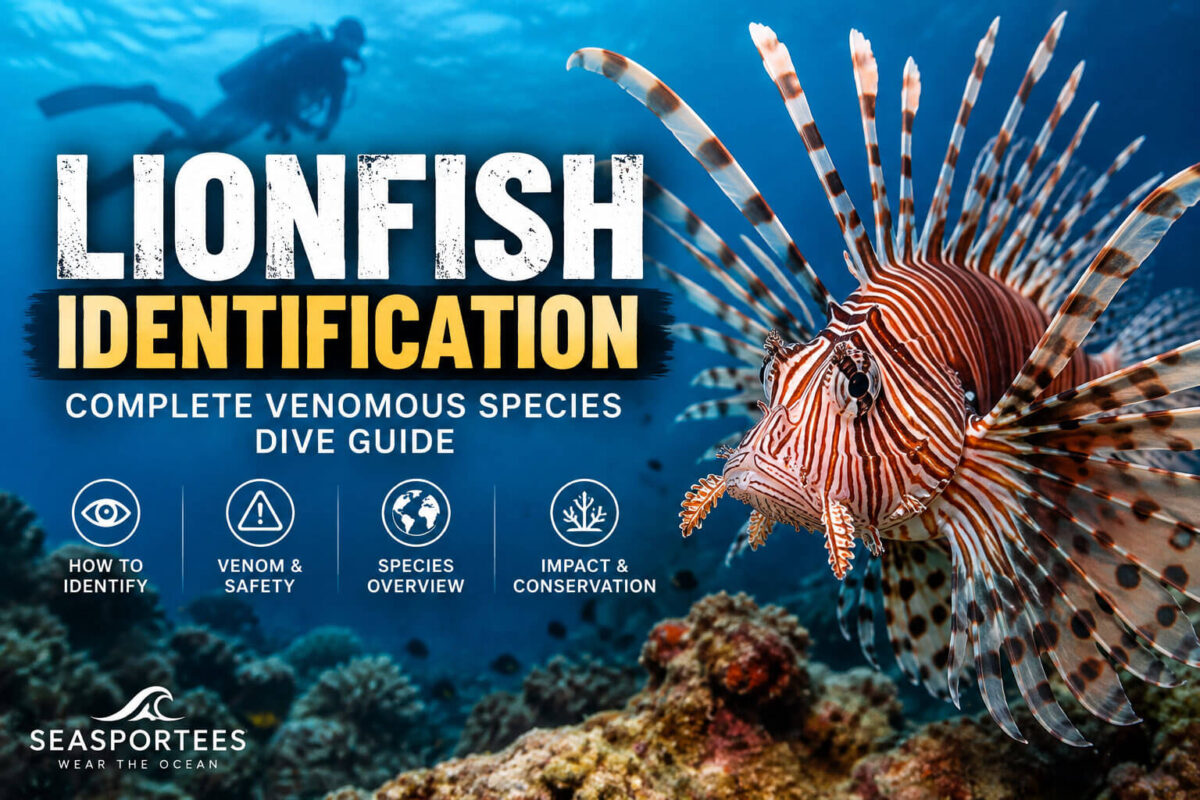
Lionfish Identification: The Complete Venomous Species Dive Guide
Everything divers, snorkelers, and ocean enthusiasts need to know about identifying lionfish, understanding their venom, and diving safely alongside one of the reef’s most striking — and dangerous — inhabitants.
What Is a Lionfish? Understanding This Iconic Venomous Species
Lionfish identification begins with recognizing one of the ocean’s most visually dramatic creatures. Members of the genus Pterois, lionfish belong to the family Scorpaenidae — the scorpionfish family — and are native to the warm, tropical waters of the Indo-Pacific. Their ornate zebra-striped bodies, feather-like pectoral fins, and dramatic dorsal spines make them instantly recognizable to even novice divers. Yet beneath that beautiful exterior lies one of the ocean’s most effective venomous defense systems, making proper identification and behavioral awareness essential for any underwater encounter.
Lionfish have become a subject of intense global attention not just because of their venom, but because of their devastating ecological footprint as an invasive species in the Atlantic Ocean, Caribbean Sea, and Gulf of Mexico. Originally introduced through the aquarium trade — likely via accidental or intentional release in South Florida during the 1980s — these fish now populate reef ecosystems where they have no natural predators. Their population explosion across non-native waters has made lionfish identification a critical skill for divers, marine conservationists, and recreational spearfishers alike.
Understanding lionfish from a biological standpoint reveals why they are so difficult to control. They are voracious predators with a near-insatiable appetite, consuming up to 30 times their stomach volume in a single feeding session according to NOAA Ocean Service. They consume more than 50 species of fish and invertebrates and can reduce juvenile reef fish populations by up to 79% in as little as five weeks on a given reef system. For divers visiting reef ecosystems, recognizing a lionfish — and knowing how to behave around one — is as fundamental as knowing your decompression tables.
From a diver’s perspective, lionfish are actually among the most rewarding creatures to observe. They are remarkably unhurried and unafraid of humans, relying entirely on camouflage and their venomous spines for defense rather than flight. This makes underwater encounters unusually close and unhurried — but it also means divers must exercise discipline to avoid accidental contact with those spines. This guide walks you through everything you need: from lionfish identification markers and species distinctions, to venom treatment, dive safety protocols, and the conservation ethics of encountering them in both native and invasive ranges.
“A lionfish doesn’t flee — it trusts its spines completely. That confidence makes it one of the most approachable and most dangerous fish you’ll ever meet underwater.”
Key Lionfish Identification Features Every Diver Must Know
Accurate lionfish identification is straightforward once you know the defining characteristics of the genus. These fish have evolved a suite of visual cues that serve as both camouflage and warning signals, and each feature tells a story about their biology and behavior. Whether you’re at 30 feet on a Caribbean reef or 80 feet on an Indo-Pacific wall dive, these markers will confirm you’re looking at a lionfish.
Body Coloration and Pattern
The most immediately recognizable feature of any lionfish is its banded coloration. Red, brown, white, and cream stripes alternate across the body in bold zebrafish-like patterns, giving the fish a misleadingly decorative appearance. These bands serve a dual function: they break up the fish’s outline against complex reef backgrounds (providing exceptional camouflage), and they advertise the fish’s dangerous nature to any would-be predators in its native range. In the Atlantic, where predators haven’t evolved alongside lionfish, the warning coloration goes largely unheeded — which is one reason lionfish have proliferated so successfully as an invasive species. Coloration can vary slightly between species, with some displaying more reddish tones and others appearing more brown or cream-dominant.
Fin Structure and Spine Configuration
The defining structural feature in lionfish identification is the fin arrangement. The elongated, quill-like dorsal spines — 13 in total — fan outward like a mane and are the primary venomous delivery mechanism. Each spine is encased in a thin layer of skin tissue, and at the tip sits a venom gland. When the spine pierces skin, it acts like a hypodermic needle, compressing the venom gland and injecting venom into the wound. The pectoral fins, by contrast, are wide, fan-shaped, and non-venomous — they’re used for herding prey into corners and are often spread dramatically when the fish feels threatened or is actively hunting. A lionfish spreads its pectorals wide, creating a “net” that corners small fish before engulfing them with a sudden, explosive strike.
Head and Facial Characteristics
Look closely at a lionfish’s head and you’ll find a suite of identifying structures unique to the genus. Tentacles extend above the eyes and nostrils — small, fleshy protrusions that vary in length and complexity between species and can help distinguish Pterois volitans from Pterois miles in the field. The mouth is large and angled upward, typical of an ambush predator that strikes from below or horizontally at prey. The jaw can expand rapidly to create a powerful suction force, swallowing prey items up to two-thirds of the lionfish’s own body size in a fraction of a second. A lionfish’s eyes are set high on the head, giving excellent panoramic vision, and they often track a diver’s movements without the fish moving its body at all — an eerie and compelling behavior to observe underwater.
Quick ID Checklist: Banded red/brown/white coloration ✓ — 13 elongated venomous dorsal spines ✓ — Wide fan-like pectoral fins ✓ — Fleshy head tentacles above the eyes ✓ — Large upturned mouth ✓ — Slow, hovering swimming behavior ✓. If you see all six of these features, you are looking at a lionfish.
Lionfish Species Comparison: The Most Common Venomous Types
While the term “lionfish” is often used generically, there are over a dozen recognized species in the genus Pterois, each with slightly different ranges, sizes, and visual characteristics. In the context of diver encounters and the global invasive species crisis, two species dominate: Pterois volitans (the red lionfish) and Pterois miles (the devil firefish). Together, these two account for more than 93% of all lionfish found in Atlantic and Caribbean waters, according to research published in the NOAA Fisheries species database. The table below breaks down the five most commonly encountered species for divers.
| Species | Common Name | Max Length | Primary Range | Encounter Risk |
|---|---|---|---|---|
| Pterois volitans | Red Lionfish | 38 cm (15 in) | Indo-Pacific + Atlantic (invasive) | High — Very Common |
| Pterois miles | Devil Firefish | 35 cm (14 in) | Indian Ocean + Red Sea | High — Atlantic invasive |
| Pterois antennata | Spotfin Lionfish | 20 cm (8 in) | Indo-Pacific, Indian Ocean | Moderate — Reef zones |
| Pterois radiata | Clearfin Lionfish | 24 cm (9.5 in) | Indo-Pacific, Red Sea | Moderate — Nocturnal |
| Pterois russelii | Russell’s Firefish | 30 cm (12 in) | Indian Ocean, Western Pacific | Lower — Deeper water |
Distinguishing between P. volitans and P. miles in the field can be genuinely challenging, as they are visually near-identical. The most reliable distinguishing feature is the number of pectoral fin rays: P. volitans typically has 11 rays while P. miles has 10. Genetic testing is often required for definitive species-level identification, which has complicated population studies in the Atlantic. For the purposes of dive safety and venom awareness, the distinction matters little — both species deliver equally painful stings through the same venom mechanism.
Field Note: In Caribbean and Atlantic waters, virtually any lionfish you encounter is either P. volitans or P. miles. In Indo-Pacific destinations like the Maldives, Komodo, or the Philippines, you’re more likely to encounter the full diversity of the genus — including smaller, deeper-dwelling species that require more careful identification.
Lionfish Venom & Dive Safety: What Every Diver Must Understand
Lionfish venom is a complex, protein-based neurotoxin that causes immediate and intense localized pain upon injection. Understanding its mechanism — and the correct first aid response — is an essential part of any dive briefing that includes lionfish territory. The venom is not typically fatal to healthy adults, but it causes severe pain, swelling, nausea, and in rare cases can trigger dangerous cardiovascular effects, particularly in individuals with underlying heart conditions or allergies. The American Association of Poison Control Centers has documented hundreds of sting cases annually across the United States alone, with the majority occurring in Florida, the Gulf Coast, and the Caribbean.
How the Venom Works
Lionfish don’t actively hunt or attack divers — every recorded sting is accidental, resulting from a diver touching, brushing against, or mishandling a fish. The venom apparatus is purely defensive. When a spine penetrates skin, it pushes against the venom gland at its base, injecting a mixture of proteins including acetylcholine and adrenergic compounds directly into soft tissue. This causes immediate vasoconstriction followed by vasodilation, creating a throbbing, burning sensation that peaks within 60–90 minutes and can persist for 12 hours or more. The affected area typically swells, reddens, and may develop vesicles. Systemic effects — including dizziness, sweating, nausea, and in rare cases temporary paralysis — are possible when multiple spines are involved.
First Aid Protocol for a Lionfish Sting
Heat is the most effective immediate treatment for lionfish venom. The proteins responsible for the pain are heat-labile, meaning they denature and lose function when exposed to high temperatures. Immersing the affected area in non-scalding hot water (as hot as the victim can tolerate without burning, typically 42–45°C / 107–113°F) for 30–90 minutes is the standard first-line treatment recommended by marine toxicologists. This dramatically reduces pain in most cases. After heat treatment, clean and disinfect the wound thoroughly to reduce infection risk. Seek medical attention immediately if pain persists, if there are signs of allergic reaction (throat tightening, difficulty breathing, rash beyond the sting site), or if multiple spines were involved.
Dive Safety Rules When Lionfish Are Present
- Maintain a 1-meter minimum distance from any lionfish at all times — even a fish that appears stationary can shift position rapidly with no warning.
- Never reach into crevices or overhangs without a visual check first — lionfish commonly rest in sheltered spots where they are invisible until disturbed.
- Wear thick gloves if you’re participating in any authorized lionfish removal program — standard dive gloves offer minimal protection against dorsal spines.
- Brief your dive buddy before entering any reef zone where lionfish have been sighted — mutual awareness significantly reduces sting incidents.
- Never touch a lionfish with bare hands, even if you believe it is dead — venom glands remain active for hours after the fish’s death and reflexive spine movement can still cause injury.
- Carry a portable hot water source or chemical heat pack on lionfish diving trips as part of your first aid kit — shore-based treatment delays can be significant on remote dives.
Safety Reminder: The fins of a lionfish — pectoral, dorsal, and tail — look very similar to a non-diver. Remember that only the spines are venomous, not the pectoral fin rays themselves. The fan-like side fins are harmless. It’s the 13 stiff dorsal spines, 2 pelvic spines, and 3 anal spines that require your vigilance.
How to Safely Approach a Lionfish: A Step-by-Step Process
Observing a lionfish up close is one of the most rewarding underwater experiences available to divers. Their slow, hovering movements and indifference to observers make for exceptional photography and behavioral study. But a safe approach requires deliberate, methodical technique to ensure neither the diver nor the fish is stressed or at risk of contact.
Spot and Pause Before Approaching
Before making any movement toward a lionfish, stop completely and observe for 20–30 seconds from your current position. Identify the fish’s full body orientation, note which direction its dorsal spines are pointing, and assess whether it is in a resting or alert posture. A resting lionfish has its fins slightly compressed; an alert fish will fan its pectorals wider, often facing a perceived threat directly. Approach only when the fish appears calm and undisturbed, and plan your angle of approach from the side or slightly below — never from directly above, which triggers a defensive response.
Control Your Buoyancy Precisely
Poor buoyancy control is the most common cause of accidental diver contact with reef creatures, including lionfish. Before closing the distance, achieve neutral buoyancy at your current depth and make sure you are finning horizontally, not angled downward. Any downward drift will reduce your margin of safety rapidly in close quarters with a reef surface where a lionfish may be perched. If you’re not confident in your buoyancy control, maintain a greater observation distance and use a zoom lens or close-focus wide-angle port for photography rather than getting physically closer.
Move Slowly and Deliberately — One Direction Only
Close your distance to the lionfish in a single, steady, slow forward movement. Erratic or darting movements, sudden direction changes, and rapid fin kicks are all likely to startle the fish and prompt a defensive posture change. Move toward your pre-planned observation position — typically 50–70 cm to the fish’s lateral side — without deviating. Use small, controlled fin kicks rather than large sweeping strokes, as the water movement from aggressive finning can also disturb the fish and dislodge it from its position onto an unpredictable new trajectory.
Observe, Photograph, and Read Behavioral Cues
Once positioned at your safe observation distance, remain still and allow the lionfish to settle. A fish that spreads its pectoral fins wide and turns to face you directly is displaying a defensive posture — back away immediately and give it more space. A fish that continues its natural behavior — hovering, fanning its pectorals rhythmically in a hunting posture, or scanning the water column — is comfortable with your presence and can be observed for an extended period. Watch for the characteristic hunting behavior: a lionfish will herd small fish into a corner using its pectoral fans, then strike with a lightning-fast engulfing gulp.
Withdraw Smoothly and Monitor Your Surroundings
When ending your observation, retreat slowly backward in the same deliberate manner as your approach. Do not turn your back on the fish and swim away rapidly — maintain a view of it during your withdrawal. Once you’ve created adequate distance, resume normal diving position. Before moving on to another point of interest, do a 360-degree visual scan of the surrounding reef — lionfish are frequently found in pairs or small groupings, and a second fish may be positioned directly in your intended path of travel, especially in creviced reef environments.
Essential Dive Gear for Lionfish Encounters and Removal Dives
Whether you’re observing lionfish for the sheer wonder of it, photographing them for science or art, or participating in an authorized removal program in the Atlantic and Caribbean, the right gear dramatically affects both safety and enjoyment. These six categories of equipment cover every aspect of a lionfish-specific dive from entry to surface.
A 3-pronged paralyzer tip pole spear (typically 5–6 feet) is the standard tool for authorized lionfish removal programs. Look for a Hawaiian sling or band-powered design for controlled, accurate shots in reef environments without reef damage.
Standard neoprene dive gloves offer insufficient protection against dorsal spines. For any handling activity, Kevlar-reinforced or heavy rubber gloves rated for puncture resistance are essential. Never handle a speared lionfish barehanded — dead fish still sting.
A Zookeeper is a clear PVC tube with a one-way valve specifically designed for safely collecting speared lionfish without direct contact. It is the industry-standard tool for lionfish removal tournaments and is widely available at dive shops in Florida and the Caribbean.
Lionfish are exceptional photographic subjects. A compact camera with a wet-lens macro attachment captures spine detail beautifully, while a mirrorless system with a wide-angle dome port allows for stunning environmental portraits of lionfish on the reef with natural light foregrounds.
Every lionfish dive kit should include a marine first aid kit with chemical heat packs or a portable immersion heater capable of maintaining 45°C water temperature. In remote dive locations far from shore facilities, this could be the difference between a painful inconvenience and a medical emergency.
Many lionfish species, particularly in their native Indo-Pacific range, are nocturnal and shelter in crevices during the day. A primary torch of 1,500 lumens minimum illuminates caves and overhangs where lionfish rest, while a backup torch is essential safety equipment on any dive involving overhead environments or complex reef structure.
Pro Tip: If you’re joining a lionfish tournament or removal program for the first time, ask your dive operator for a pre-dive gear check and handling demonstration on land before entering the water. Pole spear accuracy, Zookeeper technique, and safe transfer procedures are far easier to learn dry than wet — and a missed spear shot on a lionfish near the reef can send the fish into an inaccessible crevice or create an erratic reactive movement toward the diver.
Best Dive Destinations for Lionfish Encounters Worldwide
Lionfish are distributed across two very different global contexts: their native Indo-Pacific range, where they exist as a natural and ecologically balanced part of the reef community, and their invasive Atlantic-Caribbean range, where they have become an ecological crisis. Both offer extraordinary encounters for divers, but with very different ethical frameworks. Here are the world’s top destinations for lionfish diving.
- Roatán, Honduras (Caribbean): One of the epicenters of the Atlantic invasive lionfish crisis, Roatán is also home to some of the world’s most progressive lionfish removal programs. Dive operators including Anthony’s Key Resort and Subway Watersports run certified lionfish culling dives, where licensed divers participate directly in ecosystem restoration. Wall dives at Mary’s Place and CoCo View consistently produce large lionfish in photogenic positions at depths of 30–60 feet.
- Raja Ampat, Indonesia (Native Range): The Coral Triangle biodiversity epicenter hosts lionfish as an integral part of its extraordinary reef ecosystem. Here, Pterois antennata and P. radiata are commonly encountered at night alongside healthy populations of grouper and other natural predators. Manta Sandy and Melissa’s Garden offer daylight sightings in reef overhangs at 12–25 meters, with the unusual experience of seeing lionfish behave in a naturally balanced predator-prey context.
- Red Sea, Egypt (Native Range): The Red Sea hosts several species including P. miles in its native range. Sites such as Ras Mohammed National Park, Shark Reef, and the famous Thistlegorm wreck all produce lionfish encounters at various depths. The clear, warm water of the Sinai provides exceptional visibility for observation and photography, and lionfish here display notably different behavioral patterns than their Atlantic counterparts — more shy and more nocturnal, reflecting the presence of natural predators like grouper in the system.
- Florida Keys, USA (Invasive Range): The Florida Keys represent ground zero for the US lionfish invasive crisis, and the state has led North America in developing removal-based dive programs. Sites like Molasses Reef, French Reef, and Looe Key consistently hold significant lionfish populations, and Florida has an open season with no bag limit on lionfish harvest, requiring no special fishing license for divers using pole spears or hand-held nets in state waters.
- Maldives (Native Range / Indian Ocean): Across the Maldives’ 1,000-island archipelago, lionfish are a fixture on overhangs and in channel walls, particularly at night. Ari Atoll and North Malé Atoll offer some of the finest lionfish encounters in the Indian Ocean at 10–30 meter depths, often alongside whale sharks, eagle rays, and reef sharks — providing broader marine life context that dramatically illustrates the species’ natural place in a healthy ecosystem.
- Little Cayman, Cayman Islands (Invasive Range): Bloody Bay Wall, one of the Caribbean’s most celebrated dive sites, drops from 6 meters to over 1,000 meters and is densely populated with invasive lionfish. The Cayman Islands Department of Environment runs official lionfish removal programs, and local dive operators hold monthly lionfish culls open to visiting divers. The crystal-clear, current-free conditions and the dramatic wall topography make for extraordinary lionfish photography alongside some of the healthiest remaining Atlantic reef coral.
Top Recommendation: For divers seeking the most immersive and impactful lionfish experience available, Roatán, Honduras combines world-class reef diving with active conservation participation. The opportunity to directly remove invasive lionfish from a reef you’ve just spent a dive admiring creates a profound and tangible connection to marine stewardship that few dive experiences anywhere in the world can replicate.
Hunting vs. Observing: Two Ways to Dive with Lionfish
There are two fundamentally different approaches to a dive that includes a lionfish encounter: pure observation, for wildlife photographers, recreational divers, and those diving in native-range environments; and active removal, for conservation-focused divers operating in invasive-range regions under local authorization. Both are valid and meaningful, but they require entirely different mindsets, equipment, and preparation. Understanding the distinction is central to responsible lionfish diving.
Observation-focused lionfish diving treats every encounter as a wildlife documentation opportunity. The diver maintains safe distance, practices exemplary buoyancy, and focuses on behavioral study and photography. This approach is appropriate everywhere in the world — native Indo-Pacific range and invasive Atlantic range alike — and causes zero ecosystem disruption. It builds diver competence in lionfish identification, which is a prerequisite for any advanced involvement in removal programs. Observation dives are also the most accessible entry point for divers who do not yet hold a spearfishing certification or local removal authorization. The rewards are entirely experiential: intimate behavioral observation of a remarkable animal in its natural context.
Lionfish removal diving is an authorized conservation activity practiced exclusively in invasive-range waters — primarily the Atlantic Ocean, Caribbean Sea, and Gulf of Mexico. It is illegal and ecologically damaging to remove lionfish from their native Indo-Pacific or Indian Ocean habitat. In invasive zones, removal is actively encouraged by environmental agencies and local governments, and in many jurisdictions can be practiced by any licensed diver using approved tools. It requires specific gear (pole spear, Zookeeper tube, puncture-resistant gloves), solid buoyancy skills, and a thorough pre-dive safety briefing. The removed fish are edible and nutritious — with a mild, white, flaky flesh — and many Caribbean restaurants now serve lionfish as part of the regional conservation culinary movement.
Both approaches contribute meaningfully to the lionfish story — one builds the public knowledge base and conservation awareness that underpins marine advocacy, while the other provides direct, measurable ecological intervention in one of the reef world’s most urgent invasive species crises. As a responsible diver, understanding when each approach is appropriate, and having the skills to execute either safely, represents the fullest possible engagement with this remarkable species. For those interested in the broader ecosystem context, our guide to 15 Ocean Animals Every Sea Lover Should Know provides essential background on the reef community that lionfish inhabit and disrupt.
Lionfish Conservation: The Invasive Crisis and Ethical Diving
The lionfish invasion of Atlantic and Caribbean waters represents one of the most severe marine invasive species crises ever recorded. First observed off the Florida coast in the late 1980s, the population expanded rapidly through the 1990s and 2000s, reaching the Gulf of Mexico, the entire Caribbean basin, and as far south as Brazil’s reef systems within two decades. The speed and scale of the invasion caught marine scientists off guard, and despite years of intensive human removal efforts, population control remains elusive. Understanding this crisis — and your role as a diver in responding to it — is an ethical obligation for anyone who dives in affected waters.
The Ecological Damage in Numbers
The ecological impact of lionfish on Atlantic reef ecosystems has been thoroughly documented in peer-reviewed research. Studies have found that a single lionfish on a patch reef can reduce juvenile fish recruitment by up to 79% within five weeks. In the Bahamas, reef fish diversity declined by an average of 65% on reefs where lionfish were present but not removed. Lionfish consume herbivorous fish such as parrotfish and surgeonfish, which are critical for controlling algae growth on coral reefs. When herbivores decline, algae proliferates, smothers coral, and triggers a cascade of reef degradation that is extremely difficult to reverse. The REEF Lionfish Program estimates that coordinated, intensive removal on specific reef sites can temporarily reduce local populations by 75% — but without sustained effort, populations rebound within months.
What Ethical Divers Can Do
- Join a lionfish removal program — Many Caribbean and Gulf of Mexico operators run authorized removal dives. Participating directly is the single highest-impact action an individual diver can take.
- Eat lionfish — By creating market demand for lionfish as a seafood product, divers and consumers directly incentivize commercial removal efforts. Lionfish is available at many coastal restaurants in Florida, the Bahamas, and the Caribbean and is genuinely delicious.
- Report sightings — Use the REEF online reporting system or iNaturalist app to log lionfish sightings with GPS coordinates. This data feeds directly into population monitoring programs used by NOAA and regional governments.
- Never release aquarium fish — The lionfish invasion is attributed entirely to aquarium releases. Educating other fishkeepers and pet store customers about the devastating consequences of releasing exotic marine species is active conservation work.
- Support marine protected areas — MPAs that include coordinated lionfish management programs have shown the best long-term outcomes for reef health. Supporting organizations that advocate for robust MPA networks in the Caribbean is a meaningful long-term contribution.
- Advocate for research funding — Scientists are actively exploring biological control options, including identifying native Atlantic predators that might learn to consume lionfish and training grouper and moray eels at MPAs to do so. This research deserves broader public support.
Key Statistic: A single female lionfish can produce up to 2 million eggs per year, spawning every 4 days in warm water. This extraordinary reproductive rate — combined with the complete absence of natural predators in Atlantic waters — is the core biological reason why the invasion has proven so difficult to control through human removal efforts alone. It underscores why prevention, research into biological controls, and sustained community-level removal are all necessary in parallel.
The lionfish story is not just a conservation crisis — it’s a powerful illustration of the consequences of human interference with natural ecosystems, and a call to action for the diving community worldwide. Just as sharks are vital to ocean ecosystem balance, every member of the reef community plays an interconnected role. When lionfish displace juvenile reef fish, the entire food web is disrupted — from the coral that depends on herbivores, to the sharks and large grouper that depend on healthy fish populations, to the human communities that depend on reef-based fisheries and tourism. Every diver who engages thoughtfully with this species — whether observing it with respect in the Pacific or removing it responsibly from a Caribbean reef — is part of the solution to one of the ocean’s most pressing ecological challenges.
Lionfish Identification FAQs: Your Most Important Questions Answered
Lionfish stings are extremely painful but are very rarely fatal to otherwise healthy adults. The venom is a protein-based neurotoxin that causes intense localized pain, swelling, nausea, dizziness, and in some cases temporary cardiovascular irregularities. Fatalities are exceptionally rare and have primarily occurred in cases involving severe allergic reactions (anaphylaxis) or multiple simultaneous stings combined with underlying health conditions. Children, elderly individuals, and those with heart conditions or known allergies face significantly higher risk and should seek immediate medical attention following any sting. The correct first-line response is hot water immersion of the affected area — not cold water or ice, which worsens the pain and does not denature the venom proteins.
Both belong to the family Scorpaenidae and both are venomous, but they are visually quite different in the field. Lionfish (Pterois spp.) have long, dramatically elongated and separated dorsal spines that fan out like quills, along with wide, ornate pectoral fins — they look theatrical and unmistakable. Scorpionfish, by contrast, are masters of camouflage with compact, fused, bumpy-textured bodies that resemble algae-covered rocks almost perfectly. Scorpionfish have shorter, less conspicuous spines embedded in their dorsal surface. Stonefish — the most venomous of the scorpionfish relatives — look like literal rocks on the sea floor and are the most dangerous because they are hardest to identify. Lionfish identification is generally straightforward due to their flamboyant appearance; scorpionfish and stonefish identification requires much more careful reef observation.
No — lionfish are not aggressive toward divers in any meaningful behavioral sense. They do not pursue, charge, or actively defend territory the way some moray eels or territorial damselfish do. Every single recorded case of a diver being stung by a lionfish has been accidental — the result of the diver touching, brushing against, or reaching near the fish. Lionfish rely entirely on their venom as a passive defense mechanism and on their camouflage as a predatory strategy. They will hold their ground when a diver approaches — spreading their pectoral fins and orienting toward the perceived threat — but this is a posturing display, not an attack. If you maintain a safe observation distance and practice good buoyancy, a lionfish poses essentially zero risk to you underwater.
Yes — lionfish is entirely safe to eat and is genuinely excellent table fare. The venom is contained exclusively in the spines and is destroyed by cooking; the flesh itself contains no toxins whatsoever. The meat is white, mild, and flaky — comparable in texture and flavor to snapper or grouper — and is well-suited to ceviche, grilling, frying, or tartare preparations. The key preparation step is removing the spines before handling the fish in the kitchen, which requires scissors or sheers to clip each spine at the base. Many chefs in Florida, the Bahamas, and the Caribbean have made lionfish a centerpiece of their menus as part of the broader conservation culinary movement. Eating lionfish directly supports removal efforts by creating commercial incentive for fishers to harvest them.
This is one of the most frequently asked questions in lionfish conservation, and the answer reveals a critical distinction between native and invasive range ecology. In the Indo-Pacific, sharks and large grouper do consume lionfish occasionally, and predation pressure plays a role in keeping populations in check alongside other ecological controls. In the Atlantic, however, neither sharks nor grouper evolved alongside lionfish and therefore do not recognize them as prey — the fish is effectively invisible as a food source to Atlantic predators. Some researchers have attempted to “train” grouper and shark species at specific MPAs to consume lionfish, with limited success, but this approach cannot be scaled across thousands of miles of reef ecosystem. This is precisely why human removal remains the primary management strategy in invasive range waters, and why the conservation case for healthy shark populations is so important — as detailed in our exploration of why sharks matter to the ocean.
Requirements vary significantly by jurisdiction and are changing frequently as governments update their invasive species policies. In Florida state waters, no special fishing license is required for recreational divers removing lionfish with pole spears, hand-held nets, or Hawaiian slings — and there is no bag limit or closed season. In many Caribbean nations, a local fishing permit or dive operator authorization is required, and the tools permitted vary. In some areas, organized removal tournaments require a specific waiver and briefing. What is universally consistent is the ethical rule: lionfish removal is only appropriate in invasive range waters (Atlantic, Caribbean, Gulf of Mexico). In native Indo-Pacific, Indian Ocean, or Red Sea environments, removing lionfish is both ecologically damaging and illegal in most jurisdictions. Always verify local regulations with your dive operator before participating in any removal activity.
