


🐋 Ocean & Marine Life
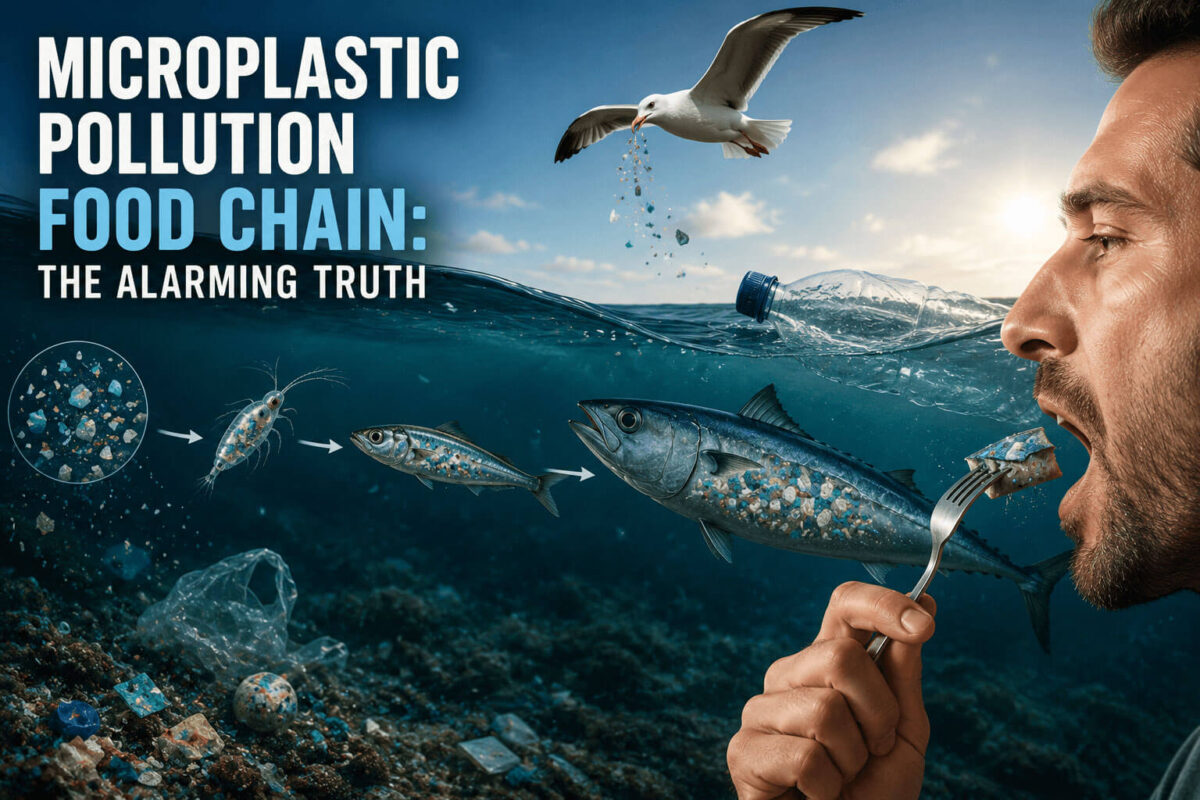
Microplastic Pollution Food Chain: The Alarming Truth
Jul
How Microplastic Pollution Moves Through the Food Chain
From the tiniest zooplankton to apex predators — and ultimately to the dinner table — microplastic pollution travels further through the food chain than most people realize.
What Are Microplastics — and Why Does Size Matter?
Microplastic pollution is not a new discovery. Scientists first formally described microplastics in 2004, but the phenomenon had been building since the mass adoption of single-use plastics in the mid-20th century. By definition, a microplastic is any plastic particle smaller than 5 millimetres in its longest dimension. That upper boundary sounds tiny, but the particles most dangerous to marine ecosystems are often invisible to the naked eye — nanoplastics measuring less than 1 micrometre, small enough to penetrate cell membranes.
Size matters for two interconnected reasons: ingestion and transport. A zooplankton organism cannot distinguish a 50-micrometre polyethylene bead from a similarly sized phytoplankton cell. A filter-feeding mussel draws in thousands of litres of water daily, accumulating particles across its entire filter apparatus. The smaller the particle, the wider the range of organisms that can accidentally consume it, and the deeper within living tissue it can migrate once ingested. Research published in Science has documented nanoplastics crossing the blood-brain barrier in fish, a finding that fundamentally changed how toxicologists model plastic’s biological risk.
The distribution of microplastics in the ocean is not uniform. Surface waters trap certain buoyant polymer types — polyethylene and polypropylene float. Denser polymers like PVC and nylon sink, settling into sediments where deposit-feeding invertebrates concentrate them further. This stratification means the microplastic food chain exposure pathway differs depending on whether an organism feeds at the surface, in the water column, or on the seafloor. Understanding this three-dimensional picture is essential before any meaningful mitigation can be designed.
What makes microplastic pollution uniquely challenging among environmental contaminants is its physical persistence combined with its chemical complexity. Plastic particles do not biodegrade on any human-relevant timescale. Instead, they photodegrade and fragment — breaking into progressively smaller pieces while leaching additive chemicals including phthalates, bisphenols, flame retardants, and heavy metals. Those chemical passengers often carry equal or greater biological risk than the plastic matrix itself, turning each particle into a slow-release contaminant capsule as it travels deeper into the food chain.
“Microplastics are not just litter at a smaller scale. They are a vector — a moving delivery system for chemical contaminants that follows the same pathways as nutrients through the ocean’s food web.”
How Microplastic Pollution Enters the Ocean
The pathways by which microplastics reach the sea are numerous and surprisingly diverse. Some particles arrive already small — primary microplastics manufactured intentionally at that scale. Others begin as macroplastics — bottles, bags, fishing nets, packaging — and fragment over time through UV exposure, wave action, and physical abrasion into the particle sizes that make ocean food web contamination possible. Tracing these entry pathways is not merely academic; effective reduction policy depends on knowing which sources contribute most to marine loading.
Primary Microplastics: Designed Small
Primary microplastics are produced intentionally for industrial or consumer use at sub-5mm dimensions. Microbeads in personal care products were among the most widely publicised, leading to bans in the UK, USA, Canada, and several EU nations. But microbeads represent a fraction of primary microplastic inputs. Plastic pellets — also called nurdles — used as feedstock for plastic manufacturing are spilled during production, transport, and handling at an estimated rate of hundreds of thousands of tonnes annually. These nurdles are the right size and density to be mistaken for fish eggs by seabirds and marine fish alike.
Synthetic Textile Fibres: The Laundry Problem
Every time a synthetic garment — polyester, nylon, acrylic — is washed in a domestic machine, it sheds between 700,000 and 1.9 million microfibres per wash cycle, according to research from Plymouth University. Those fibres pass through most wastewater treatment plant filters and enter waterways directly. Fibres are particularly hazardous in the marine food chain because their elongated shape resembles food to filter feeders. Studies of commercial mussels across European coastlines consistently find fibre concentrations that correlate directly with proximity to wastewater discharge points.
Tyre Wear Particles: The Road-to-Ocean Route
One of the largest but least-discussed sources of microplastic ocean pollution is tyre wear. As vehicle tyres degrade on road surfaces, they release rubber particles — a synthetic polymer composite — that become suspended in stormwater runoff. In coastal cities and regions with river catchments that drain directly to the sea, tyre wear particles constitute a substantial fraction of total microplastic loading. Research from the Norwegian Environment Agency estimates that tyre and road wear is among the top three sources of microplastic pollution globally.
Types of Microplastics: A Comparative Overview
Not all microplastics behave identically in the marine environment. Polymer type, shape, density, and surface chemistry determine how each particle moves through seawater, which organisms encounter it, and what chemical burden it carries. The table below compares the five major categories found in marine ecosystems, ranked by their documented prevalence in food chain contamination studies.
| Type | Common Sources | Density Behaviour | Primary Ingestion Risk | Contamination Level |
|---|---|---|---|---|
| Polyethylene Fragments | Packaging, bottles, bags | Floats — surface accumulation | Seabirds, pelagic fish, sea turtles | High |
| Synthetic Fibres | Textile washing, fishing gear | Mixed — sinks over time | Filter feeders, benthic fish, crustaceans | High |
| Polystyrene Beads | Packaging foam, microbeads | Near-neutral — mid-column | Zooplankton, larval fish, small crustaceans | High |
| Nylon Fragments | Fishing lines, nets, ropes | Sinks — sediment accumulation | Benthic invertebrates, demersal fish | Moderate |
| Tyre Wear Particles | Road runoff, stormwater | Sinks — riverbed and seafloor | Deposit feeders, sediment-dwelling worms, bivalves | Moderate |
Entry at the Base: How Plankton Start the Microplastic Food Chain
The marine food chain begins with phytoplankton — microscopic photosynthetic organisms that collectively produce roughly half of Earth’s oxygen and form the caloric base of nearly every ocean ecosystem. Zooplankton graze on phytoplankton, and in doing so they become the first animals in the chain to encounter microplastics at scale. Understanding this entry point is fundamental to grasping why microplastic contamination is now systemic rather than localised.
Mistaken Identity at the Microscopic Level
Zooplankton species including copepods — which are arguably the most numerically abundant animals on Earth — select food particles primarily by size and shape. Laboratory studies have repeatedly demonstrated that copepods actively ingest polystyrene microspheres of 2–6 micrometres at rates comparable to their natural phytoplankton prey. Once ingested, these particles can impair feeding behaviour, reduce reproductive output, and transfer up the chain when the copepod is itself consumed. This is the opening mechanism of microplastic food chain contamination.
Biofilm Coating: Making Plastic Smell Like Food
In the real ocean, microplastic particles are rarely bare. Within hours of entering seawater they acquire a biofilm — a coating of bacteria, algae, and organic compounds called the “plastisphere.” This biofilm fundamentally changes how organisms perceive the particles. Research from the Woods Hole Oceanographic Institution found that dimethyl sulphide (DMS) — a chemical naturally produced by phytoplankton and used by seabirds and marine mammals as an olfactory cue to locate feeding zones — is emitted in elevated quantities from biofouled plastic. In effect, plastic that has been at sea long enough smells like food to animals that evolved to hunt by smell.
Physical Consequences in Filter Feeders
Beyond plankton, filter-feeding organisms including mussels, oysters, sea cucumbers, whale sharks, and baleen whales process enormous volumes of water. A blue mussel filters up to 5 litres per hour; a large baleen whale may process hundreds of tonnes of seawater daily. At typical open-ocean microplastic concentrations, these filter feeders accumulate particles continuously. Studies of Mediterranean blue mussels have found an average of 0.36 microplastic particles per gram of tissue — a figure that increases dramatically in coastal and river-mouth zones, reaching over 4 particles per gram in heavily polluted areas. These bivalves are harvested commercially and consumed globally, meaning the microplastic food chain has a well-documented exit point directly onto human plates.
The Step-by-Step Bioaccumulation Path Through the Food Chain
Microplastic pollution does not simply accumulate within individual organisms — it transfers, concentrates, and transforms at each trophic level. Bioaccumulation describes the build-up of a substance within a single organism over its lifetime. Biomagnification describes the amplification of concentration as that organism is consumed by a predator, whose tissues carry the combined burden of everything it has eaten. Together, these two processes turn a diffuse environmental contaminant into a concentrated biological hazard by the time it reaches apex predators.
Phytoplankton & Nanoplastic Uptake
Nanoplastics (under 1 micrometre) are absorbed directly through the cell membranes of phytoplankton and marine bacteria. This is the entry point into the living food web. At this level, concentrations are low but the exposure is universal — nanoplastics have been documented in surface waters from the Arctic to the Mariana Trench.
Zooplankton: Active Ingestion and Particle Retention
Copepods, krill, and other zooplankton consume microplastic particles alongside phytoplankton. Particles that are not egested remain in gut tissue. As each zooplankton organism is consumed by a predator, the particles from hundreds of prey items accumulate in a single predator — the first concentration step. Krill are particularly significant vectors because of their central role feeding everything from penguins and seals to baleen whales.
Small Pelagic Fish: Concentration Begins
Anchovies, sardines, herring, and similar forage fish consume vast quantities of zooplankton. Analysis of anchovies from the Bay of Biscay found microplastics in the digestive systems of over 70% of individuals sampled, with fibres the dominant form. These species are consumed both by larger predatory fish and directly by humans — particularly in Mediterranean and Southeast Asian cuisines where whole-fish consumption is common, meaning gut contents are eaten as well.
Predatory Fish and Marine Mammals: Biomagnification in Action
A tuna, striped bass, or dolphin consuming thousands of contaminated prey items over a lifetime accumulates a particle burden that dwarfs what any individual prey item carried. More concerning, the associated chemical contaminants — PCBs, flame retardants, phthalates — are lipophilic (fat-soluble) and concentrate preferentially in fatty tissues rather than being excreted. Long-lived, high-trophic-level predators like orca and bluefin tuna therefore carry the highest chemical burdens. Research from the NOAA Ocean Service confirms that marine mammals near industrialised coastlines show persistent organic pollutant levels that correspond to their microplastic ingestion histories.
Apex Predators and the Human Table
Humans sit at or near the apex of the marine food chain when consuming high-trophic seafood. Studies have detected microplastics in commercial fish sold at markets in 11 countries, in commercial shellfish, in sea salt, and in bottled and tap water. The average person consuming a seafood-heavy diet is estimated to ingest between 11,000 and 70,000 microplastic particles annually through food and water alone. The long-term health implications of this chronic low-level exposure remain an active area of research, but early findings on inflammatory response and endocrine disruption are not reassuring. Ocean advocates who track the species most affected recognise this endpoint as both an ecological and a public health crisis.
Key Species Acting as Microplastic Vectors in the Food Chain
Certain species play outsized roles in moving microplastic pollution through the food chain — either because of their feeding method, their position in the web, their numerical abundance, or their direct importance to human food systems. Understanding these species as vectors helps identify where interventions would have the greatest downstream impact.
Antarctic krill (Euphausia superba) are the keystone prey species of the Southern Ocean, feeding penguins, seals, and baleen whales. Studies confirm they ingest microplastics and fragment larger particles further through digestion — effectively creating nanoplastics from microplastics.
The most numerically abundant forage fish in temperate oceans, anchovies and sardines are critical links between zooplankton and larger predators. Their near-global distribution makes them both major microplastic vectors and important sentinels for ocean pollution monitoring.
Squid bridge the mid-water zone between surface-feeding forage fish and deep-diving toothed whales. They accumulate microplastics readily in their digestive glands — a tissue concentrated when squid are processed commercially, representing a direct human dietary exposure pathway.
Filter feeders operating at enormous scale, baleen whales may ingest up to 10 million microplastic pieces per day during active lunge-feeding in microplastic-dense zones. As they are not commercially harvested in most jurisdictions, they represent the ecological endpoint of contamination rather than a human dietary vector — but their health signals the state of the food web they share with commercial species.
Perhaps the most important species for understanding direct human microplastic exposure through seafood. Bivalves are widely cultivated in coastal zones most affected by runoff, consumed whole without gut removal, and serve as international monitoring standards for coastal pollution due to their measurable, reproducible bioaccumulation.
Reef-associated species feed in environments where microplastic concentrations are often elevated due to coastal proximity and sedimentation patterns. Their ingestion of microplastics impairs feeding cue recognition and territorial behaviour — effects documented in clownfish and damselfish species in laboratory conditions mirroring reef-zone contamination levels.
Global Microplastic Hotspots: Where the Food Chain Is Under Greatest Pressure
Microplastic contamination is global, but it is not uniformly distributed. Oceanographic circulation patterns, river discharge volumes, fishing pressure, and proximity to industrial production all shape where concentrations are highest and where the microplastic food chain operates under the greatest stress. These locations are not merely areas of academic interest — they are regions where human seafood consumption and plastic contamination intersect most acutely.
- The Great Pacific Garbage Patch: The most widely known accumulation zone, this convergence of the North Pacific Subtropical Gyre traps buoyant plastics in a region larger than Texas. Surface microplastic concentrations here can reach 1.9 million particles per square kilometre, and the area overlaps with critical feeding grounds for loggerhead turtles, black-footed albatross, and several commercially harvested tuna and billfish species that migrate through the patch seasonally.
- The Mediterranean Sea: Nearly enclosed, with high population density around its coastlines and 30% of global maritime traffic passing through it, the Mediterranean records some of the highest microplastic concentrations in surface waters of any sea worldwide. Filter-feeding commercial species — mussels, clams, European anchovies — are under constant pressure, and studies of commercial fish landed at Italian, Spanish, and Greek ports consistently find microplastic contamination across multiple species.
- Southeast Asian River Mouths: Ten rivers — eight of them in Asia — are estimated to carry between 88% and 95% of all riverine plastic entering the world’s oceans. The Yangtze, Mekong, Indus, and Ganges discharge not only enormous plastic volumes but also carry them into some of the world’s most productive and heavily fished coastal seas. Coral triangle nations and Bay of Bengal fisheries are downstream recipients of this continental plastic load.
- Arctic Sea Ice: An unlikely but well-documented hotspot, Arctic sea ice acts as a concentrating matrix for microplastics transported by ocean currents from the North Atlantic. As ice melts seasonally, it releases pulses of microplastics into the water column that coincide with the spring phytoplankton bloom — the moment when zooplankton are feeding most intensively. This timing amplifies ingestion rates at the base of the food chain precisely when the ecosystem is most productive.
- Deep Ocean Sediments: The seafloor of the world’s oceans has emerged as the largest microplastic reservoir on Earth, with estimated depositions of 14 million tonnes. Benthic communities — sea cucumbers, polychaete worms, amphipods — in hadal trenches including the Mariana Trench have been found to contain higher microplastic concentrations than surface waters above them. Deep-sea trawling operations that target species like grenadier fish disturb these sediment-bound particles and reintroduce them into the water column.
- Coastal Upwelling Zones: Areas where cold, nutrient-rich deep water rises to the surface — the California Current, Humboldt Current, and Benguela Current — are among the most biologically productive ocean regions. They are also significant collectors of microplastics, because the same physical processes that bring nutrients up also concentrate surface-layer particles. These zones support major commercial fisheries for sardines, anchovies, and squid, species now routinely found to carry microplastic contamination.
Detection vs. Removal: Two Approaches to Tackling Microplastic Pollution
The scientific and policy communities are increasingly divided not on whether microplastic pollution is serious, but on where to focus limited resources. Two broad approaches dominate current thinking: detection and monitoring (understanding the problem’s true scale and distribution) versus active removal and source reduction (attempting to reverse or slow contamination). Both have merits and significant limitations that ocean advocates should understand.
Advanced spectroscopic techniques — Fourier-transform infrared (FTIR) and Raman spectroscopy — now allow scientists to identify polymer type, size, and surface chemistry of individual particles in tissue samples, seawater, and sediment cores. Standardised monitoring networks like the ones coordinated by OSPAR in the North East Atlantic and by UNEP’s Global Partnership on Marine Litter track contamination trends over time. This approach is essential for generating the evidence base needed to justify regulatory action, but detection alone changes nothing in the water. Monitoring is a precondition for effective policy, not a solution in itself.
Ocean cleanup technologies — surface skimmers, river-mouth barriers, and seabed trawl systems — attract significant public attention and investment. Their limitations are real: removing microplastics from open water risks incidentally collecting the zooplankton and larval fish that form the base of the food web. Source reduction — improving wastewater filtration, banning single-use plastics, designing products with longer lifespans — addresses the input rather than attempting to retrieve particles already dispersed through the ocean. Most marine scientists argue that source reduction delivers far greater ecological benefit per dollar invested than open-ocean removal at current technology levels, though both have roles in a comprehensive strategy.
The honest answer is that neither approach alone will solve the microplastic food chain contamination problem on any timescale relevant to living ecosystems. Detection without action is data collection without consequence. Removal without source reduction is bailing a flooding boat without closing the valve. The most evidence-supported path combines aggressive source reduction — targeting synthetic textile shedding, single-use plastic production, and inadequate wastewater treatment — with sustained monitoring to verify whether interventions are working. This is the position of the European Environment Agency and the majority of peer-reviewed recommendations in the field.
Ethics, Policy, and What the Science Demands We Change
The movement of microplastic pollution through the food chain is not only an ecological or toxicological question — it is fundamentally an ethical and political one. The communities most exposed to microplastic-contaminated seafood are often those with the least political leverage to demand the industrial changes that would reduce contamination at source. Small-island developing states, subsistence fishing communities in South and Southeast Asia, and Indigenous coastal peoples in the Arctic and Pacific all depend on seafood as a primary protein source and face disproportionate exposure to a pollution stream they did not generate.
The Regulatory Gap Between Science and Law
Science on microplastic food chain contamination has advanced dramatically in the past decade. Regulatory frameworks have moved considerably more slowly. The EU Single-Use Plastics Directive, enacted in 2019, addressed a visible layer of the problem — straws, cutlery, cotton buds — but left synthetic textile shedding, tyre wear, and industrial pellet loss largely unaddressed. The Basel Convention’s 2019 amendment brought plastic waste under international hazardous waste controls for the first time. But these are incremental steps against a problem whose scale is now measured in millions of tonnes annually entering the ocean.
What the Science Actually Supports
- Extended Producer Responsibility (EPR): Making plastic manufacturers financially liable for end-of-life costs creates economic incentives to reduce production and design for recyclability — the only mechanism that consistently demonstrates measurable reduction in plastic entering the environment.
- Mandatory microfibre filters on washing machines: France became the first country to legislate this requirement for new machines from 2025 — a straightforward technology fix for one of the largest identified sources.
- Tyre particle standards: EU regulations phasing out the most hazardous tyre-wear chemicals are in progress but incomplete. Material substitution and road surface management remain under-regulated.
- Transparent seafood labelling: Consumers cannot make informed choices without data. Mandatory microplastic monitoring results for commercial seafood batches would create market incentives for cleaner sourcing — a mechanism that has worked in mercury reduction for certain fisheries.
- Wastewater infrastructure investment: In many high-plastic-discharge regions, inadequate treatment capacity is the primary driver of marine input. Multilateral investment in treatment infrastructure in high-discharge river nations would reduce ocean loading at source more effectively than any cleanup technology currently deployed.
The food chain is not a metaphor — it is a physical pathway connecting the decisions made in a plastic factory in one part of the world to the tissue of a fish on a plate in another. Recognising that connection is the precondition for the systemic change that the science unambiguously supports. Ocean literacy, consumer pressure, and policy advocacy operate at different speeds, but they are not independent of one another. Every person who understands how microplastic pollution moves through the food chain is a more effective advocate for the policy changes that would slow it.
Frequently Asked Questions About Microplastic Pollution in the Food Chain
What are microplastics and how do they end up in the food chain?
Microplastics are plastic particles smaller than 5 millimetres in size, originating either as intentionally manufactured small particles (primary microplastics like microbeads and industrial pellets) or from the fragmentation of larger plastic objects through UV exposure, wave action, and physical abrasion. They enter the food chain primarily through ingestion by marine organisms at the base of the food web — zooplankton, filter feeders, and small fish — that cannot distinguish plastic particles from food. Once inside a living organism, particles can transfer to predators when that organism is eaten, accumulating and concentrating at each successive trophic level in a process called biomagnification. The result is that apex predators, including humans, carry the highest cumulative burden of both particles and associated chemical contaminants.
Can microplastics in seafood harm human health?
Current evidence indicates genuine cause for concern, though the full extent of harm from chronic dietary exposure is still being quantified. Microplastics detected in human tissue — including the lungs, blood, placenta, and recently the heart — confirm that particles do translocate from the gut into systemic circulation. Associated chemical contaminants, including phthalates, bisphenols, and persistent organic pollutants adsorbed onto particle surfaces, are established endocrine disruptors and carcinogens at sufficient doses. Animal studies show inflammatory responses, oxidative stress, and reproductive impairment. The World Health Organisation has called for urgent further research, and several national food safety agencies have advised precautionary reduction of microplastic exposure through dietary choices while the evidence base develops.
Which seafood has the most microplastics?
Filter-feeding bivalves — mussels, oysters, clams, and scallops — consistently show the highest microplastic concentrations in edible tissue, largely because they are eaten whole (gut and all) and live in coastal zones with high pollution inputs. Commercial shrimp and prawns also show significant contamination, particularly those sourced from Southeast Asian coastal aquaculture. Among finfish, smaller whole-consumed species like anchovies and sardines expose consumers to gut-content contamination, while larger filleted fish present lower per-portion risks since gut tissue is typically removed before sale. Long-lived, high-trophic predators like swordfish and shark carry the highest chemical burdens from biomagnification. Oceanic, open-water species generally show lower contamination than coastal or estuarine species.
How does biomagnification make microplastic pollution worse at higher food chain levels?
Biomagnification describes the process by which a contaminant’s concentration increases progressively at each trophic level of the food chain. A single copepod may carry a small number of microplastic particles, but a herring consuming thousands of copepods accumulates the combined particle burden of all of them in its own tissues. A tuna consuming hundreds of herrings accumulates the combined burden of all those herrings. The concentration step is compounded by the fact that lipophilic (fat-soluble) chemical contaminants associated with plastic — PCBs, DDT metabolites, flame retardants — preferentially bind to fatty tissue rather than being excreted, and these tissues are precisely the ones consumed when eating high-fat fish species. The result is that contamination at the top of the food chain can be orders of magnitude higher than in the surrounding water — a fact that makes trophic level one of the most important variables when assessing dietary microplastic exposure risk.
What is being done to stop microplastics entering the ocean?
Regulatory responses have accelerated notably since 2018 but remain well behind the scale of the problem. The EU has enacted bans on intentionally added microplastics in cosmetics and consumer products, mandatory single-use plastic restrictions, and France’s pioneering requirement for microfibre filters on new washing machines from 2025. The 2019 Basel Convention amendment brought plastic waste under international hazardous waste treaty controls for the first time. A UN Global Plastics Treaty has been under negotiation since 2022, with text expected to address the full lifecycle of plastic production. Simultaneously, corporate Extended Producer Responsibility schemes, deposit return systems for beverage containers, and investment in wastewater treatment capacity in high-discharge river nations represent the most impactful near-term interventions identified by independent scientific assessments. Individual choices — reducing synthetic textile purchases, using laundry filter bags, and choosing sustainably sourced seafood — have measurable but smaller aggregate effects.
Are freshwater ecosystems also affected by microplastic food chain contamination?
Yes — and freshwater microplastic contamination is increasingly recognised as a serious and under-studied parallel to marine contamination. Rivers, lakes, and estuaries act as both transport pathways for microplastics heading to the ocean and as independent ecosystems where food chain contamination occurs. Freshwater zooplankton, fish larvae, and benthic invertebrates in contaminated rivers show ingestion rates comparable to marine equivalents. Commercially important freshwater species — salmon, trout, perch, freshwater mussels — have been found to carry microplastics in fisheries studies across Europe, North America, and Asia. Drinking water itself, both from surface and groundwater sources, contains measurable microplastic concentrations in most countries where it has been tested. The food chain exposure pathway for microplastics is therefore not confined to marine seafood — it operates across virtually all aquatic food systems globally.
