


🏄 Surfing & Wind Sports
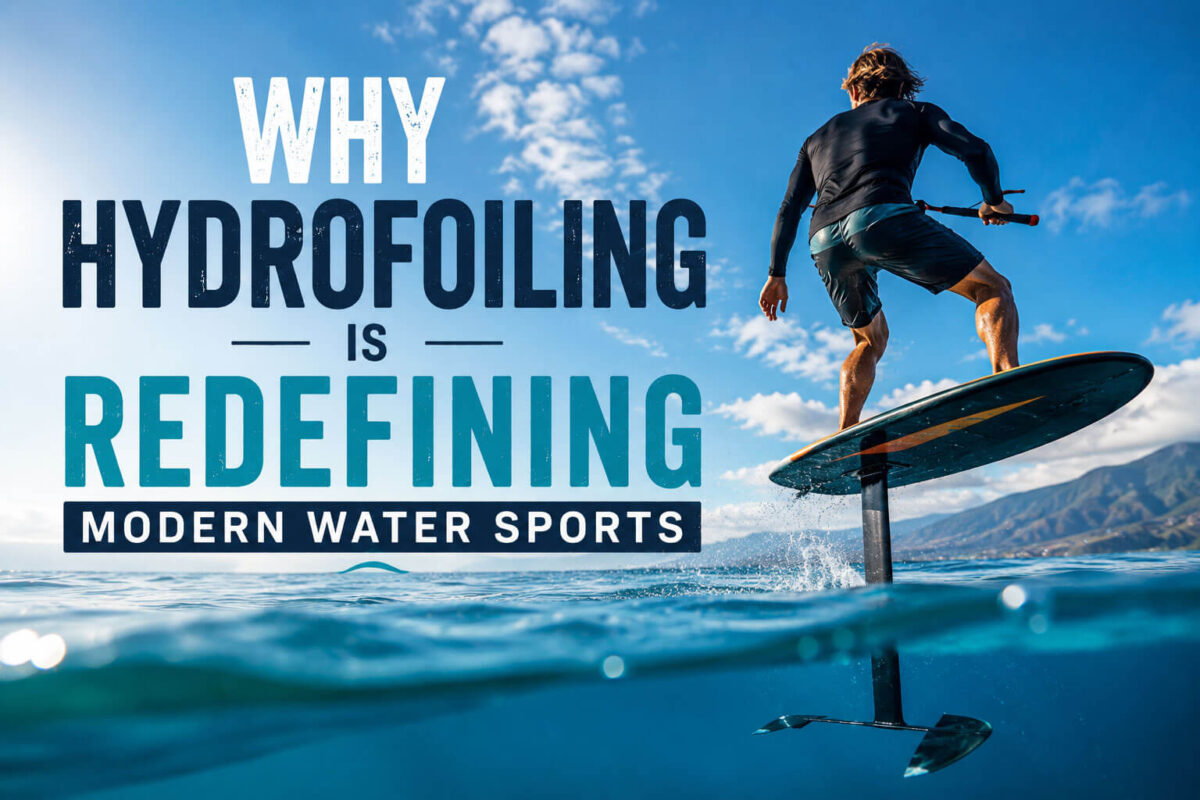
Why Hydrofoiling Is Redefining Modern Water Sports
Jul
Why Hydrofoiling in Water Sports Is Redefining How We Ride the Ocean
Hydrofoiling in water sports is no longer a niche obsession — it is the fastest-growing technological shift the ocean sports world has ever seen, transforming kiteboarding, surfing, windsurfing, and SUP into something that feels closer to flight than riding.
What Is Hydrofoiling in Water Sports and Why Does It Matter?
Hydrofoiling in water sports refers to the use of a submerged wing-like structure — the hydrofoil — attached beneath a board, boat, or craft, which generates lift as it moves through the water. Once sufficient speed is reached, this lift raises the board clear of the surface entirely, leaving the rider suspended silently above the chop, swell, or current below. The sensation is unlike anything else in outdoor sports: frictionless, whisper-quiet, and strangely meditative despite the physics-defying nature of what is happening beneath the water.
The technology itself is not new. Hydrofoil-equipped ferries were operating commercially in Europe and the Soviet Union as early as the 1950s, using the same fundamental principle — a submerged wing generating upward lift — to dramatically reduce hull drag and increase vessel speed. What changed in the 2010s was miniaturization and materials science. Carbon fiber, CNC-machined aluminum, and modular mast systems allowed foil assemblies to shrink to the scale of a surfboard or kiteboard, making personal hydrofoil use not only possible but increasingly accessible to recreational athletes.
The first widely documented personal water sports application of hydrofoil technology was Laird Hamilton’s tow-in foil surfing at Jaws, Maui, in the early 2000s. Hamilton’s sessions — strapped to a massive windsurfer foil attached to a modified wakeboard — were largely dismissed as an eccentric experiment by the broader surfing community. Within fifteen years, those experiments had seeded an industry that now encompasses kite foiling, wind foiling, surf foiling, wake foiling, SUP foiling, and the entirely battery-powered eFoil category. The dismissal of Hamilton’s early sessions stands as one of the most spectacular misreadings of technological trajectory in the history of action sports.
“The moment your board lifts free of the water for the first time, every other water sport you’ve ever tried feels like it was missing something fundamental — a dimension of freedom you didn’t know existed.”
What makes hydrofoiling in water sports genuinely transformative — rather than merely novel — is the way it decouples rider performance from surface conditions. Traditional surfing requires waves. Traditional windsurfing requires choppy, wind-blown water to plane effectively. Hydrofoiling removes these dependencies almost entirely. A kite foiler can ride in glassy, barely-rippling conditions on eight knots of wind that would send a traditional kiteboarder back to shore. A surf foiler can ride the energy from a barely-visible groundswell that produces no visible breaking wave at all. This expansion of rideable conditions has fundamentally enlarged the sport’s calendar and geography, making consistent riding possible in places and at times that were previously unusable.
The Physics That Make Hydrofoiling in Water Sports Possible
Understanding the physical principles behind hydrofoil flight transforms the way a rider thinks about every input they make. Unlike board sports where the interaction is primarily between a flat surface and water, foiling involves aerodynamic principles translated into a liquid medium — a fascinatingly complex system that rewards intuitive physics understanding.
Bernoulli’s Principle and Lift Generation
The front wing of a hydrofoil — the main wing, typically mounted at the bottom of a vertical mast — is shaped as an asymmetric aerofoil: curved on the upper surface and flatter on the lower. As the assembly moves forward through the water, this shape causes water to accelerate over the curved upper surface and decelerate beneath the flat lower surface. Per Bernoulli’s principle, faster-moving fluid has lower pressure. The resulting pressure differential between the upper and lower surfaces of the wing generates an upward force — lift — that increases proportionally with the square of the assembly’s forward speed. Once lift exceeds the combined weight of the rider and board, the system rises.
Pitch, Roll, and the Role of the Rear Stabilizer
A hydrofoil assembly is not inherently stable — left uncontrolled, the lift-generating main wing would simply drive the nose upward until the system stalled and crashed back into the water. The rear stabilizer wing, mounted horizontally at the bottom of a short fuselage behind the main wing, provides the pitch stability that prevents this. By generating a small downward force at the rear of the assembly, the stabilizer creates a balanced moment around the mast’s attachment point. The relationship between front wing size, rear stabilizer size, fuselage length, and mast height determines the assembly’s natural pitch stability — and is the primary variable that separates beginner-friendly foils from high-performance racing setups.
Mast Height, Ventilation, and Speed Sensitivity
The vertical mast connecting the board to the underwater wing assembly determines two critical performance characteristics: maximum altitude above the water surface and ventilation risk. Longer masts — typically 85cm to 110cm for advanced riders — allow greater board clearance above the water, enabling riding in larger swell without the board touching down. Shorter masts of 60–70cm are used by beginners and wave riders for their lower center of gravity and reduced instability. Ventilation — the catastrophic intrusion of air bubbles into the wing’s pressure surface when the mast breaks the water surface — causes sudden catastrophic lift loss and is the primary cause of the high-speed crashes that make foiling’s learning curve steep and occasionally dramatic.
Types of Hydrofoil Systems: A Complete Comparison for Water Sports Riders
The hydrofoil market has segmented rapidly as different disciplines have demanded purpose-specific engineering. What started as adapted windsurfing foils has evolved into a sophisticated taxonomy of designs, each optimized for a specific sport, speed range, rider weight, and wave or wind condition. Choosing the right foil system is as important as choosing the right board — and arguably more technically nuanced.
The table below compares the five dominant hydrofoil system categories available to recreational and competitive water sports athletes in 2026, covering their primary application, front wing area, recommended skill level, and approximate entry-level cost for a complete foil assembly.
| Foil System Type | Primary Sport | Front Wing Area | Entry Cost (USD) | Skill Level |
|---|---|---|---|---|
| Kite Foil (Race) | Kite foiling / Formula Kite | 600–900 cm² | $1,800–$4,500 | Intermediate–Expert |
| Surf Foil | Surf foiling / tow foiling | 1,200–2,000 cm² | $900–$2,800 | Intermediate |
| Wind Foil | Windsurfing / wind foiling | 800–1,400 cm² | $1,200–$3,500 | Intermediate |
| SUP / Pump Foil | SUP foiling / prone pump | 1,600–2,500 cm² | $700–$2,000 | Beginner–Intermediate |
| eFoil (Electric) | Powered foil surfing | 1,400–2,200 cm² | $8,000–$14,000 | Beginner–Intermediate |
Hydrofoil Safety: Rules, Risks, and Responsible Riding
Hydrofoiling in water sports introduces a unique set of hazards that do not exist in traditional board sports. The mast and wing assembly — typically constructed from carbon fiber or machined aluminum — can cause extremely serious lacerations on contact at speed. Understanding and rigorously applying foil-specific safety protocols is not optional; it is the single most important factor in long-term enjoyment and injury prevention in this discipline.
The Foil Strike Hazard
A hydrofoil assembly traveling at 20 knots generates enormous kinetic energy. Falls at speed can result in the foil striking the rider’s own body or, in crowded waterways, striking nearby swimmers or paddlers who are invisible beneath the surface. The leading edges of high-performance foil wings can have a radius as small as 2mm — effectively blade-sharp at impact velocities. Protective gear, including impact helmets and body armor designed specifically for foil sports, has become the non-negotiable minimum standard recommended by the International Kiteboarding Association and all major surf foil schools.
Separation Distance and Zone Management
Because a foil rider’s trajectory is far less predictable than that of a traditional board rider — sudden altitude changes, stalls, and direction reversals are common — maintaining substantial separation from other water users is critical. Most responsible foiling communities recommend a minimum 50-meter exclusion zone from swimmers, non-foiling surfers, and anchored or slow-moving vessels. At popular foiling destinations, designated foiling zones separated from surfing lineups by buoy lines have been established to formalize this separation. Ignoring these zones has resulted in serious injuries to bystanders and increasingly in formal beach access restrictions for foil riders.
Equipment Inspection and Failure Prevention
Unlike a surfboard, a hydrofoil assembly experiences significant mechanical stress loads during every ride. The connection points between mast and board, mast and fuselage, and fuselage and wings are all subjected to both compression and tensile forces that can cause fatigue cracking in carbon fiber components over time. Regular inspection of all bolt connections, mast inserts, and wing leading edges before every session is essential. Loose hardware on a foil system can cause sudden catastrophic disassembly at speed — an event that has caused multiple serious injuries to riders internationally.
- Always wear a foil-specific helmet: Standard surf helmets offer insufficient protection against foil wing strikes. Full-coverage helmets with reinforced ear protection are strongly recommended for all foil disciplines, not just beginners.
- Use an impact vest or foil armor: Purpose-built foil protection vests now cover the chest, back, and hips with high-density foam that absorbs wing impact energy. Several brands offer full-body armor systems for high-speed racing applications.
- Inspect all bolts before every session: Mast bolts should be checked for proper torque before entering the water. A torque wrench calibrated to manufacturer specifications is the only reliable way to ensure consistent fastener tension across sessions.
- Never foil in shallow water: Wing strike on the seabed is catastrophic for both the rider and the equipment. A minimum water depth of 1.5 meters below the board is the accepted safety threshold for most foil wing sizes during takeoff and landing phases.
- Maintain clear exit routes: Always identify safe fall zones — areas of clear water with no hazards — before executing maneuvers that involve intentional or unintentional loss of control. This is particularly critical when surf foiling in crowded lineups.
- Learn in dedicated lesson programs: Self-taught foiling has a dramatically higher injury rate than instructor-led learning. Qualified foil instructors teach controlled falling techniques, equipment handling, and progressive speed management that are genuinely difficult to replicate independently.
Learning to Foil: A Step-by-Step Progression for Water Sports Riders
The learning curve for hydrofoiling in water sports is steep but navigable with the right progression framework. Attempting to rush through stages — a common mistake driven by excitement — dramatically increases injury risk and can reinforce poor technique habits that are difficult to unlearn. The following six-step progression is used by leading foil schools worldwide.
Land-Based Familiarization and Equipment Assembly
Before entering the water, spend time assembling and disassembling your foil system on land until the process is completely familiar. Identify every bolt, connection point, and safety feature. Simulate the body position you will use on the water — feet shoulder-width apart, knees soft, weight distributed 60% over the back foot. Understanding your equipment intimately on dry land prevents hesitation and confusion during the high-stress moments of early water sessions when cognitive bandwidth is already fully consumed by balance and control tasks.
Prone Paddling with the Foil Submerged
Begin by paddling the foil board in flat water with the foil fully assembled and submerged. The goal at this stage is purely to develop comfort with the board’s unusual behavior — the significant drag of the foil assembly, the tendency to veer when weight shifts laterally, and the way the board responds to paddle strokes differently from a conventional surfboard or SUP. Spend at least two to three hours at this stage before attempting any powered riding. Riders who skip this phase consistently report greater anxiety and slower skill acquisition during powered sessions.
Low-Speed Powered Riding Without Takeoff
Using your power source — kite, motor, tow rope, or prone paddling on a wave — achieve forward motion while deliberately preventing the foil from lifting. For kite foilers, this means keeping the kite in the neutral position and resisting the urge to generate excess power. The goal is to develop confidence on the moving board without the additional complexity of altitude management. During this phase, focus entirely on maintaining a stable, centered stance and becoming comfortable with how steering inputs affect board direction. Expect to spend three to five sessions here before the foil begins to rise naturally.
First Foil Flights and Crash Management
The first unintentional foil lift is a memorable and often disorienting experience. The board rises suddenly, the drag disappears, and the rider’s instinct is to lean forward — which immediately drives the nose down and crashes the system back into the water. The correct response to unplanned altitude gain is to shift weight slightly backward and keep the front foot pressure minimal. Controlled crashes — falling sideways away from the board rather than forward over it — should be practiced consciously. Every foil instructor in the world teaches the critical rule: never fall forward over the board when foiling. The foil wing is always in front of you below the surface.
Altitude Control and Extended Foil Flight
Once consistent foil flight is achieved, the primary skill to develop is altitude management — maintaining a steady, controlled height above the water surface without oscillating up and down (a phenomenon called porpoising). The key control input is front foot pressure: adding weight to the front foot drives the nose down and reduces altitude; relieving front foot pressure allows altitude to increase. Most riders find a comfortable cruising altitude of 30–60cm above the water during early sessions, gradually extending this as confidence and reflexes develop. The IKO’s foil progression certification provides a structured benchmark framework for measuring altitude control competency.
Gybes, Tacks, and Advanced Maneuvers
Direction changes on a foil — particularly tacking (turning through the wind on a kite or wind foil) — require maintaining foil flight through the turn, which demands precise, smooth weight transfer and impeccable kite or sail control simultaneously. Most riders achieve their first foil gybe within 10–20 sessions and their first clean foil tack within 30–50 sessions. Beyond basic transitions, advanced foil maneuvers include jump landings on foil, pumping to sustain flight without wind, and eventually wave foiling — reading ocean energy to sustain flight across wave trains without any external power source. For those interested in how foiling intersects with kiteboarding disciplines specifically, our article on the evolution of modern kiteboarding provides essential historical and technical context.
Essential Hydrofoil Gear for Water Sports Riders in 2026
The hydrofoil gear market has matured significantly over the past five years, with major brands including Axis, Slingshot, Cabrinha, Duotone, Lift, and Flite offering complete, purpose-built systems rather than the cobbled-together windsurfer adaptations of the early era. Here is a breakdown of the six essential components every hydrofoil setup requires.
Best Global Destinations for Hydrofoiling in Water Sports
Because hydrofoiling in water sports works in far lighter wind and smaller swell than traditional board sports, the geography of ideal destinations differs meaningfully from conventional kiteboarding or surfing maps. Flat water lagoons, consistent thermal winds, and access to groundswell energy all create distinct advantages for different foil disciplines. These six destinations represent the global pinnacle of foil-friendly conditions.
- Dakhla, Morocco: The Saharan lagoon at Dakhla is arguably the world’s perfect kite foil training ground. The vast, flat, shallow water is completely sheltered from ocean swell, and thermal winds build reliably each afternoon to 20–30 knots from May through October. The smooth, glass-like water surface allows beginners to focus entirely on altitude control without the distraction of chop management. Several world-class kite foil schools now operate permanent facilities here, and the destination hosts multiple Formula Kite training camps annually.
- Maui, Hawaii: The North Shore’s Kanaha Beach and the legendary downwinder from Hookipa to Kahului Harbour are iconic foil routes where consistent 15–25 knot trade winds and perfectly groomed chop create ideal conditions for intermediate and advanced kite foil and wind foil riders. Maui’s foil community is among the world’s most technically advanced, and the island’s unique wave quality at Peahi and Ho’okipa has made it the birthplace of progressive surf foiling as well as kite foiling.
- Tarifa, Spain: Europe’s most wind-reliable destination, Tarifa’s Levante and Poniente winds provide foil-worthy conditions on over 280 days per year. The flat-water lagoon at Valdevaqueros is ideal for light-wind foil training, while the more exposed Playa de los Lances delivers the chop and power that advanced riders crave. Tarifa’s strong infrastructure of rental, repair, and instruction services makes it the most logistically convenient European foil destination for visiting athletes.
- Cabarete, Dominican Republic: The Caribbean’s premier foil hub, Cabarete’s Kite Beach lagoon combines warm water, consistent trade winds, and an extraordinary concentration of world-class instruction. The shallow, flat Bozo Beach lagoon adjacent to the main kite area is specifically designated for foil training, providing separation from traditional kiteboarders and reducing collision risk. Cabarete’s year-round wind reliability and excellent accommodation options make it particularly attractive for extended progression trips.
- Cornouaille, Brittany, France: For surf foiling specifically, the Atlantic swells that roll into Brittany’s rugged coastline provide some of Europe’s finest foil surfing energy. The long-period groundswell from North Atlantic storms creates the gentle, sustained wave energy that surf foilers need to generate speed and sustain flight through long, graceful turns. Brittany’s emerging foil surf community and improving access to quality rental equipment make it a compelling European alternative to Basque Country for swell-focused foil riders.
- Lake Garda, Italy: For freshwater foiling in an alpine setting, Lake Garda’s Ora thermal wind — building reliably from south each afternoon from June through September — provides consistent, smooth-water foil conditions in one of Europe’s most spectacular landscapes. The absence of ocean swell makes Lake Garda uniquely forgiving for beginners making their first foil attempts, and the Italian foil school infrastructure has expanded dramatically since 2022 to meet growing demand from central European riders seeking accessible foil instruction without transatlantic travel.
eFoil vs. Kite Foil: Two Visions of Hydrofoiling in Water Sports
The most philosophically interesting divide in modern hydrofoiling is between the wind-powered kite foil and the battery-electric eFoil. Both achieve the same fundamental result — a rider silently suspended above the water surface — but through entirely different means, with different implications for accessibility, environmental impact, skill development, and the nature of the experience itself.
The eFoil vs. kite foil debate ultimately reflects different visions of what the hydrofoiling experience is fundamentally for. eFoil advocates argue that removing the wind dependency and skill barriers democratizes the experience, allowing more people to access the unique sensation of foil flight regardless of athletic background or weather conditions. Kite foil advocates counter that the skill, wind-reading, and physical engagement of wind-powered foiling is inseparable from the experience’s deeper value — that the difficulty and the joy are the same thing. Both are compelling arguments, and the market data suggests riders are voting for both simultaneously: eFoil sales are growing at 35% annually, while kite foil participation is simultaneously expanding at its fastest-ever rate. The hydrofoiling world is apparently large enough to hold both philosophies without choosing between them. For related context on how kiteboarding disciplines compare more broadly, see our comparison of kitesurfing vs windsurfing.
Environmental Considerations for Responsible Hydrofoiling in Water Sports
Hydrofoiling in water sports presents a complex environmental profile. On one hand, wind-powered foiling is among the most energy-efficient forms of water recreation available — generating zero emissions, minimal noise pollution, and negligible wake disturbance at operating altitude. On the other hand, the sport’s materials, manufacturing processes, and specific operational behaviors introduce ecological concerns that the community is only beginning to address with appropriate seriousness.
Carbon Fiber: The Sustainability Paradox
The performance demands of hydrofoiling have made carbon fiber the dominant construction material for masts, wings, fuselages, and boards. Carbon fiber is exceptionally strong, stiff, and light — properties that are genuinely essential for safe, high-performance foiling. However, carbon fiber production is energy-intensive and petroleum-derived, and end-of-life carbon composite components are currently not recyclable through any commercially available process. Broken foil wings and masts accumulate in landfill, and the sport’s rapid growth is accelerating this accumulation. Several manufacturers, including Duotone, are investing in thermoplastic carbon composite research that would allow foil components to be remelted and reformed at end of life — but commercial availability remains five to ten years away at current development trajectories.
Seagrass, Reef, and Marine Habitat Interaction
Foil wings operating in shallow water create a genuine risk to sensitive benthic habitats. In Mediterranean lagoons, Caribbean reef zones, and Indo-Pacific shallow coral environments, foil wings traveling at speed at depths of 50–100cm below the surface can contact and damage Posidonia seagrass meadows, coral formations, and shallow reef structures. Several key foiling destinations — including specific zones in Tarifa and the Greek islands — have introduced mandatory minimum depth requirements for foil riding near protected marine habitat zones. Responsible foil riders should research local marine protection boundaries before riding at any new destination.
- Avoid launching over seagrass beds: Walk your board to deep water before mounting and commencing foiling. Foil wing contact during the low-speed takeoff phase is the highest-risk moment for benthic habitat damage.
- Respect marine protected area boundaries: Many of the world’s best foiling lagoons overlap with marine protected areas. Download and review local MPA boundary maps before riding in any unfamiliar location.
- Extend equipment lifespan deliberately: Carbon foil components that are well maintained can last 10–15 years. Repairing minor damage rather than replacing components is both economically and environmentally rational. Most carbon foil damage is repairable with standard epoxy and carbon patch systems.
- Choose brands with sustainability commitments: Several foil manufacturers now publish annual environmental impact reports and fund ocean conservation organizations. Directing purchasing decisions toward these brands sends a market signal that sustainability matters to the community.
- eFoil battery disposal: Lithium battery packs from eFoil systems require specialist disposal through certified battery recycling facilities. Never dispose of eFoil batteries in general waste streams. Most eFoil manufacturers have established take-back or recycling partnership programs.
The hydrofoiling community’s environmental responsibilities are commensurate with the extraordinary privilege of the experience the sport provides. Riders who have felt the silent, frictionless sensation of sustained foil flight — hovering above the ocean surface on nothing but physics and skill — have perhaps a more visceral reason than most to care deeply about the long-term health of the marine environments that make this experience possible. The most powerful advocacy for ocean conservation comes from those with the most to lose if it degrades — and foil riders, uniquely dependent on quality water and healthy marine ecosystems, have every reason to lead that charge. For those interested in sustainable wind sport practices more broadly, our article on kitesurfing tips for beginners includes a dedicated section on responsible beach behavior and environmental etiquette.
Frequently Asked Questions About Hydrofoiling in Water Sports
