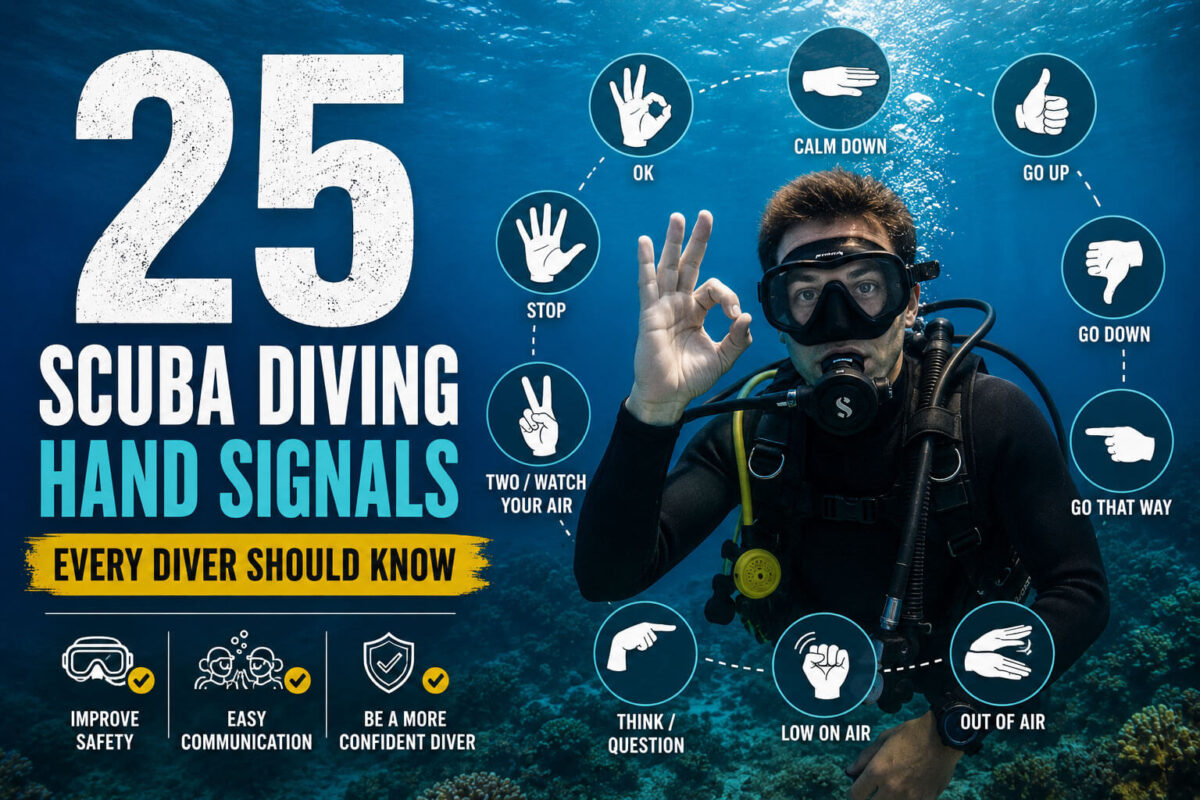
25 Scuba Diving Hand Signals Every Diver Should Know
Underwater, you can’t speak — so your hands do the talking. Master these 25 essential dive signals and you’ll communicate confidently with any buddy, anywhere in the world.
⏱ 10 min read📅 Updated June 2026Essential SkillsSave & Share
25
Essential signals every diver must know
0
Words you can say underwater
5
Categories of dive communication
Section 01
Why hand signals matter underwater
The moment you descend below the surface, verbal communication becomes impossible. Bubbles, pressure, and water make speaking completely ineffective — and yet, communicating clearly with your dive buddy is one of the most important safety skills in all of scuba diving.
Hand signals are the universal language of divers. Standardised by training agencies like PADI and SSI, the core set of signals is recognised at dive centres from the Red Sea to the Great Barrier Reef. Whether you’re diving with a brand-new buddy or an experienced divemaster you’ve never met before, these signals allow you to share critical information — your air level, your depth, any problems you’re experiencing, and the marine life you’ve spotted.
“The most important conversation you’ll ever have underwater happens without a single word.”
This guide covers all 25 essential signals, organised into five categories: safety and emergency, basic communication, direction and navigation, air and depth, and marine life. Learn them before your next dive — and practise them on dry land with your buddy before you enter the water.
📖
New to scuba? Read our Ultimate Beginner’s Guide to Scuba Diving before diving into this article — it covers everything from certification to gear to your first open water dive.
Section 02
Safety & emergency signals
These are the most critical signals in diving. Know them cold before you enter the water — in an emergency, there is no time to think. Every diver, regardless of experience, must be able to give and receive these signals instantly and correctly.
🚨
Safety & Emergency — Priority Signals
Must be memorised before your first open water dive
1
👍
OK / Ascend
Thumb pointing upward. NOT the same as the surface OK signal.
Used when: signalling to ascend or confirming readiness to go up.
2
👎
Descend / Go Down
Thumb pointing downward.
Used when: instructing buddy to descend or follow you deeper.
3
👌
OK (Underwater)
Index finger and thumb forming a circle, other fingers extended.
Used when: confirming you are fine when checked on by buddy or divemaster.
4
✋
Stop / Stay
Flat open palm facing your buddy, held still.
Used when: telling your buddy to hold position or pause movement immediately.
5
🆘
Problem / Something Wrong
Flat hand rocked side to side — the “so-so” wave.
Used when: indicating a non-emergency problem that needs attention.
6
🤙
Out of Air / Emergency
Flat hand sliced sharply across the throat — the universal distress signal.
Used when: you have run out of air and need your buddy’s alternate immediately.
7
🫁
Low on Air
Fist tapped against chest, over the heart, repeatedly.
Used when: air supply is getting low — typically at 50 bar reserve signal.
8
🫀
I Have a Problem (medical)
Point to the affected area of your body with one finger.
Used when: experiencing pain or a physical issue — ear, head, stomach.
🚨
Critical rule: When you receive a safety signal from your buddy, always respond immediately with the same signal back to confirm you understood — then act. Never ignore a signal, even if you think it might be a mistake.
Section 03
Basic communication signals
These are the everyday signals you’ll use on almost every dive — checking in with your buddy, confirming a plan, getting attention, and ending the dive. They form the conversational backbone of underwater communication.
💬
Basic Communication Signals
Used on every dive, every time
9
👀
Look / Watch Me
Two fingers pointed at your own eyes, then toward your buddy.
Used when: asking your buddy to pay attention or watch what you are about to do.
10
👫
Buddy Up / Stay Together
Index fingers pointed at each other and held side by side.
Used when: reminding buddy to stay close or regroup after drifting apart.
11
🔚
End the Dive / Go Back
Thumb and index finger forming a circle, arm swept in the direction of the exit.
Used when: signalling it is time to return to the boat or shore.
12
🔔
Get Attention
Bang on your tank with a dive knife handle or pointer — creates a loud clang. Or shake your buddy’s arm gently.
Used when: your buddy is not looking at you and you need to communicate urgently.
13
🤝
Hold Hands / Take My Hand
Open palm extended toward your buddy.
Used when: poor visibility, helping a nervous buddy, or navigating a difficult area.
14
🤔
I Don’t Understand / Repeat
Flat hand rocked side to side slowly, or a shrug with both palms up.
Used when: a signal was unclear and you need your buddy to repeat it.
Section 04
Direction & navigation signals
Navigation signals help you and your buddy coordinate movement underwater — where to go, which way to turn, and how to move as a unit. These are especially useful on drift dives, wall dives, and wreck penetrations.
🧭
Direction & Navigation Signals
Essential for drift dives, wrecks, and cave systems
15
👉
Go This Way / Turn Right
Index finger pointing in the direction of travel.
Used when: indicating which direction to swim or navigate toward.
16
🔄
Turn Around / Go Back
Index finger making a circular rotation, then pointing in the opposite direction.
Used when: asking buddy to reverse direction completely.
17
⬆️
Go Up / Ascend
Thumb pointing upward — same as the ascend signal.
Used when: directing movement upward in the water column, not just to surface.
18
⬇️
Go Down / Descend
Thumb pointing downward.
Used when: directing movement down the reef or wall.
19
🔃
Hover / Stay at This Depth
Flat hand held horizontally, palm down, held still.
Used when: instructing buddy to maintain current depth — common during safety stops.
Section 05
Air & depth signals
Monitoring air supply and depth is fundamental to safe diving. These signals let you communicate your tank pressure and current depth without a slate — using just your hands and fingers.
🔵
Air & Depth Signals
Check air with your buddy every 10–15 minutes
20
🔢
How Much Air? / Air Check
Point to your buddy, then form a fist and tap it twice on top of your other fist.
Used when: requesting your buddy’s current tank pressure in bar.
21
💯
Air Amount (in bar)
Show the number on your fingers — thumb and pinky for 50, all five fingers for 100, etc. Agree a system with your buddy before diving.
Used when: responding to an air check signal from buddy or divemaster.
22
📊
Half Tank (100 bar)
Flat hand held horizontally, palm down — like the “halfway” gesture.
Used when: communicating you are at the turn-around point for air consumption.
23
📏
Depth (in metres)
Point down, then show the number on fingers. Confirm with your buddy’s dive computer.
Used when: checking or confirming current depth with buddy.
Section 06
Marine life signals
These are the fun ones. Marine life signals let you alert your buddy to creatures you’ve spotted — and share the excitement of an encounter without a word. Most are intuitive imitations of the animal’s most distinctive feature.
🐠
Marine Life Signals
The signals that make diving unforgettable
24
🦈
Shark
Flat hand held vertically on top of your head like a dorsal fin.
Used when: a shark has been spotted — stay calm, maintain position, enjoy the encounter.
25
🐢
Turtle
Both thumbs interlocked, hands flapping gently like flippers.
Used when: a sea turtle has been spotted. One of the most universal and loved signals.
26
🦑
Octopus
Wiggle all fingers of one hand downward, like tentacles moving.
Used when: an octopus or squid has been spotted hiding in the reef.
27
🐬
Dolphin / Whale
Hand undulating smoothly up and down through the water like a cetacean tail.
Used when: dolphins or whales are in the area — often felt as sound before seen.
28
🦅
Manta Ray / Eagle Ray
Both arms extended sideways, hands undulating gently — mimicking the ray’s wing movement.
Used when: a manta or eagle ray is gliding overhead or approaching from a distance.
29
🐡
Fish (general)
Flat hand held vertically, moving side to side like a fish tail.
Used when: pointing out interesting fish or a school of fish nearby.
🦈
Shark signal reminder: The shark signal is not a distress signal. Sharks are a celebrated part of any dive encounter — stay calm, maintain your position, avoid sudden movements, and enjoy one of the ocean’s most extraordinary experiences. Read our Complete Guide to Shark Diving for more.
Section 07
Quick reference table — all 25 signals
Bookmark this table and review it before your next dive. You can also screenshot it to your phone and run through it with your buddy on the boat before you kit up.
#
Signal Name
How to Make It
Category
1
OK / Ascend
Thumb pointing up
Safety
2
Descend / Go Down
Thumb pointing down
Safety
3
OK (Underwater)
Index + thumb circle, fingers extended
Safety
4
Stop / Stay
Flat open palm facing buddy
Safety
5
Problem / Something Wrong
Flat hand rocked side to side
Safety
6
Out of Air
Hand sliced across throat
Safety
7
Low on Air
Fist tapped on chest
Safety
8
I Have a Problem
Point to affected body area
Safety
9
Look / Watch Me
Two fingers to eyes, then buddy
Communication
10
Buddy Up
Index fingers side by side
Communication
11
End the Dive
OK circle + arm sweep to exit
Communication
12
Get Attention
Bang tank or touch buddy’s arm
Communication
13
Hold Hands
Open palm extended to buddy
Communication
14
I Don’t Understand
Hand rocked side to side slowly
Communication
15
Go This Way
Index finger pointing direction
Navigation
16
Turn Around
Circular finger rotation + point opposite
Navigation
17
Go Up
Thumb up
Navigation
18
Go Down
Thumb down
Navigation
19
Hover / Stay at Depth
Flat hand horizontal, palm down
Navigation
20
Air Check
Fist tapped twice on other fist
Air & Depth
21
Air Amount
Fingers showing bar number
Air & Depth
22
Half Tank
Flat hand horizontal
Air & Depth
23
Depth
Point down + finger number
Air & Depth
24
Shark
Flat hand on head as dorsal fin
Marine Life
25
Turtle
Thumbs interlocked, hands flapping
Marine Life
Section 08
Tips for using signals effectively underwater
Knowing the signals is only half the skill. Using them clearly and consistently underwater — especially in low visibility, cold water, or with gloves — takes practice. Here’s how to communicate like an experienced diver from day one.
Best practices for underwater communication
Always make eye contact first before giving any signal — a signal your buddy doesn’t see is no signal at all.
Make signals large and deliberate — exaggerate your movements in cold water or with gloves on. Subtle gestures get lost.
Always confirm receipt — mirror the signal back to your buddy to show you understood it. This is non-negotiable for safety signals.
Agree on a number system before diving — how you communicate bar pressure on fingers varies between dive groups. Sort it on the surface.
Practice on land — run through all 25 signals with your buddy before entering the water. It takes five minutes and could save your life.
Use a dive slate for complex messages — for anything beyond standard signals (directions to a specific site, a medical issue), carry a small underwater writing slate.
Never assume — if a signal is unclear, signal “I don’t understand” and ask your buddy to repeat it. Never guess at an emergency signal.
Section 09
Regional variations to be aware of
While the core set of hand signals is internationally standardised through PADI and SSI, some regional variations exist — particularly in Asia and parts of the Pacific. Being aware of these prevents confusion when diving abroad.
The OK signal varies by region. In some parts of Asia, the circle-and-fingers OK signal is replaced by a flat palm patting the top of the head. If you’re diving somewhere new, confirm with your divemaster which OK signal the local guide uses.
“Level” vs “hover” differ between agencies. PADI and SSI use slightly different hand orientations for the hover signal. When diving with a new group, always clarify during the briefing.
Marine life signals are often improvised. The standard signals above are widely used, but many divemasters have their own creative adaptations for local species. Pay attention during the pre-dive briefing — divemasters often introduce their local signals there.
Night diving uses torch signals. Underwater torches replace hand signals in the dark — a slow circle means OK, rapid circles mean emergency, and pointing the beam at your hand mimics the standard signals. Learn torch signals before your first night dive.
🌍
Pro tip: Before every dive with a new guide or in a new location, always ask: “Are there any local signals I should know?” A good divemaster will always cover this in the briefing — but it never hurts to ask.
Section 10
Frequently asked questions
❓Are scuba hand signals the same worldwide?
The core set — particularly safety and emergency signals — is internationally standardised through PADI and SSI and recognised at dive centres worldwide. Minor regional variations exist, particularly in Asia and the Pacific, so always confirm local signals during your pre-dive briefing when diving somewhere new.
❓What does thumbs up mean underwater?
Underwater, a thumbs up means ascend or end the dive — not “everything is great.” This is one of the most commonly misunderstood signals among new divers. To signal that you are OK underwater, use the circle-and-fingers OK signal (index finger and thumb forming a ring). Save the thumbs up for when you want to go up.
❓How do I communicate air pressure underwater?
The most common method is to show the number in bar using fingers — for example, five fingers twice for 50 bar, or all ten fingers for 100 bar. Some dive groups use a simplified system: full fist for full tank, flat hand for half tank, and fist to chest for low air. Agree on your system with your buddy before you enter the water.
❓What should I do if I don’t understand a signal?
Give the “I don’t understand” signal — rock your flat hand slowly side to side — and your buddy will repeat the signal more clearly or try a different approach. Never guess at what a signal means, especially if it could be a safety or emergency signal. When in doubt, signal your buddy, stop, and sort it out before continuing.
❓Do I need to memorise all 25 signals before my first dive?
You should absolutely know the 8 safety and emergency signals before your first dive — these are covered in your Open Water course and are non-negotiable. The remaining signals covering communication, navigation, air, and marine life will become second nature over your first 10–20 dives. Review this guide before each new dive trip until they are instinctive.
❓Can I use an underwater communication device instead?
Underwater communication devices (such as Divephone or full-face mask communication systems) exist and are increasingly affordable. However, hand signals remain essential — devices can fail, batteries die, and not every buddy will have compatible equipment. Hand signals are the universal fallback that every diver must know regardless of what technology they carry.
Wear the ocean. Live the dive.
SEASPORTEES makes ocean-inspired graphic tees for divers, freedivers, and marine life obsessives. Explore our Scuba & Free Diving collection — built for people who live for the underwater world.