


🤿 Scuba & Free Diving
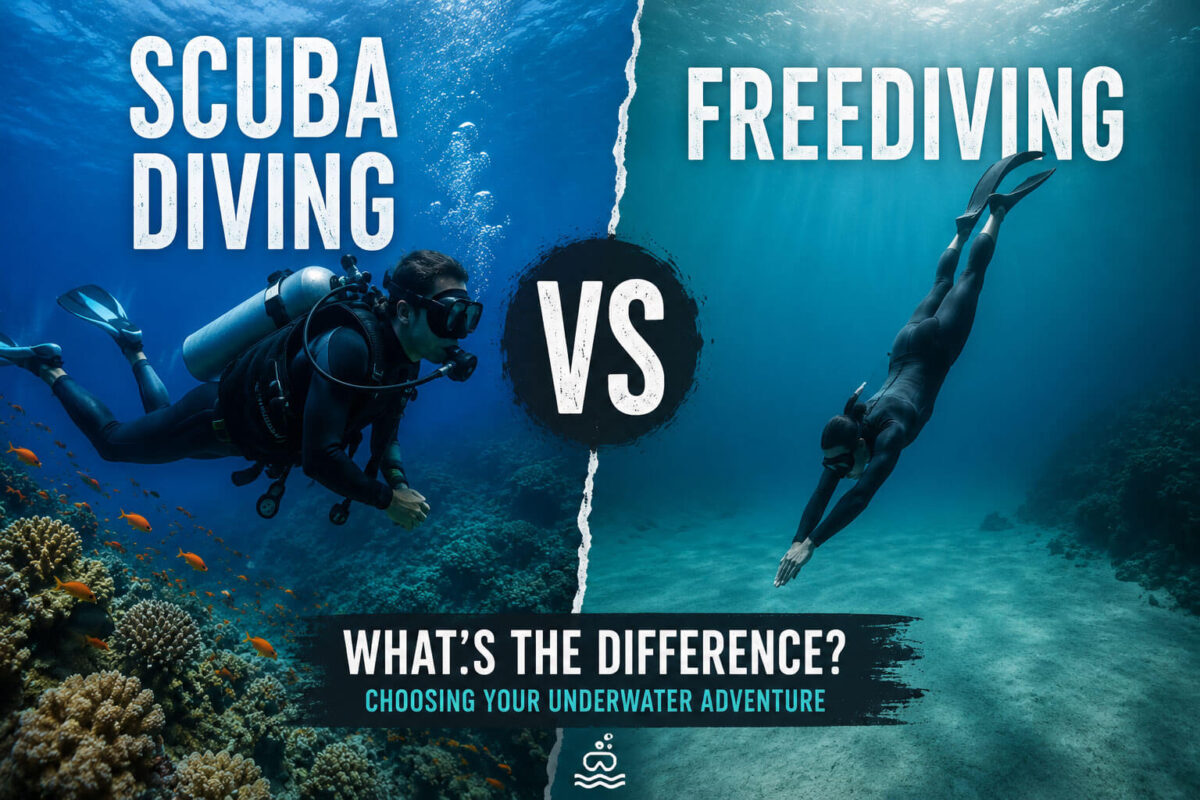
Scuba Diving vs Freediving: What’s the Difference?
Jun
🤿 vs 🌊 Scuba vs Freediving
Scuba Diving vs Freediving: What’s the Difference?
Two ways to explore the underwater world — one with a tank on your back, one on a single breath. Here’s everything you need to know to choose the right path, or embrace both.
The quick overview
Both scuba diving and freediving let you explore the underwater world — but they are fundamentally different experiences. Scuba diving uses a tank of compressed air so you can breathe continuously at depth for 30 to 60 minutes or more. Freediving asks you to descend on a single held breath, no equipment, no bubbles, just you and the ocean.
“Scuba gives you time. Freediving gives you silence. The ocean rewards both.”
- 30–60+ minutes underwater
- Breathe normally at depth
- More gear, more setup
- Explore reefs, wrecks, caves
- Certification in 3–4 days
- 1–5 minutes per dive
- Hold breath throughout
- Minimal gear, total freedom
- Interact naturally with wildlife
- Certification in 2–3 days
What is scuba diving?
Scuba stands for Self-Contained Underwater Breathing Apparatus. You wear a cylinder of compressed air on your back, connected to a regulator that delivers breathable air at the correct pressure no matter how deep you go. A BCD (Buoyancy Control Device) lets you hover weightlessly at any depth.
Scuba diving gives you time. A single tank typically lasts 40–60 minutes at recreational depths, giving you the freedom to explore slowly — studying a coral wall, following a turtle, drifting through a shipwreck. You don’t need to rush. You don’t need to think about breathing. You simply breathe, look, and explore.
What scuba diving is best for
- Extended underwater exploration at depth
- Wreck diving, cave diving, and night diving
- Beginners who want time to look around without pressure
- Underwater photography requiring long exposure times
- Marine biology and research diving
What is freediving?
Freediving — also called breath-hold diving or apnea diving — is the practice of diving underwater on a single breath, without any breathing apparatus. You inhale deeply, descend, explore, and return to the surface before your breath runs out. No tank, no regulator, no bubbles. Just you, a wetsuit, a mask, and the sea.
What freediving offers that scuba cannot is silence. Without the constant hiss and bubble of a regulator, the ocean reveals itself differently. Marine animals behave differently around freedivers — less startled, more curious. Many divers describe their first freedive as a profoundly meditative experience.
“Freediving is not about how deep you go. It’s about how present you become.”
What freediving is best for
- Ocean photographers wanting to move silently around wildlife
- People drawn to mindfulness and breath-work
- Spearfishing and underwater hunting traditions
- Surfers, swimmers, and athletes wanting ocean fitness
- Anyone who wants a minimalist relationship with the sea
Head-to-head comparison
Here’s how scuba diving and freediving compare across every dimension that matters to a beginner.
| Category | 🤿 Scuba Diving | 🌊 Freediving |
|---|---|---|
| Breathing | Continuously from a tank | Single held breath |
| Time underwater | 30–60+ minutes per dive | 1–5 minutes per dive |
| Max depth (rec.) | 40 metres | 10–20m beginner / 40m+ advanced |
| Gear required | Tank, regulator, BCD, wetsuit, computer | Wetsuit, mask, fins, weight belt |
| Certification | 3–4 days (PADI / SSI / NAUI) | 2–3 days (AIDA / SSI / PADI) |
| Cost to start | £250–£450 course + gear rental | £150–£300 course + minimal gear |
| Physical demand | Low — breathing is continuous | Higher — breath control & fitness |
| Mental demand | Equipment awareness, dive tables | Breath control, relaxation, focus |
| Best for | Wrecks, reefs, long exploration | Wildlife, photography, minimalism |
| Travel convenience | Requires dive centre / boat | Can be done almost anywhere |
Gear differences explained
One of the most striking differences between the two sports is how much — or how little — equipment you need. Scuba requires a full kit; freediving is famously minimalist.
🤿 Scuba diving gear
🌊 Freediving gear
Depth & time underwater
This is where the two sports diverge most dramatically — not just in numbers, but in what the experience actually feels like.
Scuba: time over depth
Recreational scuba diving is limited to 40 metres for certified divers, with most dives taking place between 10–30 metres. Within those limits, you can stay down for 30–60 minutes on a single tank — longer at shallower depths. The experience is unhurried. You can hover over a coral garden for ten minutes watching a single fish without any urgency.
Freediving: depth over time
A beginner freediver typically reaches 10–20 metres and stays down for 1–2 minutes. Advanced freedivers routinely reach 40–60 metres on a breath. The world record — set by Herbert Nitsch in No Limits freediving — stands at an extraordinary 214 metres. But depth is not the goal for most freedivers. The quality of presence in those 60–90 seconds is what draws people back again and again.
Cost & certification
Both sports require a certification before you dive independently. Here’s how the costs and learning curves compare.
| Item | 🤿 Scuba | 🌊 Freediving |
|---|---|---|
| Entry course | £250–£450 (UK) / $300–$500 (US) | £150–£300 (UK) / $200–$400 (US) |
| Course duration | 3–4 days | 2–3 days |
| Main agencies | PADI, SSI, NAUI | AIDA, SSI, PADI |
| Own gear cost | £800–£2,500+ (full kit) | £200–£600 (mask, fins, suit) |
| Ongoing costs | Tank fills, dive boat fees | Very low — minimal equipment |
Which one is right for you?
The honest answer is: it depends on what draws you to the ocean in the first place. Here’s a simple way to think about it.
- Want to spend a long time exploring at depth
- Dream of diving shipwrecks or coral walls
- Are new to diving and want time to relax underwater
- Love underwater photography with patience
- Want to dive with friends on organised trips
- Are comfortable with equipment and logistics
- Are drawn to minimalism and simplicity
- Want to interact more naturally with marine life
- Are interested in breath-work and mindfulness
- Already swim or surf and want to go deeper
- Want to travel light with no equipment hassle
- Are interested in spearfishing or underwater photography
Can you do both? Absolutely.
Many of the world’s most passionate ocean lovers do both — and they’ll tell you the two disciplines make each other better. Freedivers who take up scuba gain a profound new appreciation for time at depth. Scuba divers who learn to freedive develop dramatically improved breath control, buoyancy, and calm underwater.
The skills genuinely transfer. Scuba divers who train in breath-hold diving typically reduce their air consumption significantly — because they’ve learned to slow down, relax, and breathe with intention. Freedivers who take up scuba can explore environments — wrecks, deep reefs, night dives — that are simply not accessible on a single breath.
If you’re serious about the ocean, learning both eventually is one of the best decisions you’ll make as a diver.
Frequently asked questions
Built for ocean obsessives
Whether you’re a scuba diver, a freediver, or both — SEASPORTEES makes apparel for people who live for the underwater world. Explore our Scuba & Free Diving collection.
Shop the Scuba & Freediving Collection → Or explore our full ocean lifestyle range ↗Related articles
